

The Florida DUI Trial Manual
A Working Reference for Taking the State’s Science Apart
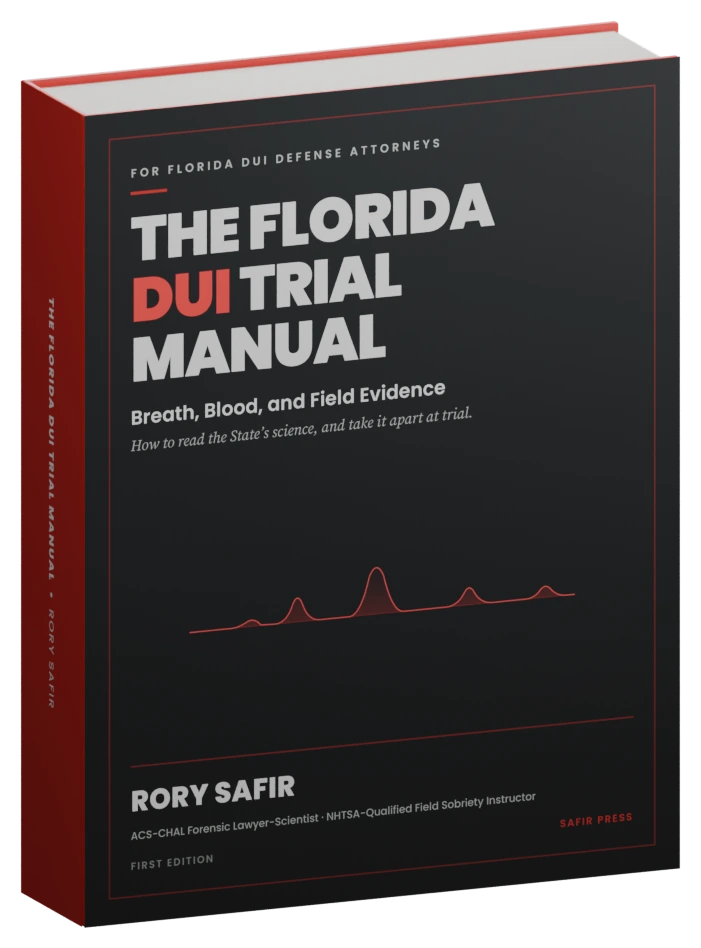
Most DUI cases are decided by a number. A breath result, a blood result, a set of clues an officer scored on the roadside. The number arrives looking like a fact, and the file gives you almost no way to test it. This book is the working reference for testing it anyway: what the science actually measures, what the State’s own records have to show, and how to take each piece apart in a Florida courtroom.
Get the book
- Ebook, available now. Get it on Amazon. Amazon also lets you read a free sample before you buy, so you can see the science chapters for yourself.
- Hardcover, available now. Get it on Lulu: a case-bound edition built to sit open on counsel table, 784 pages at 8.5 by 11.
What is inside
Roughly 780 pages in seven parts, plus eight appendices of practice material you can file.
- The science floor and measurement uncertainty. What a result is, what it is not, and why an interval is the honest way to report one. Includes the parts of the distribution that cut against the defense, stated plainly.
- Breath. The Intoxilyzer 8000, the physiology of the breath sample, and the machine’s own records: agency inspections, department inspections, the error log, and the repair history, read the way a defense lawyer needs to read them.
- Blood. Headspace gas chromatography from the vial forward, the collection and preservation rules, hospital blood and the enzymatic assay problem, chain of custody, and auditing the laboratory that produced the number.
- Drugs. Screening versus confirmation, metabolites, tolerance and baseline, oral fluid roadside screening, and the drug recognition evaluation protocol.
- Field evidence. Standardized field sobriety testing from the instructor’s chair, the horizontal gaze nystagmus test and what the validation studies actually claim, and boating under the influence.
- The litigation. Discovery practice, the administrative suspension and formal review, predicates and Daubert, arguing the motion, working with and against experts, crossing the science witness, theory and theme, and when to associate.
- Search and seizure. The stop, the search, the remedy, and a chapter of trial motions and objections.
- At trial, worked. Jury selection for a science case, opening, explaining the science to a jury, direct of your expert, and full cross-examinations of the breath analyst, the blood analyst, the arresting officer, and the percipient witnesses, through to closing.
The appendices carry records request templates, deposition question banks, an 11D-8 quick reference, motion skeletons, an intake that builds the science defense, the serious injury and manslaughter material, an objections and opening-the-door reference, and the formal review forms.
Eleven tips from the book
Printed here exactly as they appear in the manual, one from each corner of it. This is what the other seven hundred pages read like.
The Science Floor
Never concede that the liver clears alcohol at a fixed rate no matter what. A constant rate is the premise the State’s retrograde extrapolation needs, because only a straight line runs backward with math. Concede it and you have handed the State its model and called it science.
Measurement Uncertainty as a Legal Concept
Do not present the published inspection uncertainty as if it were the whole interval. It is measured on known reference samples in the laboratory, so it is only the floor. Pull the figure for the specific instrument and the relevant concentration, then have a qualified expert widen it for what a real subject test adds: the observation period, breath temperature, sample volume, the assumed blood-to-breath ratio, contamination, interferents, and radio interference. Near the limit, that added width is what reaches below the line.
The Machine’s Own Records
When you cross on the Volume Not Met episode, do not argue your client was one of the 181. Argue what the timeline proves about the system: the defect rode in the evidentiary software for more than a year, the Department’s own validation had tested the volume function and passed it, and a defense lawyer, not the machine, caught it. That makes the machine’s acceptance of a sample a claim the State must defend, not a fact beyond question.
Headspace Gas Chromatography
Ask for the raw chromatogram and the peak-integration codes, never just the one-line report. Rule 11D-8.011(2)(f) commands the procedure to discriminate among methanol, ethanol, acetone, and isopropanol and to employ an internal standard, so a valley-to-valley or baseline-to-valley edge drawn on the ethanol peak is a documented reason to ask whether this run met that floor. Read the rule for what it says, though: it names those four compounds and requires the internal standard; it does not require a second column, and telling a judge otherwise hands the State an easy correction.
Auditing the Lab
Make the analyst build the budget out loud, not just recite a plus-or-minus. Ask which Type B sources were counted, the certified value of the reference material, the calibration and drift of the balance and the pipette, the instability of the sample, because a budget that counts only the laboratory’s own day-to-day scatter has left out the doubt that rides in on its standards and instruments, and has undercounted the uncertainty it reports.
The Standardized Field Sobriety Tests
Frame the battery in limine before the officer takes the stand. Under Meador the psychomotor exercises come in only as lay observation, so move to bar the words test, pass, fail, points, and score, and to require a full scientific predicate before the HGN test reaches the jury. Win that motion and the officer has to describe what he saw in plain language, without the vocabulary that makes an artificial exercise sound like a validated measurement.
The DRE Protocol, Taken Apart
In Florida the evaluation is admitted, so build the case around weight and discovery, not a motion to exclude the whole procedure. The clean vehicle is a reliability challenge under section 90.702, Florida Statutes: the controlling case that admitted the evaluation predates Florida’s move to that standard, so a hearing supported by the validation record and a qualified expert asks a question no Florida appellate court has yet reached.
Cross of the Blood Analyst
One fact controls this run: whether the tube was in date when the blood went in. Pull the tube’s lot number and expiration date from discovery, along with the storage and handling records; where the tube was expired, or the file cannot show it was not, the concession is simply that nothing in the number confirms the preservative was still guarding the sample.
Jury Selection
The relief that a not-guilty verdict does not call the officer a liar, because an honest officer can still be wrong, is worth planting here and spending again in closing. A juror who has already agreed to it in voir dire can doubt the number later without feeling he is accusing anyone of dishonesty.
Appendix G, Objections and Opening the Door
When the State cries open door, make it name the door. Ask the court to require the prosecutor to identify, on the record, the specific piece of defense evidence that was itself inadmissible or misleading, and to do so before any bad-acts or character material reaches the jury. A bias fact, a prior inconsistent statement, or a procedure the analyst cannot deny was admissible in the first place, so it opens nothing. Put that on the record and the section 90.404 and section 90.610 limits stay where they belong.
Appendix H, Formal Review Forms
Cut two checks, not one. The formal-review request on HSMV 78065 carries a twenty-five-dollar fee payable to DDL; the restricted-license application on HSMV 78306 carries a twelve-dollar fee payable to the Division of Motorist Services. Two forms, two amounts, two payees: a single check or the wrong payee leaves an application incomplete, and the Department treats a review as not requested until its fee is paid. Pay each fee with its own filing and keep dated proof of both, because a clock the Department says never started is a clock you cannot enforce.
The full table of contents
Part One: The Science Floor
- The Science Floor, Pharmacokinetics for Trial Lawyers
- Measurement Uncertainty as a Legal Concept
Part Two: The Breath Machine
- The Intoxilyzer 8000, How the Breath Number Is Made
- The Machine’s Own Records, 11D-8 Compliance and the FDLE Data
Part Three: Blood and Urine
- Headspace Gas Chromatography, How the Blood Number Is Made
- Drug Testing, Screening, Confirmation, and What a Positive Really Means
- Oral Fluid, the Roadside Drug Screen and What It Cannot Tell You
- Auditing the Lab, SOPs, Accreditation, and Uncertainty Budgets
Part Four: The Roadside
- The Standardized Field Sobriety Tests, From the Instructor’s Chair
- The DRE Protocol, Taken Apart
- The Boating Under the Influence Case
Part Five: The Threshold
- The Stop, the Gate Before the Science
- The Search and the Remedy
Part Six: Litigating the Science
- Discovery, Getting the Paper the State Would Rather Not Produce
- The Administrative Suspension Hearing, Your First and Best Discovery
- The Gates, Predicates and Daubert in Florida
- Arguing the Motion
- The Expert Battle, Getting Your Science In and Testing Theirs
- Trial Motions and Objections
Part Seven: At Trial
- Theory and Theme
- Jury Selection for a Science Case
- Opening
- Explaining the Science to a Jury
- Direct of Your Expert
- Cross of the Breath Analyst
- Cross of the Blood Analyst
- Cross of the Arresting Officer
- Percipient Witnesses
- Client Testimony
- The Closing Argument
Appendices
- A. Records Request Templates
- B. Deposition Question Banks
- C. Chapter 11D-8 Quick Reference
- D. Motion Skeletons
- E. The Intake That Builds the Science Defense
- F. The Serious Injury and Manslaughter Overlay
- G. Objections and Opening the Door
- H. Formal Review Forms
- Table of Authorities
The authorities, published free
Every case and every study the manual works from is indexed publicly, no purchase required: 160 Florida and federal decisions and 54 scientific sources, grouped by subject. If you want to see what the book is built on before you buy it, start there.
Who wrote it
I am an ACS-CHAL Forensic Lawyer-Scientist, the designation of the American Chemical Society’s Chemistry and the Law Division, and one of only six attorneys in Florida who hold it. I earned it through 160 hours of hands-on laboratory coursework at Axion Analytical Labs, including forensic chromatography for alcohol twice, forensic drug analysis, and the science of drugged driving. I am NHTSA-recognized as both a practitioner and an instructor in standardized field sobriety testing, which means I am qualified to train the officers who administer it. I serve on the National College for DUI Defense National Task Force committees on alcohol and drug testing devices and on trial advocacy. I began my career as an Assistant Public Defender in Tampa’s Thirteenth Judicial Circuit.
The book is the method I actually use, written down.
Or send me the case
If the case rises or falls on the number and you would rather not run the science yourself, I take DUI referrals and co-counsel arrangements from lawyers across Florida. Fees are divided as the Rules Regulating The Florida Bar allow. See how that works.
For lawyers
The rule scheme behind all of this is summarized in the 11D-8 quick reference: the two inspection cycles, the test sequence, the records the rules generate, and what the rule’s silences mean.
Questions lawyers ask
Who is this book for?
Florida criminal defense lawyers. It assumes you already know how to try a case and takes up what is hardest to self-teach: the forensic science behind a breath or blood result, and how to test it in a courtroom. It is not written for people charged with DUI. For that, Arrested for DUI in Florida is the plain-English book, and it is free.
Do I need a science background to use it?
No. The science chapters start at the floor and build: what a breath result actually measures, why a blood result carries an uncertainty interval, and what a chromatogram is before it is evidence. The point is to get you to the place where you can read the State’s own paperwork and see what is in it.
Is it current with Florida law?
It is written to the current version of chapter 11D-8 of the Florida Administrative Code, the Florida Evidence Code as amended, and the Daubert standard as Florida applies it, with Florida appellate authority throughout. Law moves, so verify the statute or rule before you file.
Is there a hardcover?
Yes. The case-bound hardcover is available on Lulu. The ebook is available on Amazon, and Amazon lets you read a free sample of it before you buy.
Can I hire you on a case instead?
Yes. I take DUI referrals and co-counsel arrangements from lawyers across Florida, particularly where the case rises or falls on a breath or blood result. See the referrals page.
From the blog: the working reference behind the manual.
This page is general information, not legal advice, and nothing here creates an attorney-client relationship. The book is a practice reference for licensed attorneys and does not substitute for independent research and judgment in a particular case.