When a DUI threatens everything, you need a lawyer who understands the science and knows how to challenge the prosecution’s case.



























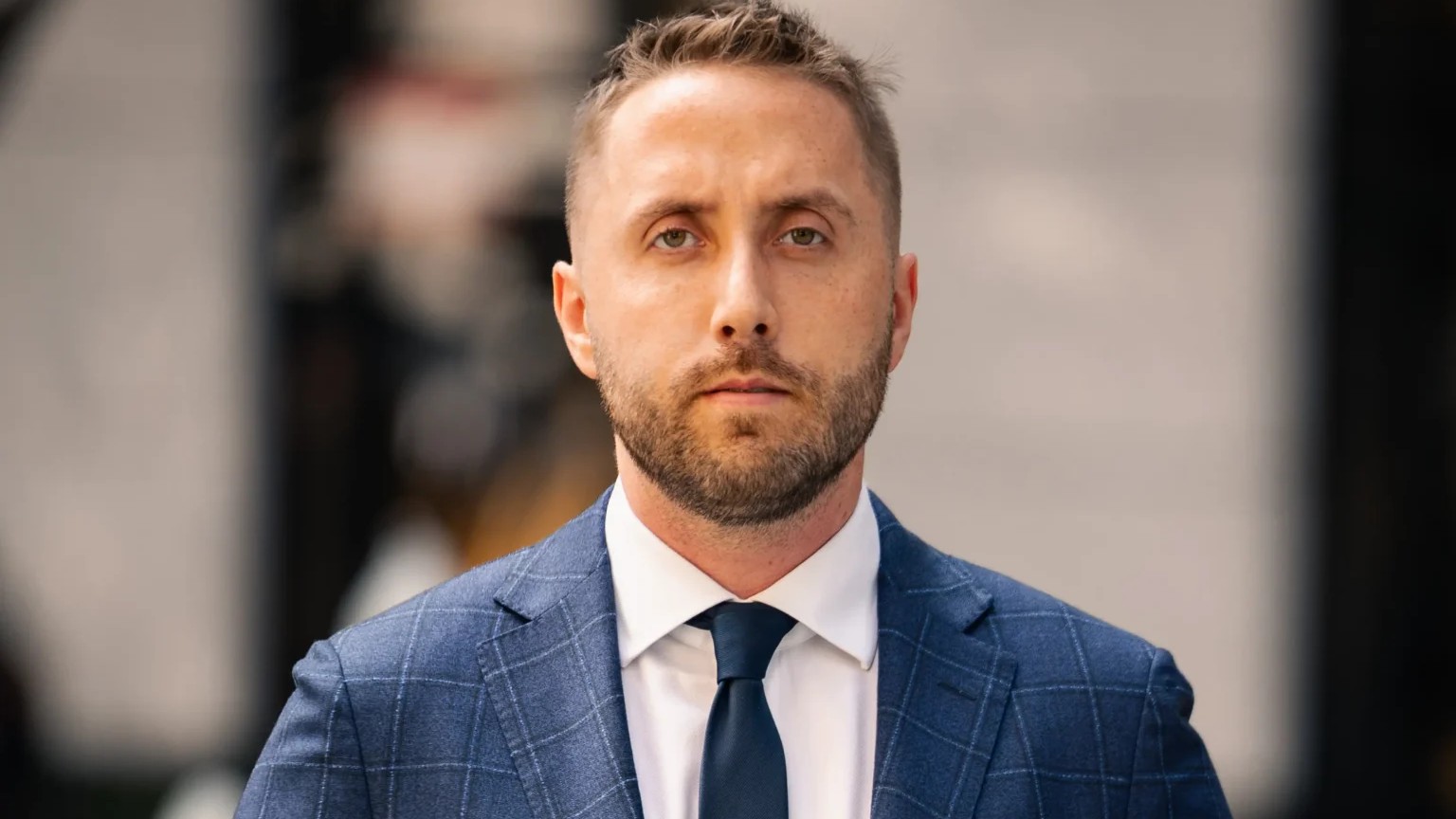
Rory Safir is a St. Petersburg DUI attorney who drivers across Tampa Bay turn to when everything is on the line. He is one of only six Forensic Lawyer Scientists in Florida, a designation earned through the American Chemical Society’s Chemistry and the Law Division by attorneys who complete rigorous scientific training, including advanced forensic education through Axion Labs in toxicology, pharmacology, forensic chemistry, and analytical testing methods used in DUI and drug cases. He also holds NHTSA-recognized, instructor-level credentials in standardized field sobriety testing, is qualified to train law enforcement and other attorneys, and serves on the Faculty of the National College for DUI Defense, the attorneys appointed to teach DUI defense to lawyers nationwide. His practice focuses on challenging the government’s evidence and requiring the prosecution to meet its burden to protect your license, livelihood, and freedom.

The ACS-CHAL Forensic Lawyer-Scientist Designation recognizes attorneys who have completed advanced scientific education, passed a demanding forensic science examination, and demonstrated the ability to critically analyze forensic evidence used in criminal and DUI cases. Only six attorneys in Florida hold this credential through the American Chemical Society’s Chemistry and the Law Division, and Rory is one of them. Rory completed the required scientific coursework and passed the Lawyer-Scientist examination through the Axion Labs program, equipping him to evaluate toxicology, laboratory procedures, and analytical testing methods that often form the foundation of DUI and drug prosecutions.
A DUI arrest starts a clock. License suspensions, court deadlines, and early decisions can have lasting consequences. Reaching out sooner gives you more options to protect your record, your driving privileges, and your future. If you’ve been arrested, the right experience and guidance early can make a meaningful difference.
For a St. Petersburg arrest, the two cases run on different tracks. You have ten days from the arrest to demand a formal review of the license suspension, and for a Pinellas case that hearing runs through the Clearwater Bureau of Administrative Reviews. The criminal case is heard at the Pinellas County Justice Center on 49th Street North in Clearwater, since the downtown St. Petersburg courthouse handles mostly civil matters. The St. Petersburg DUI page covers both, along with DROP diversion and DUI school.
Every case is different. These results are examples of past outcomes and do not predict, promise, or guarantee the result of any other case. A prospective client may not obtain the same or similar result.
Attorneys are careful about who they refer their clients to. When DUI cases involve breath, urine, or blood testing, or standardized field sobriety procedures requiring deeper scientific analysis, lawyers refer those matters to Rory.
The Books
One for the person charged. One for the lawyers who defend them.
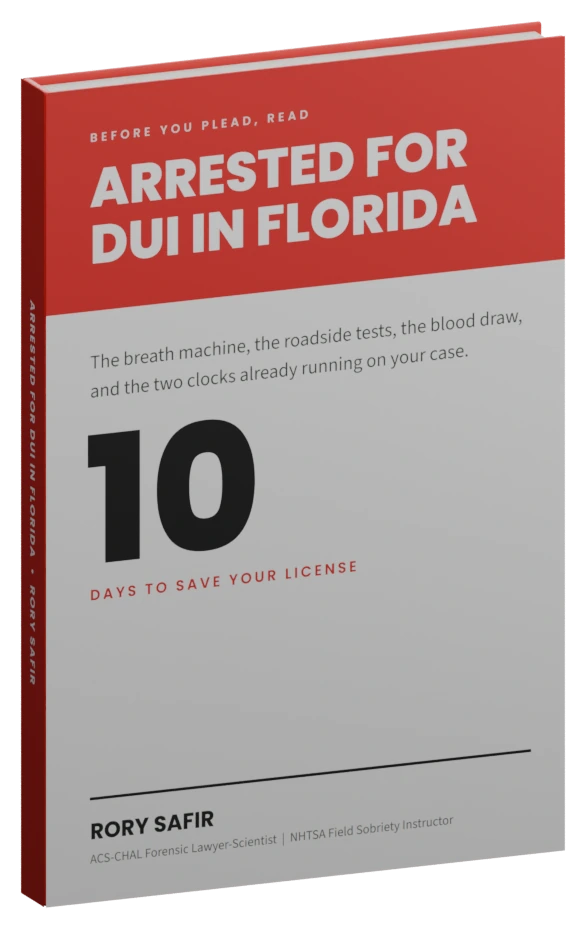
For people charged
250 pages of plain English on the ten day license clock, the breath machine, the roadside exercises, and the three roads out of a DUI. Free to Tampa Bay residents facing a charge, mailed from the first printing, with the digital edition to read the moment you ask.
Get the free book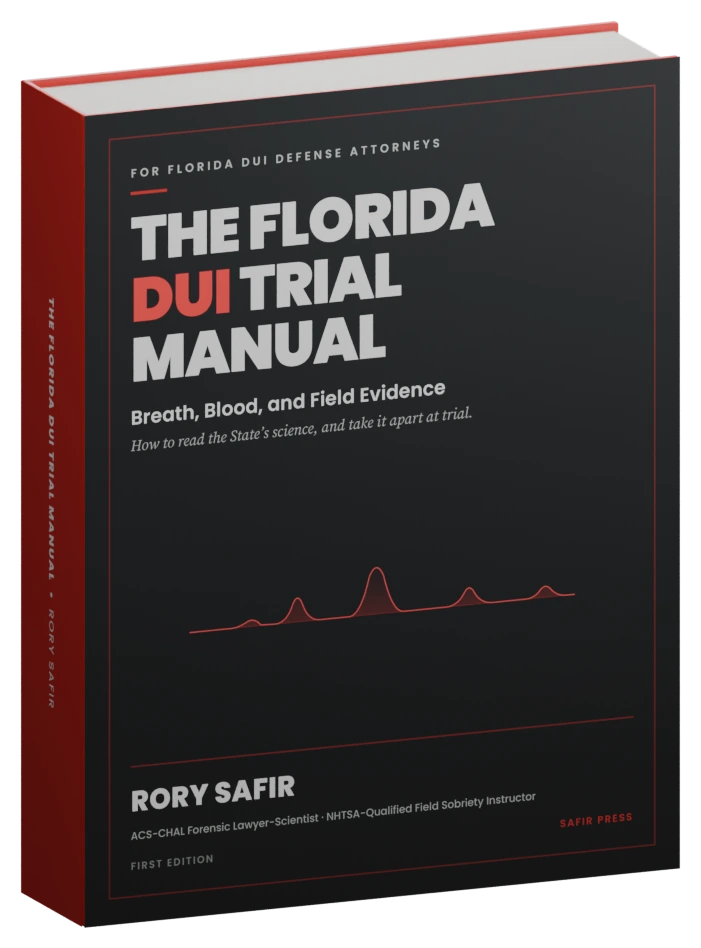
For defense lawyers
The working reference other defense lawyers reach for: roughly 780 pages on the forensic science behind breath, blood, and field sobriety testing, and how to take each piece apart in a Florida courtroom. Ebook on Amazon, hardcover on Lulu.
Get the manualFree Tools
Both of these answer in seconds, take no email address, and tell you the same thing I would tell you on the phone.
The honest answer takes about three minutes. These are the questions I would ask you: what the officer saw, what happened at the roadside, and what the machine did. It tells you what looks strong, what looks weak, and what to pull first.
Evaluate my caseAfter a DUI arrest the paper the officer gave you is your permit to drive, and it expires. Answer three questions and see the exact date, the suspension you are facing, and whether you can keep driving while you fight it.
Check my deadlineNot the lawyer. The conviction. Fines are the small number; the three years of FR-44 insurance are the large one. See the whole bill, and what a reduction to reckless driving takes off it.
See the real cost
One of only six attorneys in Florida holding the ACS-CHAL Forensic Lawyer-Scientist Designation. We examine breath testing, blood and urine evidence, and standardized field sobriety procedures with the same level of scientific scrutiny the government relies on.

DUI defense is the core of our practice, led by a former Assistant Public Defender from the Thirteenth Judicial Circuit who knows how the State builds and tries these cases. That focus means deeper preparation, sharper cross-examination, and attention to the scientific details that decide them.

Available 24/7. You call, we answer, nights, weekends, and holidays, because arrests do not happen during office hours. We explain developments in plain language and keep you informed at every stage.

More than 200 client testimonials and a 4.9-star Google rating. Legal problems are stressful, and we treat every client with respect, patience, and the human touch that makes a difficult time more bearable.
Florida law sets 0.08 as the legal threshold for DUI. You can be charged if your blood-alcohol level is 0.08 grams or more per 100 milliliters of blood, or if your breath-alcohol level is 0.08 grams or more per 210 liters of breath. At this level or higher, the law considers it prima facie evidence of impairment, meaning it is strong evidence that you were impaired.
Florida law also establishes legal presumptions at different levels. If your BAC is below 0.05, you are presumed not to be impaired. Between 0.05 and 0.08, there is no presumption either way, and this evidence can be considered with other factors. You can still be charged with DUI even below 0.08 if alcohol, chemical substances, or controlled substances impair your normal faculties. Normal faculties include the ability to see, hear, walk, talk, judge distances, drive, make judgments, act in emergencies, and perform the mental and physical tasks of daily life.
A first DUI conviction in Florida carries fines of $500 to $1,000 and potential jail time of up to 6 months. You may also face up to 1 year of probation, during which you must complete at least 50 hours of community service or pay $10 per hour instead. Your vehicle will be impounded or immobilized for 10 days, and you are required to complete a substance abuse course and evaluation.
If your BAC was 0.08 or higher, the court may require an ignition interlock device on your vehicle for 6 months. Penalties increase significantly if your BAC was 0.15 or higher or if a minor under 18 was in the vehicle. In these cases, fines rise to $1,000 to $2,000, jail time can extend to 9 months, and ignition interlock is mandatory for at least 6 months. These enhanced penalties apply even for first-time offenses.
Refusing a breathalyzer test in Florida is now a crime in itself. Under Trenton’s Law, effective October 1, 2025, a first refusal is a second degree misdemeanor and carries a 1-year driver’s license suspension. A second or subsequent refusal is a first degree misdemeanor and carries an 18-month suspension. The officer reading you the implied consent warning is required to tell you the refusal itself is a crime.
By accepting a Florida driver’s license and operating a vehicle, you automatically consent to submit to approved chemical tests if lawfully arrested for DUI, and your refusal can also be used as evidence against you in criminal DUI proceedings. You do have the right to obtain an independent test at your own expense, administered by a physician, nurse, or qualified laboratory technician of your choosing, and law enforcement must provide you with timely telephone access to arrange it.
Florida law requires vehicle impoundment or immobilization following DUI convictions: 10 days for a first conviction, 30 days for a second conviction within 5 years, and 90 days for a third or subsequent conviction within 10 years. You or the vehicle owner must pay all impoundment costs and fees unless the order is dismissed.
However, you have limited time to challenge the impoundment order, and it may be dismissed under specific circumstances. The order can be dismissed if the vehicle was stolen at the time of the offense, if you purchased the vehicle after the offense from someone other than the defendant, if your family has no other means of transportation, if the vehicle is operated solely by employees of the defendant or their business, or if a functioning ignition interlock device has been installed on all vehicles. Understanding these exceptions and acting quickly is critical to protecting your property rights.
A DUI becomes a third-degree felony in Florida under two main circumstances. First, if you are convicted of a third DUI within 10 years of prior convictions, it is automatically a felony carrying penalties under Florida’s felony sentencing statutes, including mandatory vehicle impoundment for 90 days, a minimum of 30 days imprisonment, and mandatory ignition interlock for at least 2 years. Second, any fourth or subsequent DUI conviction, regardless of when prior convictions occurred, is a third-degree felony with a minimum $2,000 fine.
DUI also becomes a felony if it causes serious bodily injury or death. DUI with serious bodily injury, defined as an injury creating substantial risk of death, serious disfigurement, or prolonged loss or impairment of any body part or organ, is a third-degree felony. DUI manslaughter, which involves causing the death of any human being or unborn child while driving under the influence, is a second-degree felony with a mandatory minimum 4-year prison sentence. This escalates to a first-degree felony if you knew or should have known a crash occurred and failed to provide information and render aid as required by law.
Arrested for DUI? Time matters. Complete the form to schedule a free strategy session with attorney Rory Safir. Your information is confidential, and we will follow up promptly.