Updated August 25, 2026
A DUI arrest starts two clocks at once. One is the criminal case in court. The other is a 10-day deadline to save your license. They run on separate tracks, and the sooner each one is answered, the more of your license, your record, and your driving you can protect.
If you want to know what working with me actually looks like before you call, here is what I promise criminal and DUI clients, and the things no lawyer is permitted to promise you.
That is the work I do for drivers across St. Petersburg and the wider Tampa Bay area. I am a DUI defense attorney and a forensic lawyer-scientist, and I read the breath data, the blood chromatography, and the field sobriety records the way the State’s own analyst does. When those records do not hold up, your case changes. And because the science is the same in every county, I work as a Florida DUI defense lawyer statewide on breath, blood, and drug cases where the chemistry decides the outcome.
Wherever You Are Right Now, Start Here
A DUI case has many moving parts. Find the question you are asking right now.
How the Science Can Change Your DUI Case
A DUI is a science case wearing the costume of a traffic case. The number on the breath report, the blood-alcohol result, the count of clues on a field sobriety test: those are the heart of the prosecution, and they come from instruments and procedures that have to be done correctly. Holding them to that standard takes training most defense lawyers never receive.
The science is the core of most cases, and in the right facts Florida also recognizes defenses that go to whether the driving was a crime at all, like being made to drive or having no safe choice, which I cover on the lesser-known DUI defenses page.
Credentials and Affiliations











Rory is an ACS-CHAL Forensic Lawyer-Scientist, a National College for DUI Defense Faculty member who also sits on its National Task Force Committee, a member of the DUI Defense Lawyers Association, and an NHTSA-qualified field sobriety instructor trained through the NCDD and Impaired Driving Specialists.
“Very impressed with Rory’s dedication to criminal defense, especially his commitment to understanding DUI cases. As a fellow attorney, he wins my DUI referrals.”
Chris Hunt, Attorney at Law. Other Florida attorneys send Rory their toughest DUI science cases. Read what they say.
Start with the free guide
6 Things You Should Know About DUIs
Before you read another page: the six myths and mistakes that decide DUI cases in the first days, and exactly what to do about each one.
The 10-Day Deadline to Save Your License
Your DUI citation works as a temporary permit for the first 10 days. After that, an automatic suspension takes effect unless you act.
Time-sensitive
You have 10 days to demand a formal review hearing.
Within 10 days of the arrest, we file a demand for a formal review hearing with the DHSMV Bureau of Administrative Reviews in Clearwater and secure a 42-day permit so you keep driving while we fight. When you hire us, we file that request the same day.
The hearing does more than protect your license. It lets us put the officer under oath early and lock in testimony that often helps the criminal case. Call or text (727) 761-4318, or book a free consultation online.
Tools and Reference
- The case evaluator, three minutes of the questions I would ask you, and what your answers suggest
- The BAC estimator, for comparing what you drank against the number the machine printed
- How to choose a DUI lawyer, the questions worth asking any lawyer you interview, including me
- License deadline checker, if the arrest was recent and you are counting days
- What a DUI actually costs, the whole bill, not just the fine
- Florida DUI Reference, the cases and studies behind these defenses
- The 11D-8 quick reference, the testing rules themselves, for lawyers
- Bureau of Administrative Reviews offices, statewide
The video and the policy are both public. Where each Tampa Bay agency keeps them, including the St. Petersburg police General Orders in full: the recording policy, the hospital procedure behind a blood draw, and the search and evidence rules.
How Florida Defines DUI
Under Florida Statute 316.193, the State can prove a DUI two ways. It can show that alcohol, a chemical substance, or a controlled substance impaired your normal faculties. Or it can show a blood-alcohol or breath-alcohol level of 0.08 or higher.
Normal faculties means the everyday abilities to see, hear, walk, talk, judge distances, and make decisions. That standard is softer than it sounds, and it leaves a lot of room to argue when the only proof of impairment is an officer’s opinion about how you looked at the roadside.
The law also reaches drivers who were never driving. If you were in actual physical control of the vehicle, which can include sitting in a parked car with the keys accessible, you can be charged. Actual physical control is a fact question, and it is one we can challenge.
DUI Refusal and Trenton’s Law
Under Florida’s implied consent law, driving here means you agreed to breath, blood, or urine testing after a lawful DUI arrest. On October 1, 2025, House Bill 687, known as Trenton’s Law, changed the stakes.
- A first refusal of a lawful breath or urine test is now a second-degree misdemeanor, with up to 60 days in jail and a fine, on top of a one-year license suspension.
- A second or subsequent refusal remains a first-degree misdemeanor and carries an 18-month suspension.
- The law also raised the maximum for repeat DUI-manslaughter and vehicular-homicide cases to a first-degree felony.
A refusal is still defensible. Was the stop lawful? Was the implied-consent warning read correctly, including the new advisory that refusal is now a crime? Was the arrest lawful before the test was requested? When the answer is no, the refusal evidence can be suppressed.
DUI Checkpoints and Pinellas Wolf Pack Patrols
Pinellas County runs aggressive DUI enforcement, including sobriety checkpoints and the multi-agency saturation patrols local deputies call Wolf Packs. Checkpoints are legal only when officers follow a written operational plan that limits their discretion, sets the pattern for which cars stop, and controls how the stop is run.
When a checkpoint departs from its own plan, or when a saturation-patrol stop lacked a lawful basis, the stop can be challenged under the law of search and seizure and the evidence that followed can be suppressed. We request the operational plan and the supervisor’s records as a matter of course.
What Are You Charged With?
Every level of Florida DUI has its own page, its own penalties, and its own defense angles.
Florida DUI Penalty Chart
Even a first DUI carries mandatory penalties that are, in some ways, harsher than many third-degree felonies. They climb fast with each prior offense, with a BAC of 0.15 or higher, or with a minor in the car. The chart below lays out the core penalties under Florida law. Serious bodily injury and DUI manslaughter are covered underneath it.
| Type of DUI | Max jail | Statutory fine | License revocation | Vehicle impound | Other mandatory penalties |
|---|---|---|---|---|---|
| First DUI BAC under 0.15 316.193(2)(a) |
Up to 6 months | $500 to $1,000 | 180 days to 1 year 322.28(2)(a)1 |
10 days 316.193(6)(a) |
DUI school, evaluation and treatment, 50 hours community service, up to 1 year probation |
| First DUI BAC 0.15+ or minor in car 316.193(4) |
Up to 9 months | $1,000 to $2,000 | 180 days to 1 year 322.28(2)(a)1 |
10 days | Everything above, plus ignition interlock for at least 6 months |
| Second DUI within 5 years 316.193(2)(a) |
10 days required, up to 9 months | $1,000 to $2,000 | 5 years required 322.28(2)(a)2 |
30 days 316.193(6)(b) |
Multiple-offender DUI school, ignition interlock at least 1 year. Hardship license possible after 1 year. |
| Second DUI outside 5 years 316.193(2)(a) |
Up to 9 months | $1,000 to $2,000 | 180 days to 1 year 322.28(1) |
10 days | Multiple-offender DUI school, ignition interlock at least 1 year |
| Third DUI within 10 years (felony) 316.193(2)(b)1 |
30 days required, up to 5 years prison | $2,000 to $5,000 | 10 years required 322.28(2)(a)3 |
90 days 316.193(6)(c) |
Third-degree felony, ignition interlock at least 2 years. Hardship possible after 2 years. |
| Third DUI outside 10 years 316.193(2)(b)2 |
Up to 12 months | $2,000 to $5,000 | 180 days to 1 year 322.28(1) |
10 days | Ignition interlock at least 2 years |
| Fourth or more lifetime (felony) 316.193(2)(b)3 |
Up to 5 years prison | $2,000 or more | Permanent 322.28(2)(e) |
10, 30, or 90 days | Third-degree felony no matter how old the priors are, ignition interlock at least 2 years |
Statutory fines are shown above. Total fines plus court costs and surcharges run higher, often near $1,000 even on a first offense. Figures track Fla. Stat. 316.193 and 322.28.
DUI Causing Serious Injury or Death
A DUI that causes serious bodily injury is a third-degree felony, punishable by up to 5 years in prison (Fla. Stat. 316.193(3)(c)2). DUI manslaughter is a second-degree felony with a 4-year mandatory minimum and up to 15 years (Fla. Stat. 316.193(3)(c)3). It rises to a first-degree felony, punishable by up to 30 years, if the driver knew or should have known about the crash and failed to stop and render aid. These cases usually involve a mandatory blood draw and accident reconstruction, and both are areas we examine closely.
Two ways these penalties get avoided
The chart shows what a conviction looks like. A conviction is not automatic.
- For many first offenders, the Sixth Circuit’s DROP diversion program reduces a first DUI to reckless driving, which keeps these mandatory DUI penalties off the table entirely.
- When the stop, the arrest, or the breath or blood evidence does not hold up, the charge can be reduced or dismissed, or the case can end in a not guilty verdict at trial.
Beyond the courtroom, a conviction can mean FR-44 insurance that multiplies your premium for years, a permanent record that cannot be sealed, and consequences for a professional license, a security clearance, immigration status, or a commercial driver’s license. Reducing or avoiding the conviction protects all of it.
First-Offense Diversion: The DROP Program
Many first-time DUI arrests in Pinellas County qualify for the Sixth Circuit State Attorney’s DUI Rehabilitation of Offenders Program, known as DROP. It is one of the cleanest ways to keep a DUI conviction off your record.
You apply at or before the second pretrial hearing and complete three pre-plea conditions: 20 community service hours, DUI school, and the MADD Victim Impact Panel. On successful completion, the State amends the charge to reckless driving under Fla. Stat. 316.192.
Tier 1
BAC 0.120 or below, and drug DUI cases. The State recommends a withhold of adjudication on the reckless driving, so there is no conviction and no points on your license.
Tier 2
BAC above 0.120 up to 0.150, and breath-test refusals. Resolved as reckless driving with adjudication.
DROP has firm limits. It is closed to cases with a BAC over 0.150, a crash with injury or significant property damage, a minor in the car, a pending felony or prior similar offense, or a CDL holder. Eligibility is decided case by case at the State Attorney’s discretion. We read the file early, line up the conditions, and position the case so the option stays open. Diversion is run by circuit, so the program and its terms depend on where the case is filed: DROP in the Sixth Circuit for Pinellas County, RIDR in Hillsborough County, and DETER in the Twelfth Circuit covering Sarasota and Manatee. A full breakdown is on the DUI diversion page.
How We Challenge the Evidence
This is where the forensic training earns its place. DUI evidence tends to look stronger than it is, because a jury assumes a machine cannot be wrong and an officer must have followed his training. Here is what a forensic review really examines.
01 The Breath Test and the Intoxilyzer 8000
Florida’s only evidentiary breath instrument is the Intoxilyzer 8000, a device designed in the early 2000s. Every machine has a serial number, and the Florida Department of Law Enforcement keeps maintenance and calibration records for each one. Those logs are public, and they can reveal failed accuracy checks, calibration drift, and error codes.
The issues that come up again and again include a missed 20-minute observation period under Florida Administrative Code 11D-8, mouth alcohol from reflux or dental work, radio-frequency interference from radios and phones, and the machine’s built-in partition-ratio assumption that treats everyone’s breath the same when it varies from person to person. When the records do not hold up, the breath result can be excluded.
02 Blood Testing and Gas Chromatography
Blood cases feel unbeatable, which is exactly why this training matters most here. Blood alcohol is measured by headspace gas chromatography, and the result depends on collection, the right preservative and anticoagulant tubes, storage, and a clean analytical run. The wrong tube can let alcohol form or break down in the sample.
I review the chain of custody, the calibration and controls on the run, and the chromatograms themselves. Having trained on this instrumentation, I can cross-examine the analyst on what the data really shows, beyond the summary on the report.
03 Field Sobriety Exercises and HGN
The walk-and-turn, the one-leg stand, and the HGN eye test are presented as objective measures. They are valid only when an officer administers and scores them exactly as NHTSA requires, and I am qualified to teach that standard. Roadside, at night, on uneven pavement, the conditions alone work against an honest result.
Add an officer who gives the instructions wrong, counts a clue that is not there, or ignores your age, weight, injuries, or nerves, and the exercises measure anxiety instead of impairment. HGN in particular invites a challenge under Florida’s rules for scientific evidence.
And you can refuse a field sobriety test in Florida, with no automatic license penalty, which many drivers never learn until it is too late to matter.
04 Urine Testing and Drug DUI
Urine is the weakest of the three tests for proving impairment. It can show that a substance was used days earlier without showing impairment at the time of driving, and for most drugs Florida has no per se legal limit. The State has to prove actual impairment, and that is a much harder case. With ARIDE and drug-recognition training, I challenge the leap from a positive screen to an impaired driver, especially in prescription and marijuana cases.
05 Rising BAC and Retrograde Extrapolation
Alcohol takes time to absorb. A reading taken an hour after the stop can be higher than your actual level while driving, which may have been below 0.08. Depending on your last drink, what you ate, and your own physiology, a careful retrograde analysis can show the State’s number does not prove impairment at the moment that legally counts.
The Science, Sourced
Everything on this page rests on published authority. The case law and the peer-reviewed research behind it are indexed here, free and public, so you can read the sources yourself rather than take my word for any of it.
DUI Cases We Defend
He Wrote the Book on Florida DUI. Twice.
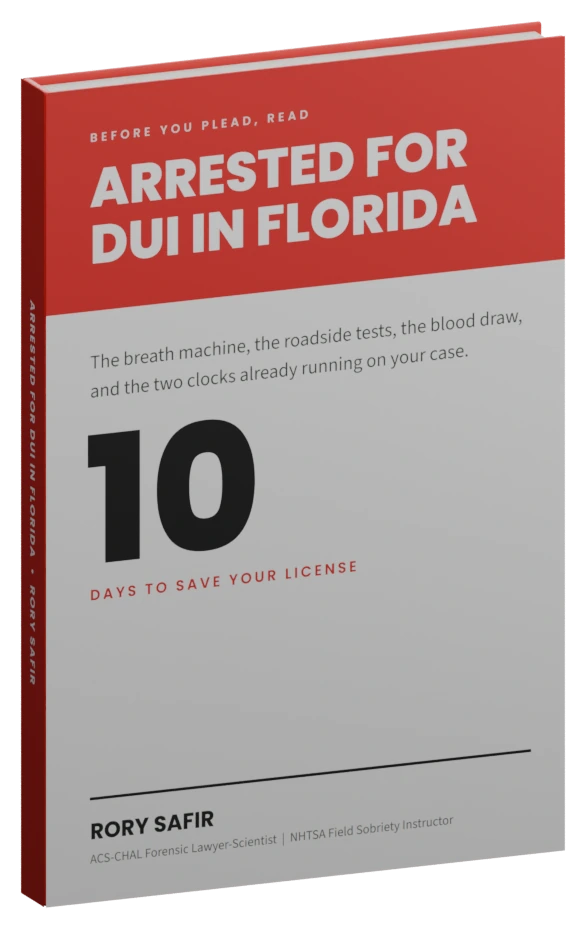
Everything on this page is covered in more depth in Arrested for DUI in Florida: What a Forensic Lawyer-Scientist Wants You to Know Before You Plead: 250 pages and 19 chapters of plain English on the stop, the breath machine, the roadside exercises, blood and urine evidence, your court dates, and hiring the right lawyer, with a Case Notes workbook in the back you fill in and hand to whoever takes your case.
Free to Tampa Bay residents
Facing a charge? The book is free.
Request a copy: the digital edition arrives the moment you submit the form, so you can start reading right away, and a paperback from the first printing follows in the mail.
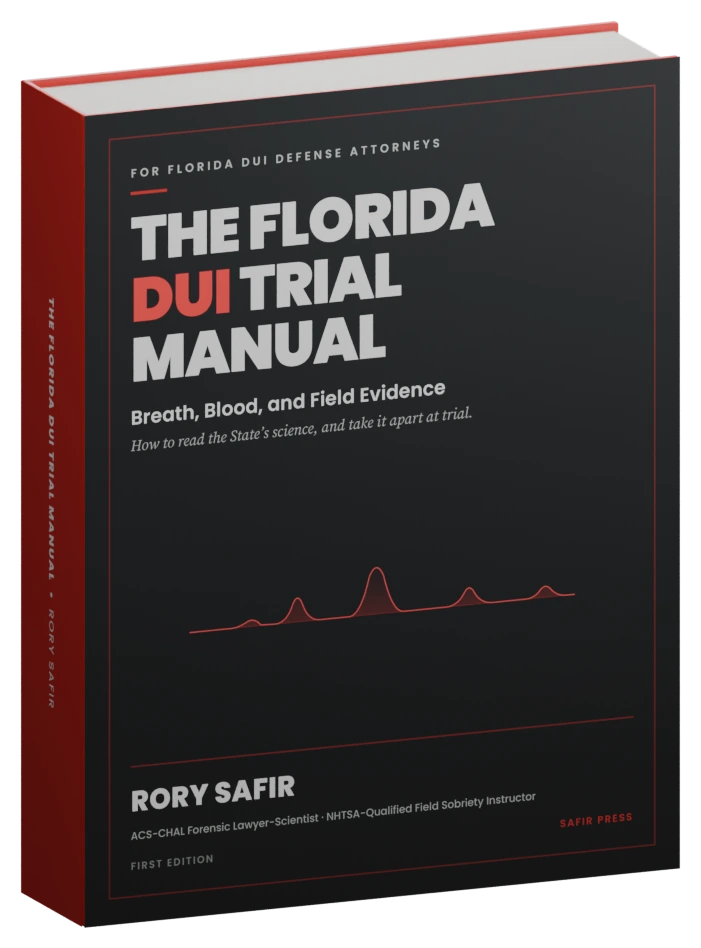
And a second one, written for the lawyers
There is a companion volume, and it is not written for you. The Florida DUI Trial Manual runs roughly 780 pages for defense attorneys: the forensic science behind the breath machine, the blood vial, and the roadside exercises, and how to challenge each piece in a Florida courtroom, down to worked cross-examinations of the analyst and the arresting officer.
You do not need to read it. It is mentioned here for one reason: when you ask how a lawyer knows this science, this is the answer. The person who would handle your case wrote the reference other Florida defense lawyers use.
Why Clients Choose the Safir Advantage
Forensic Lawyer-Scientist
We examine breath, blood, urine, and field sobriety evidence with the same scientific scrutiny the government relies on.
A Field Sobriety Instructor
As an NHTSA-qualified instructor in the roadside exercises, Rory knows the scoring standard from the teaching side and shows where an officer departed from it.
A Real DUI Focus
DUI defense is a core focus of the practice, which means deeper preparation and sharper cross-examination on the details that decide these cases.
Fast, Clear Communication
We file your license paperwork the same day you hire us, and we explain every step in plain language so you always know what comes next.
No Surprises on Fees
Fees are discussed upfront and payment plans are available, so you can focus on your case instead of guessing about cost.
Recent DUI Results
Cannabis DUI Dismissed on the Urine Testing Science
Two breath samples at 0.000, a negative eye examination, and no drug recognition evaluation. The State’s case rested on a urine test for the inactive cannabis metabolite. We declined diversion, sent the prosecutor the science, and the State dropped the charge.
License Suspension Set Aside After Radio Interference Voided a Breath Test
An outside officer carried his electronic gear into the breath room and the instrument flagged radio frequency interference. The rules required the operator to restart the twenty minute observation period before testing again. He did not, the test was not in substantial compliance, the hearing officer set the suspension aside, and she kept her license.
DUI Jury Acquittal for an Immigrant Client Facing Deportation
The stop was based on a minor equipment issue, not driving behavior. The jury returned not guilty.
DUI Jury Acquittal After Road-Rage Allegations Collapsed
An elderly couple followed the client for miles and accused him of reckless driving. The case did not survive trial.
DUI Dropped After an Unlawful Stop
An officer stopped a client with no lawful basis for pulling the car over. We moved to suppress everything that came after the stop, the court agreed the stop was unlawful, and with that evidence gone the State dropped the DUI.
Not Guilty Verdict on a Contested HGN and DRE Case
The State relied on field sobriety clues and a drug-recognition officer. The jury acquitted.
Where I Actually Am
A fair question when you are choosing a DUI lawyer is whether that lawyer is in your courthouse or just advertising in your zip code. Here is the plain answer.
I am in court every weekday, usually morning and afternoon. I am at the Pinellas County Justice Center in Clearwater every week and often on more than one day of it. I appear throughout the Sixth Judicial Circuit, Pinellas and Pasco, and regularly in Manatee County, in Sarasota including the Venice courthouse, and in Hillsborough, where I started out as an Assistant Public Defender trying cases in front of juries.
What that buys you is not mystical. It is knowing which judge wants the motion argued a certain way, which prosecutor will actually look at a mitigation packet, how a docket runs on a busy morning, and that the first-DUI diversion program is a different animal depending on where you were arrested: DROP in the Sixth Circuit for Pinellas and Pasco, RIDR in Hillsborough, and DETER in the Twelfth Circuit for Sarasota, Manatee, and DeSoto. Different eligibility, different terms. I have written a guide to each one. I have also written a walk-through of each courthouse I work in, down to where to park, what security takes off you at the door, and which floor you need: the Pinellas County Justice Center in Clearwater, the Silvertooth Judicial Center in Sarasota and the South County courthouse in Venice, the Manatee County Judicial Center in Bradenton, the DeSoto County Courthouse in Arcadia, and both Pasco courthouses, West Pasco in New Port Richey and the Sumner Judicial Center in Dade City, and in Hillsborough the Criminal Courthouse Annex in Tampa, which you reach through the Edgecomb Courthouse.
The St. Petersburg and Pinellas DUI Process
Arrested in St. Petersburg itself? The St. Petersburg DUI and criminal defense page carries the local detail: the courthouse your case actually goes to, the Clearwater BAR office, DROP diversion, and the free tools for the first ten days.
St. Petersburg DUI cases run through Florida’s Sixth Judicial Circuit, which covers Pinellas and Pasco. Misdemeanor DUI cases are handled in Pinellas County Court, and felony DUI cases are prosecuted at the Pinellas County Justice Center on 49th Street in Clearwater. The license side goes through the DHSMV Bureau of Administrative Reviews in Clearwater on Gulf to Bay Boulevard, where the 10-day deadline applies.
For many first offenders with no aggravating facts, the Sixth Circuit’s DROP program can reduce a first DUI to reckless driving. DUI school in the area runs through the Suncoast Safety Council, with locations in St. Petersburg and Clearwater. We handle cases arising from stops by the St. Petersburg Police Department, the Pinellas County Sheriff’s Office, and the Florida Highway Patrol.
DUI Questions We Hear Most
What should I do in the first 10 days after a DUI arrest?
Call a DUI lawyer right away and demand a formal review hearing with the DHSMV in Clearwater within 10 days. That hearing protects your license and can secure a 42-day permit. We file that request the same day you hire us. Your criminal case runs on a separate track, so the sooner we start, the more we can protect.
I already blew over 0.08. Is my case hopeless?
No. A breath reading is only a starting point. The Intoxilyzer 8000 depends on calibration and maintenance records, a proper observation period, and an operator who followed the rules. Mouth alcohol, the machine’s partition-ratio assumption, and timing can all affect the reading. Reviewing those records is one of the first things I do.
Can a DUI be reduced or dropped in Pinellas County?
Yes. DUI charges are reduced to reckless driving or dismissed when the evidence does not hold up. Common paths include suppressing an unlawful stop or arrest, excluding an unreliable breath or blood result, exposing field sobriety errors, and, for many first offenders, the DROP diversion program that reduces a first DUI to reckless driving.
Do I have to take field sobriety tests?
You are not legally required to perform roadside field sobriety exercises, and declining them is not a crime. The exercises are valid only when an officer administers and scores them exactly as NHTSA requires. As an NHTSA SFST instructor, I show where an officer departed from that standard.
Can I be charged if I was parked or asleep in my car?
Possibly. Florida law reaches anyone in actual physical control of a vehicle, even one that is not moving, so sleeping in a parked car with the keys accessible can support a charge. These cases are very defensible, and actual physical control is a fact question we can challenge.
What happens if I refuse the breath test?
Refusing a lawful breath, blood, or urine test triggers an automatic license suspension of one year for a first refusal and 18 months for a second. Since Trenton’s Law took effect on October 1, 2025, a first refusal is also a second-degree misdemeanor and a later refusal is a first-degree misdemeanor. A refusal can still be challenged when the stop, the arrest, or the implied-consent warning was not handled correctly.
What is the difference between my criminal case and the license suspension?
A DUI arrest starts two separate cases. The criminal case runs through the court and decides the charge itself, while the license case runs through the DHSMV and decides your driving privilege on its own 10-day clock. We handle both, because what happens in one often shapes the other.
Will a DUI conviction stay on my record forever?
Yes. Florida courts cannot withhold adjudication on a DUI, so a conviction can never be sealed or expunged. That is the strongest reason to fight the charge or reduce it to an offense that can be sealed, such as reckless driving with a withhold.
Can I get a DUI for prescription drugs or marijuana?
Yes. Florida’s DUI law covers impairment by any substance, including prescribed medication and medical marijuana. Because there is no per se limit for most drugs, the State has to prove actual impairment at the time of driving, which often opens real defenses.
How much does a DUI lawyer cost?
It depends on whether the case is a misdemeanor or felony, whether there is a breath, blood, or refusal issue, and whether it is likely to go to trial. Fees are discussed upfront, payment plans are available, and the first strategy session is free.
Some clients come to me with stakes an ordinary case does not carry. I am proud to represent veterans and servicemembers and the LGBTQ community across my practice, with the respect and discretion every client deserves.
Your Whole Story, Not Just Your Case
A prosecutor reads a police report, which holds the worst hour of your life and nothing else. Every client here completes a detailed biographical questionnaire, and those answers become the mitigation report I build in every case: family, work, health, service, and context, delivered to the prosecutor early and to the court when sentencing is on the table. It is part of every case, at no additional fee.
Not sure how many days you have left? The Florida DUI License Deadline Checker asks three questions and gives you the exact date your permit expires, the suspension length you are facing, and whether you still qualify to keep driving.
From the blog: why Tampa Bay gets the DUI book free, the test I want you to give every DUI lawyer, including me, the strangers already working on your case.
This page is general information, not legal advice, and it does not create an attorney-client relationship. Penalties and procedures are summarized from Florida Statutes 316.193, 316.1932, 316.1933, and 316.1934, and from 2025 amendments (HB 687, Trenton’s Law). Laws change and every case turns on its own facts. Past results do not guarantee a similar outcome.
How long drugs stay in your system sets the published detection windows for thirteen drugs against how long the effects actually last. Detection runs in days and sometimes weeks; impairment runs in hours, and for several drugs the molecule the laboratory looks for is not the one that affects you.