In Brief
One DUI arrest opens two cases, and the fast one is run by a DHSMV hearing officer you have never heard of. This post pulls three things from the firm’s free guide to the strangers working on your case: who they are, which of them decide things early, and which one to worry about first.
My newest Safir Guide, The People in Your DUI Case, introduces the whole cast: who they are, what each one can do to you, what they can’t, and where a defense begins. Here are three things worth knowing tonight.
Three things from the guide
One arrest opened two cases, and only one of them is slow
A Florida DUI starts a criminal case and a separate license case at the same moment. The criminal case crawls along over months. The license case, run by a DHSMV hearing officer you’ve never heard of, sprints. That paper the officer handed you is a temporary permit that expires ten days after the arrest, and on day eleven the suspension becomes automatic. No hearing, no warning, no reminder in the mail. And if you waive your right to fight and take the immediate hardship license instead, that suspension sits on your driving record for 75 years, even if the criminal charge is later dropped.
The prosecutor never comes to your license hearing
I’ve handled hundreds of formal review hearings and never once seen a prosecutor in the room. That absence is an opening. Your lawyer can subpoena the arresting officer and the breath test operator and question them under oath with nobody there to coach them. Officers get casual. They guess. Sometimes they contradict their own report. All of it is recorded, and once something is said under oath it can’t be unsaid. And if a subpoenaed witness fails to appear, the suspension gets invalidated. That’s the rule, whatever your facts look like.
The report is a story. The video is the evidence.
Arrest reports have a way of sounding alike: the odor of an alcoholic beverage, the bloodshot eyes, the slurred speech. I have read that same narrative nearly word for word in report after report. Body and dash camera footage shows what happened: your driving, your speech, the roadside exercises, how the officer treated you. When the video contradicts the report, that gap becomes one of the most useful things in your entire case. The guide walks through all three hats the officer wears, including the breath machine and the public FDLE maintenance records behind every number it prints.
Every one of them leaves a record
Each stranger in the cast has a file, and the file is where the questions come from. The officer who called your case a drug case has a training record that says which course they sat, which edition, and how they scored. The breath operator’s machine kept every attempt, not only the one that printed. The lab analyst’s instrument kept the calibration, the controls, and the raw data behind the number. I don’t ask a witness what they think until I’ve read what their own records say, which is why the first request in every case is paper rather than opinions. What the officer’s training file can show is in the post on ARIDE training, and what you can bring to the first meeting is in the post on what to gather.
Get the whole cast
The guide is free. One email unlocks it, along with the entire Safir Guides library, at thesafirlawyer.com/free-guides. The full web coverage of the license fight lives in the DHSMV formal review section. And if your ten days are already running, skip the reading. Get in touch and we’ll sit down with your facts, your paperwork, and your deadlines. Every case is different, and no lawyer can promise an outcome. But you don’t have to face this cast alone.
You’re better Safir than sorry.
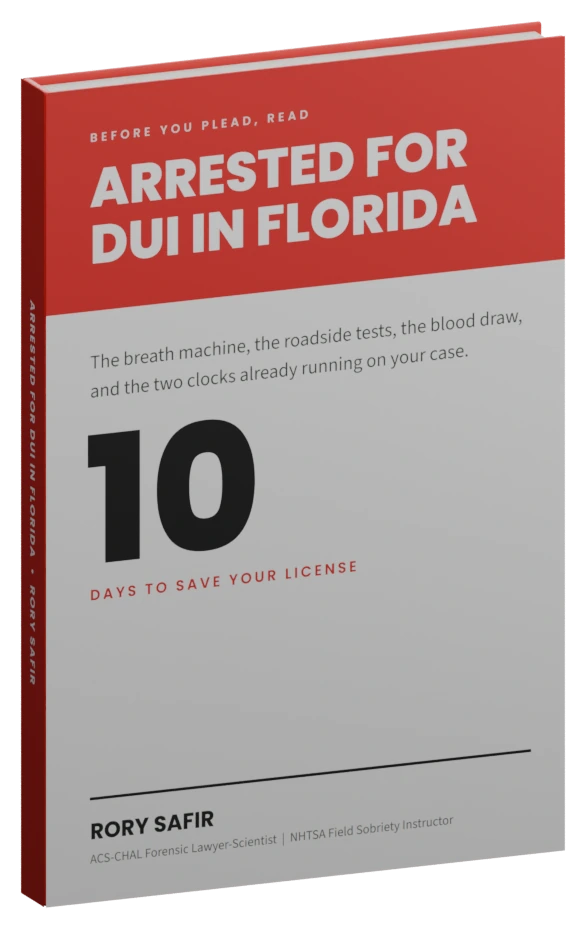
The book
Arrested for DUI in Florida
What a forensic lawyer-scientist wants you to know before you plead: the ten day license clock, the breath machine, the roadside exercises, and the three roads out of a DUI. Free to Tampa Bay residents facing a charge, with the digital edition to read the moment you ask.

About the author
Rory Safir is a St. Petersburg attorney who handles injury claims and criminal defense across the Tampa Bay area. He is one of a handful of ACS-CHAL Forensic Lawyer-Scientists in Florida and a former Assistant Public Defender in Tampa, and he brings that same evidence-driven approach to fighting for injured clients.
WRITTEN AND REVIEWED BY
Rory Safir, ACS-CHAL Forensic Lawyer-Scientist
He is the author of The Florida DUI Trial Manual, an NHTSA-qualified instructor in the standardized field sobriety exercises, faculty of the National College for DUI Defense, and a former Assistant Public Defender in the Thirteenth Judicial Circuit.
This post is general information about Florida law as of this writing. It is not legal advice about any specific case.