
Most DUI lawyers have never held a stimulus pen at the front of a classroom. I have. I went through the same National Highway Traffic Safety Administration training the police go through, both the 24-hour practitioner course and the 32-hour instructor course, on the current NHTSA curriculum, taught through Impaired Driving Specialists under a longtime SFST instructor-trainer who has trained thousands of officers. That is the same standardized field sobriety battery, taught the same way, that the officer in your case learned.
Here is why that matters. The entire battery rests on one rule, that the exercises are only valid when they are administered exactly as the training prescribes. To show a jury that the officer broke that rule, you have to know the rule cold, step by step and clue by clue. Because I was trained to give these exercises and then trained to teach them, I can read the bodycam in your case against the same checklist the officer was graded on and name the precise point where it went off the standard.
The four courses I completed
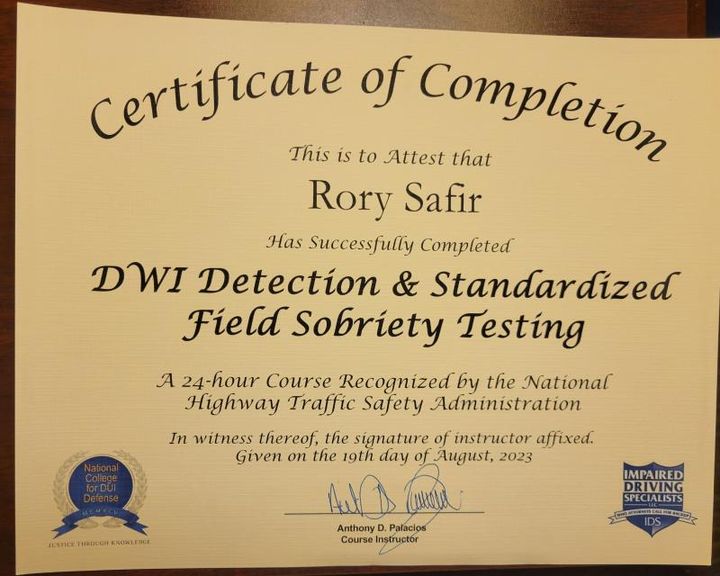
The NHTSA DWI Detection and SFST practitioner course
This is the 24-hour, 15-module course that officers take to be qualified to administer the standardized battery. It teaches exactly how the horizontal gaze nystagmus, the walk and turn, and the one leg stand are given, scored, and interpreted, and it includes live alcohol workshops where students administer the exercises to volunteers dosed to a measured breath alcohol level. I took the same course, in full, that the officer in your case took.
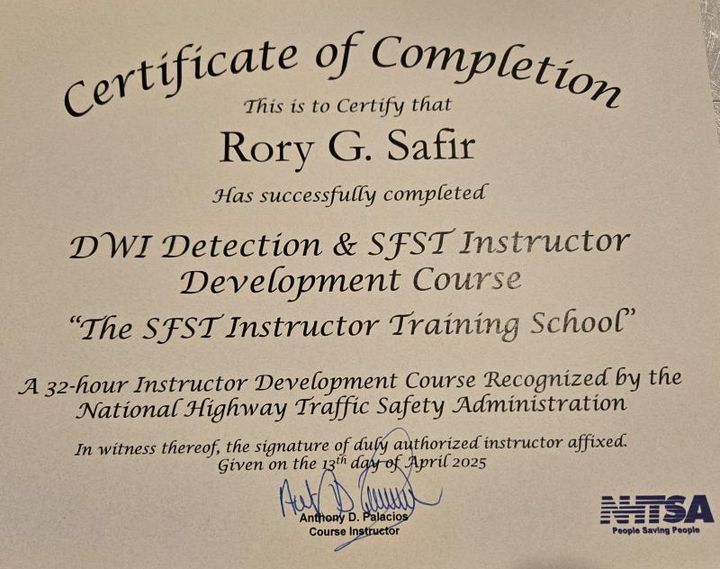
The NHTSA SFST Instructor Development course
This is the 32-hour, 9-module course that qualifies a person to teach the battery to others, and the practitioner course is its prerequisite. It adds a teaching-proficiency requirement and a second live alcohol workshop. Finishing it is the difference between having taken the battery once and being trained to instruct the officers who give it, which means I can speak to the standard the way the officer’s own instructor would.
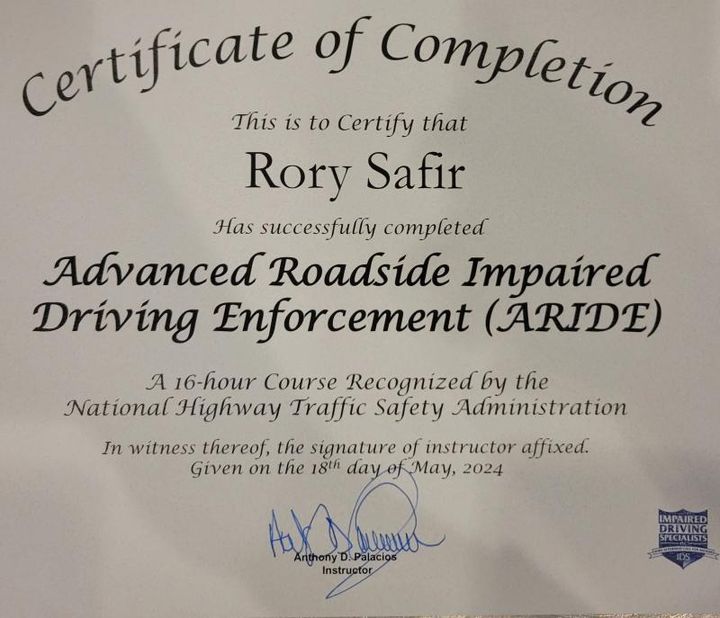
NHTSA ARIDE, Advanced Roadside Impaired Driving Enforcement
This two-day course picks up where the standardized battery ends and teaches officers how to screen for drug impairment at the roadside, including the modified Romberg balance estimate, the lack of convergence check, and the finger to nose exercise, along with which drug categories affect the eyes and the pupils. ARIDE is the prerequisite for drug recognition expert school, so it is the bridge between an ordinary DUI stop and a drug case.
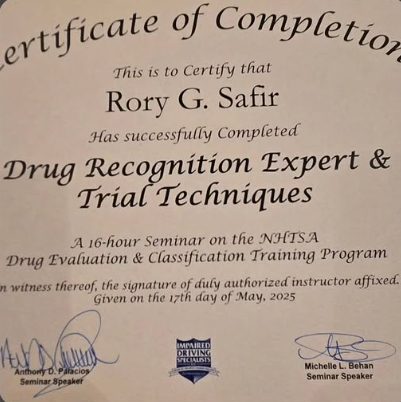
The DRE overview and trial techniques seminar
Taught by a former drug recognition expert instructor-trainer, this course covers how to read a DRE case file, including the Face Sheet, the Narrative, the twelve-step evaluation, the eye and vital-sign exams, and the drug symptomatology chart, and how to cross-examine on all of it. I did not take it to become a drug recognition expert. I took it to be able to take one apart, and the drugged driving section of this site is where that work lives.
The certificates
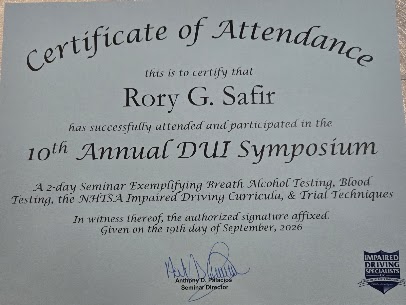
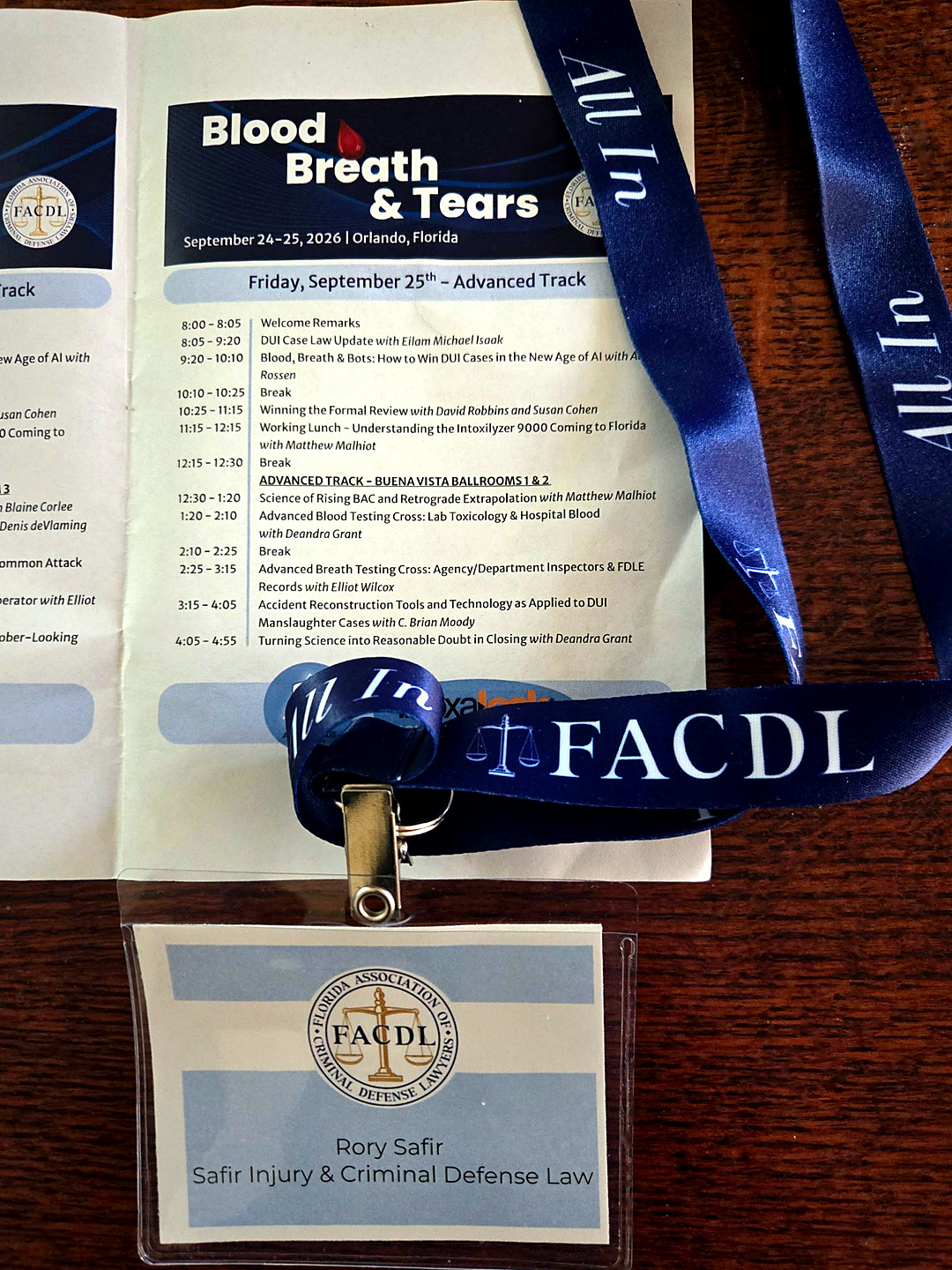
Here are four of those completion certificates, each for a course recognized by the National Highway Traffic Safety Administration, and the certificate of attendance from the 10th Annual DUI Symposium in September 2026, plus my attendee badge from Blood, Breath & Tears the next week.
Continuing training, kept current
The training doesn’t stop at the certificates above. In September 2026 I completed the 10th Annual DUI Symposium, a two-day seminar through Impaired Driving Specialists on breath alcohol testing, blood testing, the NHTSA impaired driving curricula, and trial techniques, September 18 and 19, 2026, run by Anthony Palacios of Impaired Driving Specialists, the instructor-trainer whose courses appear above. It’s the same curriculum family the officer in your case was trained on, taught to defense lawyers with the current editions in hand, and the ARIDE manual it covers is the one quoted, with page numbers, in the post on what ARIDE training says about itself. Each edition changes what an officer was taught, which is why the training file in your case gets matched to the edition the officer actually sat rather than to the one on my shelf.
The next week I attended Blood, Breath & Tears, the DUI seminar put on by the Florida Association of Criminal Defense Lawyers, in Orlando on September 24 and 25, 2026. Its advanced track covered rising blood alcohol and retrograde extrapolation, cross-examining crime lab and hospital blood results, the breath test inspection records kept by the Florida Department of Law Enforcement, accident reconstruction in DUI manslaughter cases, and the Intoxilyzer 9000 breath test machine that’s coming to Florida.
Why a defense lawyer takes the officer’s own training
Reading a manual is not the same as having stood at the front of the room teaching from it. The standardized field sobriety exercises were validated only under controlled conditions by trained administrators following the procedure to the letter, and NHTSA’s own rule is that changing any standardized element compromises the result. That rule is useless to your defense unless someone can show the jury, concretely, which element changed. When I watch the video in your case, I am matching it against the exact module, instruction, timing, and scoring the officer was taught, and that is a different conversation than a lawyer simply suggesting the officer might have made a mistake.
What this means for your case
In practice it means four things. I read the bodycam against the manual and mark every deviation. I check whether the eye test even clears the predicate Florida requires before a jury hears it under State v. Meador, 674 So. 2d 826 (Fla. 4th DCA 1996). I tie each roadside condition, each physical factor, and each scoring choice back to the standard it broke. And I put all of it in front of the jury in plain language. This credential runs through every page in the field sobriety section of this site, from the eye test to the way the clues are counted.
This is one half of how I work a DUI case. The other half is the science of the chemical test that often follows the roadside, the breath and blood results and the forensic toxicology behind them. See the Lawyer-Scientist page for that side.
Questions About the Instructor Credential
Are you a police officer?
No. I am a criminal defense lawyer and a former Assistant Public Defender. I completed the same National Highway Traffic Safety Administration courses the police take, which is unusual for a defense attorney and is exactly the point.
Are you a qualified field sobriety instructor?
I completed the 32-hour NHTSA SFST Instructor Development course, the same course that qualifies the officers who train other officers to give the standardized battery. Its prerequisite is the 24-hour practitioner course, which I also completed.
Does this make you a drug recognition expert?
No. I completed a DRE overview and trial-techniques course taught by a former DRE instructor, which trained me to analyze and cross-examine a drug recognition evaluation rather than to perform one. The drug side is covered in the drugged driving section.
Why does instructor training matter in a DUI case?
Because the exercises are only valid when administered exactly as trained. Knowing the standard at the level of the people who teach it is what lets me show a jury the precise step the officer missed, rather than arguing about it in the abstract.
How is this different from other DUI lawyers?
Many DUI lawyers have read about the field sobriety exercises. Far fewer have been trained to administer them, and fewer still have completed the instructor course. That training, together with my ACS-CHAL forensic science credential, is the core of how I work a case.
Do you only handle alcohol cases?
No. The same training covers drug impairment through ARIDE and the DRE material, so it applies to alcohol, drug, and combined cases, with the drug-specific analysis carried in the drugged driving section of this site.
Related: the field sobriety overview, the three standardized tests, the HGN eye test, the NHTSA standard, and the Lawyer-Scientist credential.
This page is general information, not legal advice, and it does not create an attorney-client relationship. Field sobriety exercises in Florida are governed by case law including State v. Meador, 674 So. 2d 826 (Fla. 4th DCA 1996), and by section 316.193, Florida Statutes. Procedures and rules change, and every case turns on its own facts. Past results do not guarantee a similar outcome.