You blew into the machine, a number came up, and now it feels like the case is already decided. It is not. In Florida, that number comes from one device, the Intoxilyzer 8000, and the device is only as reliable as its calibration, its environment, and the officer who ran it. A breath reading is a starting point, and a starting point can be challenged.
That challenge takes training most defense lawyers never receive. As an ACS-CHAL Forensic Lawyer-Scientist who sits on the National College for DUI Defense (NCDD) National Task Force on alcohol and drug testing devices, I read the machine’s data, the inspection records, and the testing procedure the way the State’s own analyst does, and I find where the result does not hold up. This page is the overview. Each issue opens into its own in-depth page, because a breath case is won in the details.
How the Intoxilyzer 8000 Works
Florida’s only approved evidentiary breath instrument is the Intoxilyzer 8000, a device designed in the early 2000s. It uses infrared spectroscopy, which measures how much infrared light the alcohol molecules in your breath absorb, and converts that into a number.
The machine never tests your blood. It shines infrared light through a sample of your breath, measures how much the alcohol absorbs, and converts that into an estimated blood-alcohol level.
The machine does not measure alcohol in your blood. It measures alcohol in a sample of your breath, then multiplies it by an assumed ratio to estimate what your blood-alcohol level must be. That assumption is built into every result, and it is one of several places a breath case can come apart. Read the full breakdown of how the 8000 works.
Do not miss this
A breath reading at or above 0.08 also starts the 10-day license clock.
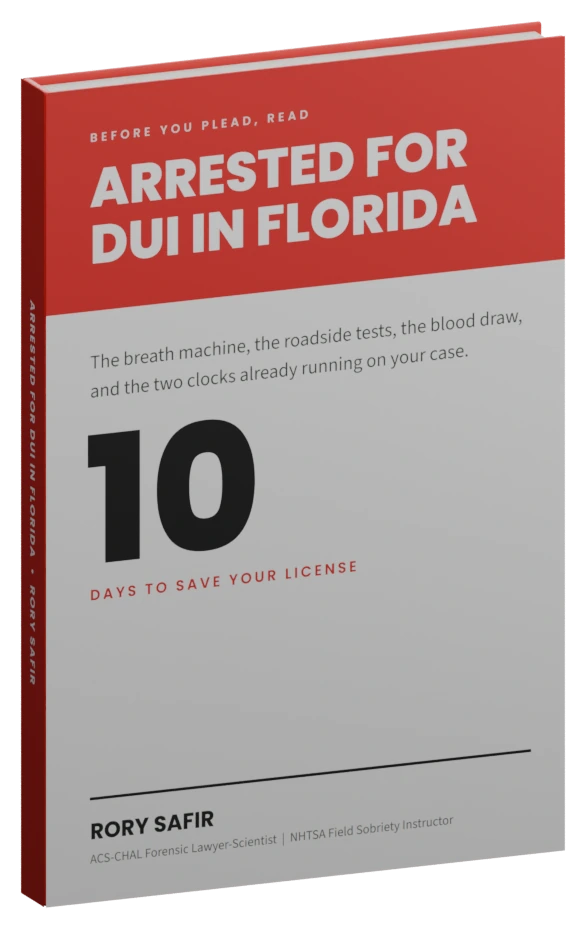
A breath result over the limit triggers an administrative suspension on top of the criminal case. You have 10 days from the arrest to demand a formal review hearing with the DHSMV in Clearwater, which protects your license and can secure a 42-day permit. We file that request the same day you hire us. Call or text (727) 761-4318.
Why this page is different
I treat the breath number as a scientific claim and test it. I pull the FDLE records for the exact instrument used in your case, study the data, and hold the State to the standard the science requires. See what the Lawyer-Scientist training covers.
A Breath Reading Is an Estimate
The Intoxilyzer 8000 assumes a blood-to-breath ratio of 2,100 to 1, the same for every person who blows into it. Real people vary. Breath temperature, breathing pattern, red blood cell volume, and individual physiology all move that ratio, and a small change can move the reported number across the legal limit.
When your true ratio is lower than the machine’s assumption, the device reports a blood-alcohol level higher than the one you had. The number looks precise. The science underneath it is an average applied to you as if you were average. More on the partition ratio and why 2,100 to 1 fails real people.
Free guide No. 02
The Breath Testing Device
The machine your case depends on, in plain language: how the Intoxilyzer 8000 measures, what it assumes about your body, and why a number near the line is an estimate, not a verdict. One request unlocks the whole Safir Guides library.
What a Breath Result Does Not Prove
Even a clean test captures one moment, and that moment is at the station, not behind the wheel. Alcohol takes time to absorb, so a reading taken an hour after the stop can be higher than your actual level while driving. The legal question is your level at the time you were in control of the car.
Alcohol keeps absorbing after your last drink. A test taken an hour after the stop can read higher than your actual level behind the wheel, the only moment that legally counts.
See how rising BAC and retrograde extrapolation can undo the State’s number.
How We Challenge a Breath Test
A forensic review looks past the printout to the procedure, the instrument, and the operator. Some cases are won by keeping the test out before trial. Others are won by taking the result apart in front of a jury. In one case, a client who had vomited after a crash on the Courtney Campbell Causeway was tested anyway. Using the machine logs, the bodycam footage, and the FDLE rules, we discredited the breath result, and the case resolved as reckless driving with no DUI conviction. Each link below goes deep on one part of that work.
Two ideas sit underneath all of it. First, a breath result is admissible only if the State shows the test was run in substantial compliance with the methods the Florida Department of Law Enforcement approved, which is a real burden and a real opening. Second, the number you see is the end of a chain of assumptions stacked on top of one another, about your breath, your body, and the machine, and Florida law has long warned that piling inference on inference is a shaky way to prove a case. See State v. Collins, 438 So. 2d 1036 (Fla. 2d DCA 1983).
See the full breath test defense playbook, from suppression to trial.
Why the Forensic Credential Matters Here
Challenging a breath case means showing, with the records and the science, exactly where the result fails. I am an NHTSA-qualified field sobriety instructor, I sit on the NCDD National Task Force on alcohol and drug testing devices, and I train continually with the NCDD and the DUI Defense Lawyers Association (DUIDLA), which means I can read the data, question the State’s analyst, and explain the weakness in plain terms a jury understands. That is the difference a forensic lawyer-scientist makes on a breath case.
Breath Test Questions We Hear Most
I blew over 0.08. Is my case over?
No. A breath reading is only a starting point. The result depends on a proper 20-minute observation period, current FDLE inspection and calibration records, and an operator who followed every step. Mouth alcohol, radio frequency interference, breath temperature, and the machine’s partition-ratio assumption can all push a reading higher than your true level. Reviewing the records and the data is one of the first things I do.
What is the 20-minute observation period?
Florida Administrative Code 11D-8 requires an officer to watch you continuously for at least 20 minutes before the test so you do not burp, regurgitate, vomit, or put anything in your mouth, any of which can introduce mouth alcohol. When the officer looks away, leaves you alone, or starts the clock late, the result becomes unreliable and can be challenged.
What is the partition ratio?
The machine does not measure alcohol in your blood. It measures alcohol in your breath and multiplies it by an assumed blood-to-breath ratio of 2,100 to 1 to estimate a blood-alcohol level. That ratio varies from person to person and within the same person. When your true ratio is lower than the assumption, the machine reports a higher number than your actual level.
Can I get the breathalyzer’s records?
Yes. Every Intoxilyzer 8000 has a serial number, and the FDLE keeps public inspection, maintenance, and calibration records for each one. Those logs can show failed accuracy checks, calibration drift, and error codes. We pull them and compare them to the night of your test.
Should I have refused the breathalyzer?
It depends on the facts. Since Trenton’s Law took effect on October 1, 2025, a first refusal of a lawful breath test is a criminal charge as well as a license suspension. Both a breath result and a refusal can be challenged, and we look hard at the stop, the arrest, and whether the implied consent warning was given correctly.
Can the Intoxilyzer 8000 be wrong?
Yes. It is an infrared breath instrument designed in the early 2000s, and its accuracy depends on calibration, maintenance, the testing environment, and the operator. Mouth alcohol from reflux or dental work, radio frequency interference, an improper breath sample, and the assumption that everyone has the same blood-to-breath ratio can all produce a result that does not reflect actual impairment.
Related reading: Blood test defense, field sobriety and HGN, DUI refusal and Trenton’s Law, the Intoxilyzer 9000, whether a breathalyzer detects weed, breathalyzer repairs and the Kilburn ruling, and the main Florida DUI defense page.
In the News
The Intoxilyzer 8000’s rocky Florida track record · Justin Timberlake and the refusal decision · How an officer’s radio undid a 0.179 breath test
Every case and study behind this analysis is indexed publicly in the Florida DUI Reference, with most linked straight to the opinion on CourtListener or the paper on PubMed.
For lawyers, the rule scheme behind all of this is summarized in the 11D-8 quick reference: the two inspection cycles, the test sequence, the records the rules generate, and what the rule’s silences mean. The strategy note behind this page is from The Florida DUI Trial Manual, Ch. 1, The Science Floor: when the State offers the breath number to prove impaired faculties, build the record that its own reference volume says a quantitative level-to-impairment relationship has not been demonstrated. The number is strong evidence of the per se prong and weak evidence of the impairment prong, and the State habitually offers it for both.
The bodycam video and the recording policy are both public records, and where each Tampa Bay agency keeps them is indexed, including the St. Petersburg police General Orders in full: the recording policy, the hospital procedure behind a blood draw, and the search and evidence rules.
Does the number match your night? The BAC estimator runs the Widmark model from what you say you drank and shows the range, then sets it against what the machine printed. A reading well above that range is a reason to pull the instrument records.
This page is general information, not legal advice, and it does not create an attorney-client relationship. Breath testing in Florida is governed by Fla. Stat. 316.1932 and 316.1934 and the Florida Administrative Code chapter 11D-8. Procedures and rules change, and every case turns on its own facts. Past results do not guarantee a similar outcome.