In Brief
A breath machine does not measure blood alcohol. It measures breath and then converts, using a single fixed ratio applied to every human being, and that is where the fights live. The 2100 to 1 assumption, temperature, mouth alcohol, and breathing pattern all move the number, and this post walks through each one.
On This Page
A breath testing machine is built to look like the last word. It hums, it prints a number on a slip of paper, and from that moment nearly everyone in the room treats that number as a fact about your blood. It is not a fact about your blood. It is an estimate, produced by a machine that never touched your blood, resting on a chain of assumptions that hold up for an average person under ideal conditions and start to slip the moment you stop being average or the conditions stop being ideal.
I am one of a handful of ACS-CHAL Forensic Lawyer-Scientists in Florida, and I trained on the same kind of instruments the State relies on. Here is what the Intoxilyzer 8000, the machine used across Florida, is doing under the hood, and where the number it prints can go wrong.
The machine measures breath and then guesses blood
Start with what the device is doing. It shines infrared light through a captured sample of your breath. Alcohol absorbs that light at a known wavelength, and the more the light dims, the more alcohol the machine reports in the breath. So far this is real measurement. The problem is the next step. Florida’s DUI law is written in terms of grams of alcohol in your blood, and the machine never sees your blood. To bridge that gap it multiplies the breath figure by a single fixed conversion number and reports the result as if it had measured blood directly.
The 2100 to 1 problem
That fixed conversion is the blood to breath ratio, set in law at 2100 to 1. The machine assumes that for every unit of alcohol in your breath there are 2100 units in your blood. The figure comes from Henry’s law, the chemistry of how a dissolved gas moves between a liquid and the air above it, and 2100 to 1 is a fair average. The trouble is that it is only an average. Real ratios vary from one person to the next, and even within the same person across a single day, and someone whose true ratio sits below 2100 to 1 gets a breath result that reads higher than their actual blood alcohol. The machine has no way to know your real ratio. It applies the legislative one and prints a number with the confidence of a fact.
Temperature moves the number
That 2100 to 1 ratio is pinned to a breath temperature of 34 degrees Celsius, the assumed temperature of air as it leaves the mouth. Warm the breath and the same blood alcohol pushes more alcohol into the vapor, so the reading climbs. A low fever, or simply running warmer than the assumed average, can lift a result by a real margin, and experiments with people breathing warm humid air have shown breath temperature and breath alcohol readings rising together. The machine does not take your temperature before it converts. It assumes it. You can read more on how breath temperature skews results.
Mouth alcohol fools it
The device is built to read deep lung air, but it cannot tell deep lung air from a trace of alcohol sitting in your mouth or throat, and mouth alcohol is far more concentrated than what comes from your lungs. A burp, silent reflux, a recent sip, dental work that traps fluid, even chewing tobacco can leave alcohol in the mouth that the machine reads as if it came from deep in the chest. That is why Florida requires an observation period before the test, where the operator is supposed to make sure nothing went into or came up from your mouth. The machine carries a slope detector meant to flag mouth alcohol, but it is not foolproof, and a quiet belch during the wait can spoil the sample without anyone noticing.
How you breathe, and what else is in your breath
Even how you breathe into the machine changes the result. Hold your breath beforehand and the reading goes up; hyperventilate and it goes down. Beyond breathing, the machine can be tripped by other compounds. People in ketosis, including some people with diabetes and many folks on very low carb diets, produce acetone and related compounds that a breath device can misread as alcohol. On top of that, radio frequency interference and a machine that is out of calibration or behind on maintenance each add their own error. None of this prints on the slip. The slip just shows a number.
What this means for your case
None of this is a trick or a loophole. It is the documented limit of what a breath machine can do, written into the science and into the manuals that train the people who run it. The defense work lives in the records: whether the observation period was honored, what your breath temperature and medical history were, whether the calibration and maintenance logs are clean, and whether the machine’s data hold up. I trained on gas chromatography at Axion in Chicago and I am NHTSA qualified to teach the field tests, so I read these records the way the State’s analysts do, and I know where they tend to break. See how we challenge a breath test. If your case turns on a breath number, that number is the beginning of the conversation, not the end of it.
One more thing to ask for, because the slip doesn’t show it. The printout is the last item in a sequence, and the sequence is what tells you how the test actually went: every attempt the machine recorded, including the ones that ended in a status code instead of a number, the exact model and software version so the records request fits the instrument, the native log rather than the summary, and the breath-room video lined up against the printed times. A code names something the machine noticed. It doesn’t say why, and neither does the slip. The full explanation is on the breath test printout page.
Charged with a DUI in the Tampa Bay area?
A breath or blood number is a starting point, not the whole story. Let’s look at what the records show.
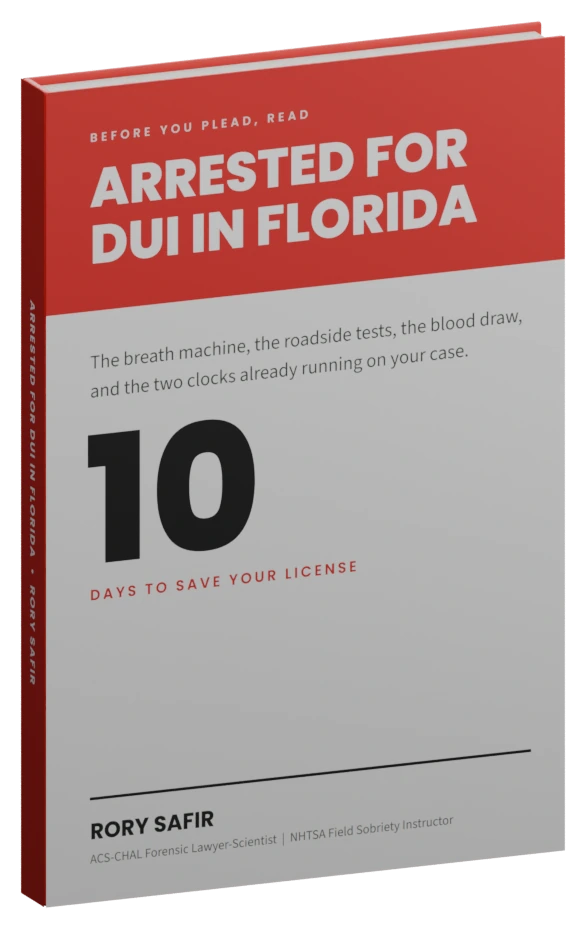
The book
Arrested for DUI in Florida
What a forensic lawyer-scientist wants you to know before you plead: the ten day license clock, the breath machine, the roadside exercises, and the three roads out of a DUI. Free to Tampa Bay residents facing a charge, with the digital edition to read the moment you ask.

About the author
Rory Safir is one of a handful of ACS-CHAL Forensic Lawyer-Scientists in Florida, an NHTSA qualified field sobriety instructor, and a former Assistant Public Defender in Tampa. He trained on the same gas chromatography instruments the State labs use, which is why he reads breath and blood evidence the way an analyst does.
Keep reading
Common Questions
Does the Intoxilyzer 8000 measure my blood alcohol?
No. It measures alcohol in a sample of your breath and then converts that figure to a blood alcohol number using a fixed ratio set in law. It never tests your blood, so the result is an estimate, not a direct measurement.
Can a breath result be wrong even if the machine was working correctly?
Yes. Even a properly working machine relies on assumptions about your blood to breath ratio, your breath temperature, and your breathing that do not hold true for everyone. A result can be inflated without the machine ever malfunctioning.
Why does the observation period before the test matter so much?
Because the machine cannot tell deep lung air from alcohol left in the mouth or throat, which is far more concentrated. The observation period is meant to rule out a burp, reflux, or a recent drink. If it was not done properly, the result is open to challenge.
Can I challenge a breath test result in Florida?
Yes. The result can be challenged on the science and on the records behind it, including the observation period, the machine's calibration and maintenance history, your medical conditions, and how the test was administered.
Further Reading
- Chapter 11D-8, Florida Administrative Code, the FDLE breath test rules, flrules.org
- Fla. Stat. 316.1932, implied consent and approved testing methods, full text, Online Sunshine
WRITTEN AND REVIEWED BY
Rory Safir, ACS-CHAL Forensic Lawyer-Scientist
He is the author of The Florida DUI Trial Manual, an NHTSA-qualified instructor in the standardized field sobriety exercises, faculty of the National College for DUI Defense, and a former Assistant Public Defender in the Thirteenth Judicial Circuit.
This post is general information about Florida law as of this writing. It is not legal advice about any specific case.