In Brief
Justin Bieber’s Miami arrest had everything except alcohol over the limit, and Florida would not have cared: drug impairment counts the same, street racing is its own crime, and the plea ladder from DUI to reckless to careless is how cases like his actually resolve. This post also covers why drug DUIs fall apart more often than breath cases.
On This Page
Back in January 2014, Miami Beach police arrested Justin Bieber after they said he was drag racing a Lamborghini on a residential street before dawn. He was charged with DUI, resisting arrest without violence, and driving on an invalid license. The twist: he was not drunk. What came back was marijuana and Xanax, not alcohol. The case eventually resolved to careless driving, a step below even reckless driving, along with a charitable donation, anger management, and a driving program.
It is an old case, but it is a Florida case, and it teaches three things people still get wrong: that a DUI needs alcohol, that racing is just a traffic ticket, and that a serious-sounding arrest cannot come all the way down. Here is the Florida law underneath it.
This is general commentary on a publicly reported, long-resolved case. It is not legal advice, and The Safir Lawyer does not represent Mr. Bieber.
Drugs, not alcohol, and Florida did not care
Florida’s DUI law does not require alcohol. It covers impairment by a controlled substance, so marijuana and a benzodiazepine like Xanax both qualify, and a prescription for the Xanax would not have been a shield. If a substance impairs your normal faculties to drive, it can support a drug DUI whether it came from a bar, a dispensary, or a pharmacy.
Racing is its own crime, not a ticket
People think of street racing as a souped-up speeding ticket. In Florida it is a criminal offense in its own right under the criminal traffic laws, carrying jail exposure, fines, and a driver license revocation, entirely apart from any DUI. Spectating at an organized race is even covered. So a racing arrest stacks a second, independent charge onto the DUI.
The plea ladder: DUI to reckless to careless
Bieber’s case landing at careless driving was not luck. Florida cases move down a ladder. A DUI can be reduced to reckless driving, and in the right case further to careless driving, which is a lower traffic offense rather than a crime. How far a case slides depends on the strength of the proof, and drug cases tend to slide farther, because the State has to prove impairment rather than point to a number.
Why drug DUIs fall apart
There is no legal limit for marijuana or Xanax the way there is a 0.08 for alcohol. The State has to prove your faculties were impaired, and a blood or urine test mostly shows that a drug was present at some point, not that it was impairing you behind the wheel. That gap is why a flashy arrest with racing and two drugs in the mix can still come down to careless driving.
What this means in Florida
The lesson of the Bieber case is not about fame. A drug DUI, even one wrapped in a racing arrest and a scene, is often the most defensible kind, because the impairment proof is soft and the science separating use from impairment is contested. As a forensic lawyer-scientist, that is exactly the terrain where these cases get won or reduced.
Charged with a DUI in the Tampa Bay area?
A drug DUI, even with a dramatic arrest around it, often has the softest proof of all. Let’s look at what the State can really show.
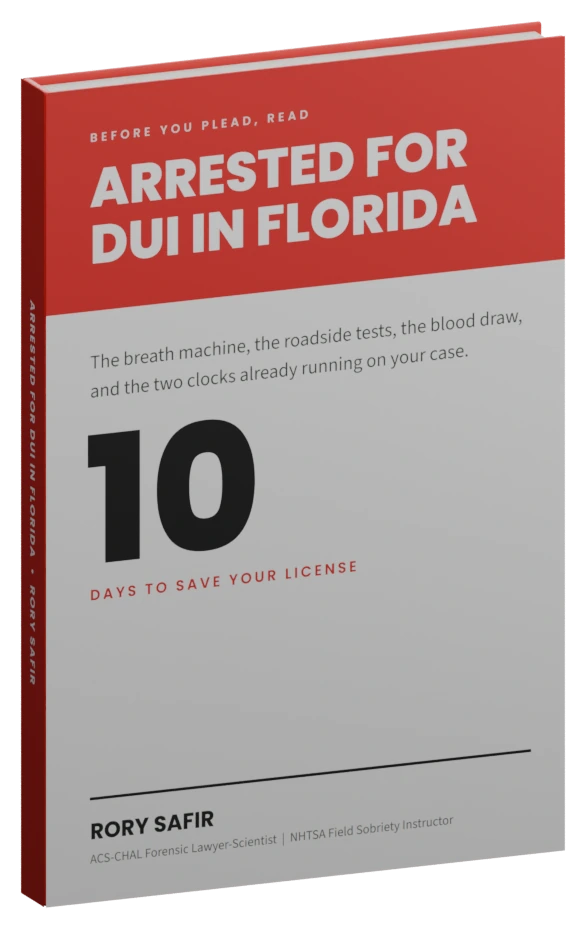
The book
Arrested for DUI in Florida
What a forensic lawyer-scientist wants you to know before you plead: the ten day license clock, the breath machine, the roadside exercises, and the three roads out of a DUI. Free to Tampa Bay residents facing a charge, with the digital edition to read the moment you ask.

About the author
Rory Safir is one of a handful of ACS-CHAL Forensic Lawyer-Scientists in Florida, an NHTSA qualified field sobriety instructor, and a former Assistant Public Defender in Tampa. He trained on the same gas chromatography instruments the State labs use, which is why he reads breath and blood evidence the way an analyst does.
Keep reading
Common Questions
Can you get a DUI in Florida for marijuana or Xanax?
Yes. Florida's DUI law covers impairment by any controlled substance, including marijuana and benzodiazepines like Xanax. A prescription does not change the analysis if you were impaired.
Is street racing a separate crime in Florida?
Yes. Racing on a highway is its own criminal offense, separate from DUI, and it carries jail exposure, fines, and a driver license revocation. Even spectating at an organized race is covered.
What is the difference between DUI, reckless driving, and careless driving?
DUI and reckless driving are crimes; careless driving is a lower traffic offense. A DUI can sometimes be reduced down that ladder through negotiation, with how far it slides depending on the strength of the evidence.
Does a prescription protect you from a drug DUI?
No. If a medication impaired your ability to drive safely, it can support a DUI in Florida regardless of the prescription, though the prescription can matter to how the case is handled.
WRITTEN AND REVIEWED BY
Rory Safir, ACS-CHAL Forensic Lawyer-Scientist
He is the author of The Florida DUI Trial Manual, an NHTSA-qualified instructor in the standardized field sobriety exercises, faculty of the National College for DUI Defense, and a former Assistant Public Defender in the Thirteenth Judicial Circuit.
This post is general information about Florida law as of this writing. It is not legal advice about any specific case.