In Brief
A rideshare crash is a different case from an ordinary accident, because who pays turns on the app: the coverage follows the driver’s status at the moment of the crash, the driver’s personal insurer usually walks away, and suing the company directly is harder than the headlines suggest. The steps that protect a rideshare claim.
On This Page
A rideshare crash is not an ordinary car accident, because the moment an Uber or Lyft is involved, who pays for your injuries turns on a corporate insurance structure the companies built to control what they owe. If you were hurt as a passenger, as another driver, or as a pedestrian or cyclist struck by one, the coverage that answers depends almost entirely on what the driver’s app was doing at the moment of impact.
If you were hurt in a St. Petersburg or Pinellas County crash, start with my St. Petersburg car accident lawyer page. For other kinds of injuries, see my St. Petersburg personal injury lawyer page.
The coverage follows the app status
Florida sets rideshare insurance in tiers tied to the driver’s app status, and identifying the tier is usually the first fight. With the app off, only the driver’s personal policy is in play. With the app on but no ride accepted, the company must carry lower limits, roughly fifty thousand dollars per person and one hundred thousand per crash in bodily injury. Once the driver accepts a ride and until the passenger is dropped off, the company must carry at least one million dollars in primary coverage, which is where the real value in a serious case sits. Because a difference of seconds can move a claim between tiers, pinning down the app status with the platform’s own data is decisive.
Why the driver’s own insurer walks away
A rideshare driver’s personal auto policy almost always contains a commercial use exclusion, so the moment the app is on for work, that personal insurer will point to the exclusion and deny. That surprises injured people who assumed the driver was covered. Florida law fills the gap, because when the driver’s personal policy excludes or has lapsed, the rideshare company’s insurance has to cover from the first dollar and defend the claim. The claim just has to be presented against the right policy in the right order.
Can you sue Uber or Lyft directly?
Usually the recovery runs through the company’s insurance rather than a direct claim, because Uber and Lyft classify their drivers as independent contractors. But where the company put a driver on the road who never should have been there, a negligent onboarding claim can sometimes reach the company directly, which matters most when the available policy may not be enough.
What to do after a rideshare crash
Screenshot everything from the app, the trip, the driver, the times, and the receipt, because that record proves the app status the whole case turns on. Call 911 and make sure a crash report is written. Get medical care the same day and get the names of other passengers and witnesses. And do not give a recorded statement to the driver’s insurer or the rideshare company before you have talked to a lawyer.
Rideshare cases are won on the details, the app status, the coverage tier, and the order the claim is presented, and I work those details the way I read any technical record. I present the claim against the policy that answers, and I represent the people hurt in these crashes, not the drivers or the companies or their insurers. If an Uber or Lyft crash hurt you anywhere across the Gulf Coast, here is how I handle Florida rideshare accident claims.
Hurt in Florida? Let’s talk about your case.
The insurance company is already working to pay you less. A free strategy session is the fastest way to understand what your claim is really worth.
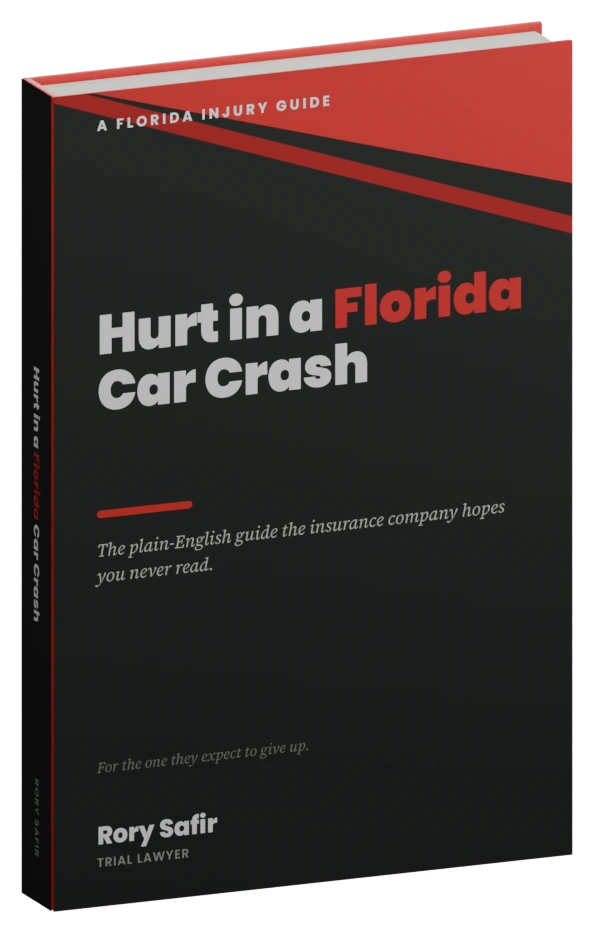
The book
Hurt in a Florida Car Crash
The insurance company’s playbook, the 14-day PIP rule, and Florida’s two-year deadline, in one plain-English book on the hours, days, and weeks after a crash. Free to Tampa Bay crash victims, with the digital edition to read the moment you ask.

About the author
Rory Safir is a Florida injury and criminal defense lawyer and one of a handful of ACS-CHAL Forensic Lawyer-Scientists in the state. He builds injury cases the way he builds a defense, from the evidence up: the crash reconstruction, the records, and the cross-examination of the insurer’s experts.
Keep reading
WRITTEN AND REVIEWED BY
Rory Safir, ACS-CHAL Forensic Lawyer-Scientist
He is the author of The Florida DUI Trial Manual, an NHTSA-qualified instructor in the standardized field sobriety exercises, faculty of the National College for DUI Defense, and a former Assistant Public Defender in the Thirteenth Judicial Circuit.
This post is general information about Florida law as of this writing. It is not legal advice about any specific case.