In Brief
A crash with a loaded tractor trailer is a different case from a car accident, starting with the fact that the truck is carrying a recording of the crash. This post covers the black box evidence, why it vanishes and why speed matters, and why there is usually more than one party at fault.
On This Page
A crash with a fully loaded tractor trailer is not just a bigger version of a car accident, and treating it like one is how injured people leave the real case on the table. A loaded commercial truck can weigh twenty to thirty times what a passenger car weighs, so the injuries are more serious, the players are more numerous, and the evidence that proves fault sits inside the trucking company’s own systems. On the interstates that cut through Tampa Bay, I-275, I-4, and I-75, a truck crash almost always becomes a race to preserve proof before it is gone.
The truck is carrying a recording of the crash
Modern commercial trucks run on data. The engine control module, often called the black box, can capture speed, braking, throttle, and hours of operation in the moments around a crash. On top of that sit the electronic logging device that tracks the driver’s hours, the dispatch and routing records, the maintenance and inspection history, and often forward facing or cab camera video. Read together, these records can show a driver who was speeding, fatigued, off schedule, or behind on brake maintenance. That is the evidence that turns a he said, she said into a documented case.
Why it vanishes, and why speed matters
Here is the hard part. Much of that data can be overwritten, lost, or lawfully discarded on the carrier’s ordinary retention schedule, and the truck itself can be repaired or put back in service within days. Once it is gone, it is gone. That is why a serious truck case often starts with a spoliation letter, a formal demand that the company preserve the black box data, the logs, the video, and the vehicle. Moving in the first days, not the first months, is frequently what separates a full case from a thin one.
There is usually more than one party at fault
A truck crash rarely comes down to just the driver. Depending on the facts, responsibility can reach the motor carrier that employed or scheduled the driver, the company that owned or leased the trailer, a maintenance contractor that skipped a repair, a broker or shipper, or a parts manufacturer if a component failed. Federal safety rules govern much of how these companies are supposed to operate, and a violation of those rules can become evidence of negligence. Identifying every responsible party early is part of what makes these cases worth pursuing, because it is also what opens the layers of insurance a catastrophic injury requires.
What to do after a truck crash
Get medical care right away, both for your health and for the record. Make sure law enforcement investigates and documents the scene, since a serious truck crash usually draws a full report. Photograph the trucks, the company markings on the cab and trailer, and the scene if you safely can. Get the names of witnesses. And do not give the trucking company or its insurer a recorded statement before you have counsel, because their adjusters and investigators are often working the scene within hours, and they are working for the company.
Reading the technical evidence in a crash, the data, the records, and the physical proof, is the work I have built my career on, first on the defense side of impairment and forensic cases and now for injured people. In a truck case, that means moving fast to lock down the black box, the logs, and the video before the company’s schedule erases them, and holding every responsible party to the federal rules they operate under. If a commercial truck injured you or your family anywhere across the Gulf Coast, the clock on the evidence started at the moment of impact. See how I handle Florida truck accident claims.
Hurt in Florida? Let’s talk about your case.
The insurance company is already working to pay you less. A free strategy session is the fastest way to understand what your claim is really worth.
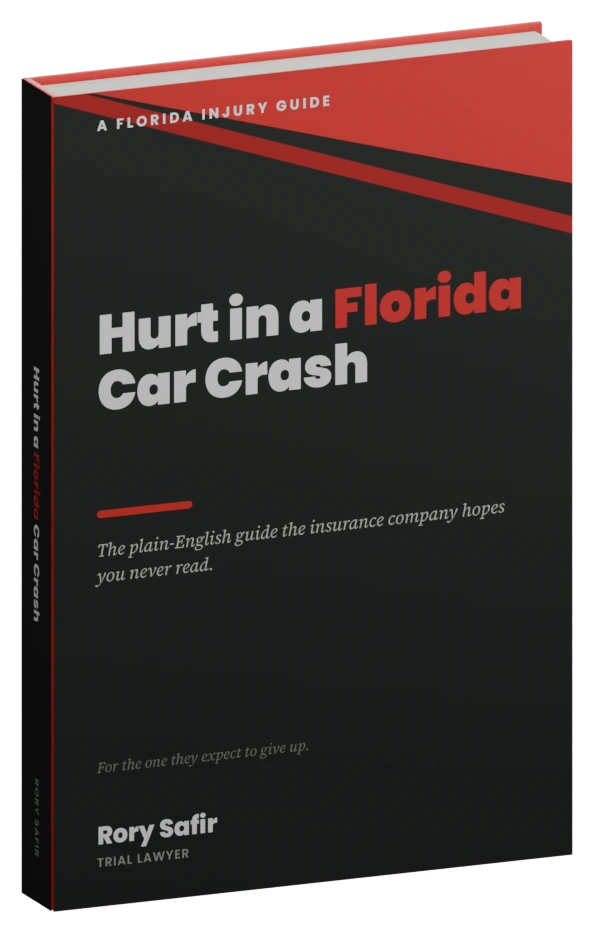
The book
Hurt in a Florida Car Crash
The insurance company’s playbook, the 14-day PIP rule, and Florida’s two-year deadline, in one plain-English book on the hours, days, and weeks after a crash. Free to Tampa Bay crash victims, with the digital edition to read the moment you ask.

About the author
Rory Safir is a Florida injury and criminal defense lawyer and one of a handful of ACS-CHAL Forensic Lawyer-Scientists in the state. He builds injury cases the way he builds a defense, from the evidence up: the crash reconstruction, the records, and the cross-examination of the insurer’s experts.
Keep reading
WRITTEN AND REVIEWED BY
Rory Safir, ACS-CHAL Forensic Lawyer-Scientist
He is the author of The Florida DUI Trial Manual, an NHTSA-qualified instructor in the standardized field sobriety exercises, faculty of the National College for DUI Defense, and a former Assistant Public Defender in the Thirteenth Judicial Circuit.
This post is general information about Florida law as of this writing. It is not legal advice about any specific case.