In Brief
Most people arrested for DUI have never heard of the National College for DUI Defense, and there is no reason they should have. It matters anyway: it is the national organization that trains DUI defense lawyers, and its faculty are the lawyers appointed to do the teaching. This post explains what the credential means and, just as carefully, what it does not.
On This Page
Most people arrested for DUI in Florida have never heard of the National College for DUI Defense, and there is no reason they should have. It is not something the public interacts with. It matters anyway, because it is one of the few places a lawyer can go to learn the part of a DUI case that decides it.
I have been appointed to its faculty. This page explains what that is, and more usefully, what it says about how these cases actually get fought.
What the organization is
The National College for DUI Defense, usually shortened to NCDD, is a national organization that trains lawyers who defend impaired driving cases. Its work is continuing legal education, and its task forces go at the technical subjects directly. One of them, the Alcohol and Drug Testing Task Force, runs sessions on the material that actually decides these cases, including pretrial and trial tactics in blood alcohol cases.
Its purpose is narrow on purpose. DUI is the only area of criminal law where the government routinely produces a number and asks a jury to treat that number as a fact. Attacking a number takes different skills than attacking a witness, and those skills are not taught in law school. NCDD exists to fill that gap.
What faculty means there
Faculty are the attorneys the college asks to teach. That is the whole distinction, and it is worth being precise about it, because credentials in this field get inflated constantly.
Joining an organization means you met its membership criteria and paid the dues. Being asked to teach in one means the lawyers who run it decided other lawyers should learn from you. Those are different things, and only the second is a judgment made by peers about the work rather than about the paperwork.
Why the teaching credential is the one that tells you something
Here is the practical version, and it is the reason any of this is worth a page.
A Florida DUI case usually turns on one of three pieces of forensic evidence, and each one has a technical failure mode that has nothing to do with whether the driver was impaired.
Breath. An infrared instrument does not measure blood alcohol. It measures how much infrared light a breath sample absorbs, then converts that to a blood figure using an assumed ratio between breath and blood. The assumption is a population average, and real people vary around it. Separately, alcohol still in the mouth rather than in deep lung air will read high, which is why every breath protocol requires a supervised observation period before the test.
Blood. A blood alcohol result comes from headspace gas chromatography, which is reliable when the protocol is followed and quietly unreliable when it is not. The preservative in the tube, how full the tube was, whether the internal standard behaved, and whether the calibrators bracketed the result are all recorded somewhere, and all of them are checkable after the fact.
Field sobriety. The standardized battery was validated to do a specific job under specific conditions. Whether those conditions existed on the side of a road at two in the morning is a question of fact, and the answer is written into the officer’s own report and video more often than anyone expects.
None of that is intuition. It is document work, and it is learnable. The lawyers who learn it mostly learn it alone, slowly, on real clients. Teaching it shortens that for everyone except the State, which is the entire argument for an organization like NCDD existing.
What it does not mean
It does not mean a case is winnable. Every case turns on its own facts and its own record, and no credential changes that. It also does not mean the science is always wrong. Often the instrument worked, the protocol was followed, and the number is what it is. Knowing the difference is the point.
Where to go from here
If you are trying to work out whether a lawyer actually knows this material, the questions worth asking are set out in how to choose a DUI lawyer in Florida. The forensic side of the practice is explained in forensic lawyer-scientist, and the general overview of how a Florida DUI case proceeds is on the DUI defense page.
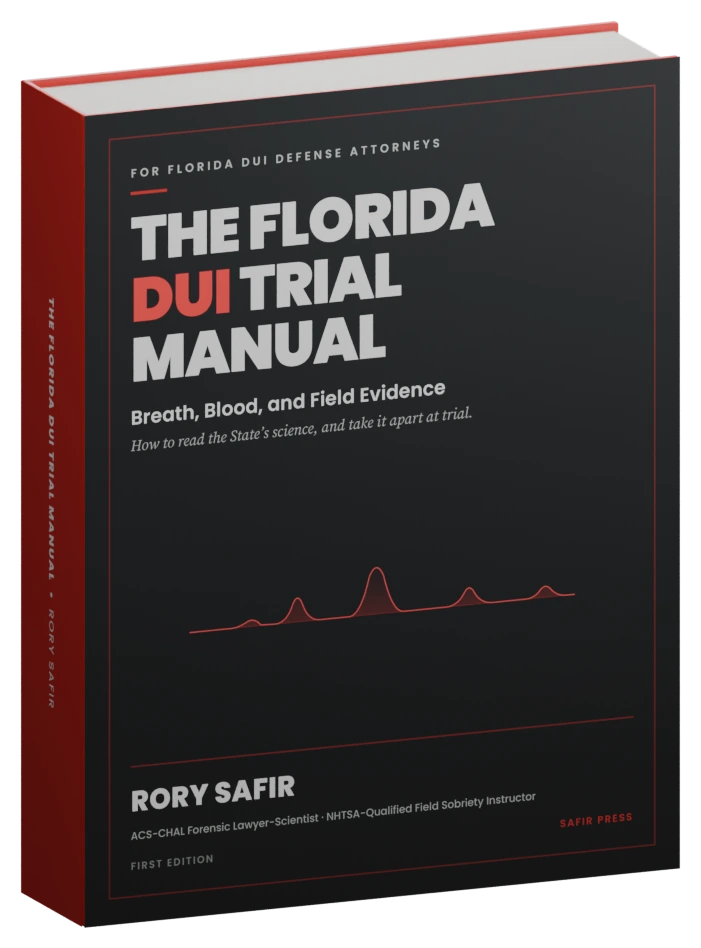
For lawyers rather than clients: the material above is worked out in full, with the record citations and the cross-examination sequences, in the Florida DUI Trial Manual.
WRITTEN AND REVIEWED BY
Rory Safir, ACS-CHAL Forensic Lawyer-Scientist
He is the author of The Florida DUI Trial Manual, an NHTSA-qualified instructor in the standardized field sobriety exercises, faculty of the National College for DUI Defense, and a former Assistant Public Defender in the Thirteenth Judicial Circuit.
This page is general information, not legal advice, and it does not create an attorney-client relationship. Every case turns on its own facts, and past results do not guarantee a similar outcome.