A crash takes a few seconds and then reorders everything: your health, your ability to work, the car you depend on, and your sense of control. While you are dealing with all of that, the other driver’s insurer is already working to pay you as little as possible. The law gives you real tools to push back, and this page lays out how recovery works in Florida, who can be held responsible, and how a crash case is built from the evidence up.
Florida is its own world on car crashes. It is a no-fault state with a serious-injury threshold, it lets the owner of a car answer for a driver they never rode with, and it changed several of its injury laws in 2023. Getting those details right is the difference between a quick low offer and a full recovery.
Florida is a no-fault state, so your PIP pays first regardless of fault. Reaching the at-fault driver for everything else means crossing the serious-injury threshold, and your own UM or UIM coverage matters when the other driver is uninsured or underinsured.
Where your recovery comes from
Recovery after a Florida crash comes in layers, not from one place. Your own Personal Injury Protection, the no-fault coverage every driver must carry, pays the first medical bills and part of your lost wages no matter who caused the crash. When an injury is serious enough, you move past no-fault and pursue the at-fault driver and that driver’s bodily injury coverage for the full harm, including pain and suffering. If the driver who hurt you carried little or no insurance, your own uninsured and underinsured motorist coverage can fill the gap. I work all of these sources at once so nothing that should pay is left on the table. You can read more on how PIP works, on whether Florida has repealed no-fault, and on uninsured and underinsured motorist coverage, and on getting your car repaired, totaled out, and paid for.
I bring something to a crash case that many injury lawyers do not have. As an ACS-CHAL Forensic Lawyer-Scientist who spent years defending DUI cases, I know how the physical evidence of a wreck is built and taken apart, from the speeds and forces to the data a vehicle records to the breath, blood, and field-sobriety evidence when a driver was impaired. I represent injured people, not insurance companies, and I came up in the courtroom as a public defender who tried numerous cases and cross-examined witnesses constantly. I am willing to put a case in front of a jury, which is often what moves an insurer to pay fair value, and I read the crash evidence myself rather than accept the adjuster’s first story. I handle your case personally, from the first call through trial. Learn more about my background.
No-fault and the serious-injury threshold
No-fault is built to handle small crashes without a lawsuit, which is why it pays quickly but pays only so much, and only if you are seen by a provider within fourteen days under Fla. Stat. 627.736. To reach the at-fault driver for everything else, your injury has to cross the threshold in Fla. Stat. 627.737: a permanent injury, significant and permanent scarring or disfigurement, significant and permanent loss of an important bodily function, or death. Whether an injury crosses that line is often contested, and it is where the medical proof has to be built carefully. More detail is on the serious-injury threshold page.
How fault is decided in Florida
Florida now follows modified comparative negligence under Fla. Stat. 768.81: your recovery is reduced by your share of fault, and a person found more than fifty percent at fault recovers nothing. That was a 2023 change; for decades before it, Florida was a pure comparative state, and the shift makes the fight over apportionment matter more than ever. The insurer’s first version of who was at fault is rarely the accurate one.
Several Florida rules shape that fight. In a rear-end collision the rear driver is presumed negligent, but since Birge v. Charron, 107 So. 3d 350 (Fla. 2012), that presumption is rebuttable and gives way to comparative fault when there is evidence the front driver was negligent too, for example by stopping abruptly for no reason. A driver who breaks a traffic law, by running a light, speeding, or following too closely, can be negligent per se, so the violation itself helps prove fault. The other side, in turn, may argue a sudden emergency forced the driver’s hand, or raise Florida’s seat-belt defense to claim an unbelted passenger added to their own injuries. Knowing how each of these plays out is the work; the comparative negligence page goes deeper.
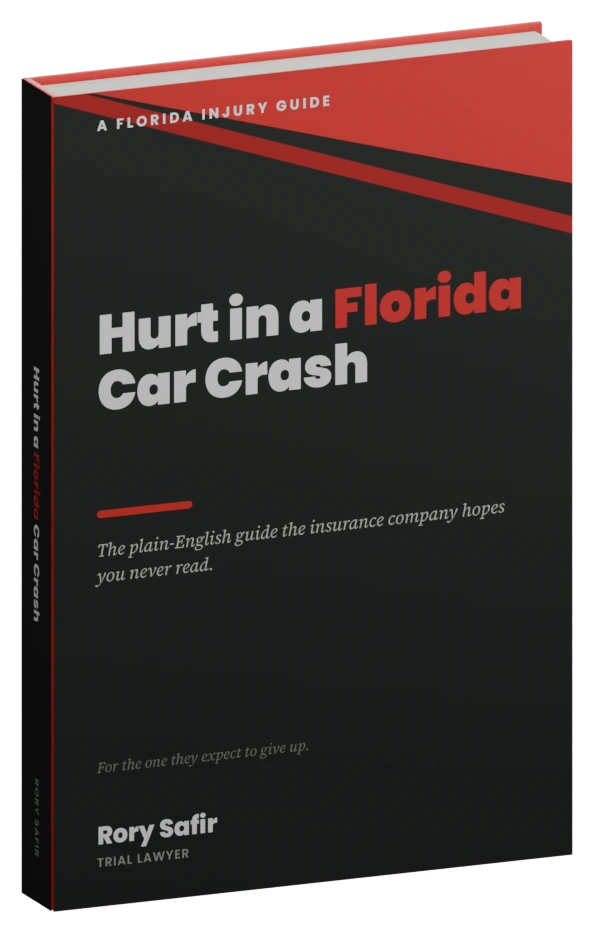
The book
Hurt in a Florida Car Crash
The insurance company’s playbook, the 14-day PIP rule, the serious injury threshold, and Florida’s two-year deadline, in one plain-English book on the hours, days, and weeks after a crash. Free to Tampa Bay crash victims, with the digital edition to read the moment you ask.
Who can be held responsible besides the driver
One of the most valuable questions after a serious crash is who owned the car, because Florida is the rare state where an owner can answer for a crash they had nothing to do with. Under the dangerous instrumentality doctrine, which the Florida Supreme Court applied to automobiles more than a century ago in Southern Cotton Oil Co. v. Anderson, 86 So. 629 (Fla. 1920), and reaffirmed as recently as Emerson v. Lambert, 374 So. 3d 756 (Fla. 2023), an owner who lets another person drive is vicariously liable for that driver’s negligence. The owner needs an identifiable interest in the vehicle, such as legal title or the right to control it, a line the court drew in Aurbach v. Gallina, 753 So. 2d 60 (Fla. 2000). Section 324.021(9)(b)(3), Florida Statutes, caps a private owner’s vicarious exposure, but those caps never touch the owner’s own negligence, and a separate claim for negligent entrustment reaches an owner who handed the keys to a driver they knew was unfit. More on this is on the vehicle owner liability page.
| Source of liability | When it applies |
|---|---|
| The at-fault driver | The person whose negligence caused the crash, for the full harm once your injury crosses the no-fault threshold. |
| The vehicle owner | Under the dangerous instrumentality doctrine, an owner who let the driver use the car, even one who was nowhere near the crash. |
| An employer | When the driver was on the job, through respondeat superior, and sometimes through negligent hiring or supervision. |
| A bar or social host | When over-service, or service to a minor, fueled a drunk driver, through a separate liquor-liability claim. |
More than one of these can apply to the same crash, which matters most when the driver alone does not carry enough insurance to cover the harm.
Finding the second and third sources of responsibility is often what turns a thin claim into a full recovery. When a drunk driver is involved, that can include the establishment that over-served, which I handle as a dram shop and liquor-liability claim alongside the crash case.
The crashes I handle
The same Florida rules apply across the crashes that fill the roads here, and each turns on its own evidence and its own version of the fault fight. The most common are rear-end collisions, intersection and left-turn crashes, head-on and wrong-way wrecks, and multi-vehicle pileups. Others turn on who or what was involved: hit-and-run crashes, where your uninsured motorist coverage becomes the case, distracted-driving crashes, Uber and Lyft crashes, and the more exposed people on the road in motorcycle, bicycle, and pedestrian crashes. The most serious of all is the drunk-driving crash, where my background carries the most weight.
The evidence that decides a crash case
Crash cases are won on evidence, not on who tells the better story to an adjuster. The crash report itself carries a statutory privilege under Fla. Stat. 316.066 and cannot simply be dropped into evidence, so the real work is in the independent proof: the physical scene and the damage patterns, the data a modern vehicle records in its event data recorder, the medical records that tie the injury to the impact, and the witnesses. My forensic training is built for this part of a case, because reading speed, force, and toxicology evidence, and knowing where it is weak, is the same skill I spent years using on the other side of the courtroom.
Your car, your medical bills, and your lost income
A crash case is more than the injury claim. Your property damage, including a fair number on a totaled vehicle and the diminished value of a car that has been wrecked and repaired, is its own piece of the recovery. Your medical bills run through PIP first, which pays eighty percent of reasonable charges and sixty percent of lost wages up to the policy limit, and then through the claim against the at-fault driver, where Florida limits recoverable medical damages under Fla. Stat. 768.0427. Medical liens and health-insurance reimbursement have to be handled so they do not quietly eat your recovery. The damages and compensation page breaks down what a crash claim can include.
What to do after a crash
A few early steps protect both your health and your case. Get to safety and make sure law enforcement creates a report. See a doctor within fourteen days, because no-fault coverage turns on it and because some injuries hide for days. Photograph the vehicles, the scene, and your injuries, and collect the other driver’s insurance and the names of any witnesses. Be cautious about giving a recorded statement to any insurer, including your own, before you understand what you are agreeing to, and keep every bill and record in one place. When in doubt, get advice before you sign anything or accept an early offer.
How I handle a crash case
I keep the work close. You deal with me, not a rotating cast, and I build the case around the evidence from the start: preserving the vehicle data, pinning down the medical proof, and identifying every source of responsibility and coverage. I will give you a straight read on what your claim is worth and what it will take.
The deadline
For a crash on or after March 24, 2023, Florida generally gives you two years to file suit under Fla. Stat. 95.11(5)(a). If a government vehicle or agency was involved, a separate pre-suit notice requirement applies under Fla. Stat. 768.28, and its timing is strict. Because the proof in a crash case fades fast, the practical deadline to start is much sooner than the legal one. The statute of limitations page explains how the clock runs.
Recent Car Crash Results
$300,000, Rear-Ended by a Box Truck
A driver was rear-ended by a box truck in stopped interstate traffic.
$240,000, Brain Injury from a Failure-to-Yield Crash
A driver pulled out of a shopping center and caused a crash that left the client with a brain injury.
$180,000, Rideshare Rear-End Collision
A rideshare driver looking for a passenger rear-ended the client while traffic was stopped, causing disc injuries and a mild brain injury.
Common Questions
What should I do after a car crash in Florida?
Get to safety and call law enforcement so there is a report, then get medical care quickly. Florida's no-fault coverage only pays your medical bills if you are seen within fourteen days of the crash, so do not wait. Document the scene and the other vehicles if you can, get the other driver's insurance information, and be careful about giving a recorded statement to any insurer before you understand your rights.
Who pays for my injuries after a crash?
It happens in layers. Your own Personal Injury Protection pays the first medical bills and part of your lost wages regardless of fault, up to the policy limit. When your injury is serious enough to cross Florida's threshold, you can pursue the at-fault driver and that driver's bodily injury coverage for the rest, including pain and suffering. If that driver has little or no coverage, your own uninsured and underinsured motorist coverage can step in.
When can I claim pain and suffering?
When your injury meets the serious-injury threshold in Fla. Stat. 627.737, which covers a permanent injury, significant and permanent scarring or disfigurement, significant and permanent loss of an important bodily function, or death. No-fault coverage does not pay for pain and suffering; reaching the threshold is what opens the door to it through a claim against the at-fault driver.
What if the crash was partly my fault?
You can still recover in Florida, but less. Florida now follows modified comparative negligence: your damages are reduced by your percentage of fault, and a person found more than fifty percent at fault recovers nothing. That rule changed in 2023; before then Florida was a pure comparative state. How fault gets apportioned is often the whole fight, and it is rarely as one-sided as the insurer first claims.
How long do I have to file a car crash claim?
For a crash on or after March 24, 2023, you generally have two years to file suit under Fla. Stat. 95.11(5)(a). If a government vehicle or agency was involved, a separate pre-suit notice requirement applies under Fla. Stat. 768.28. The evidence that proves a crash case disappears long before the deadline, so it is better to act early.
A car crash can do lasting harm to the body, and the most serious injuries are where insurers fight hardest. Learn how we handle traumatic brain injuries, whiplash and neck injuries, and herniated discs and spinal injuries, or start with an overview of the serious injuries we handle.
Related: How a Florida injury claim works, How PIP works, Is Florida no-fault repealed?, Serious-injury threshold, Comparative negligence, Uninsured motorist coverage, Damages and compensation, Statute of limitations, and Hurt by a drunk driver.
In the News
Hit by an Unlicensed Driver in Florida? A New Law Just Changed the Picture
The Black Box in Your Car Knows What Happened. Here Is How a Crash Gets Reconstructed.
What to Do After a Car Accident in Florida (and the 14-Day Rule That Trips People Up)
From the blog: the quiet deadlines that decide Florida crash claims, why the crash book is free.
If your crash happened locally, see the St. Petersburg pages on drunk driving crashes, rideshare accidents, and pedestrian injuries.
This page is general information about Florida law, not legal advice, and it does not create an attorney-client relationship. The governing authorities include Fla. Stat. 627.736 (PIP and no-fault), 627.737 (the injury threshold), 627.727 (uninsured and underinsured motorist coverage), 768.81 (comparative negligence), 768.0427 (recoverable medical damages), 324.021 (owner financial responsibility), 316.066 (crash reports), and 95.11(5)(a) (the two-year limitations period). Case law is cited as it stood when this page was written; every case is different, and past results do not guarantee a similar outcome. The hiring of a lawyer is an important decision that should not be based solely on advertisements.