In Brief
The other driver’s story often changes between the roadside and the insurance claim, and the answer is usually sitting in the vehicles: the black box data and the scene itself are records. This post covers what your car recorded, why the physical evidence decides disputed crashes, and what to preserve before it disappears.
On This Page
The other driver’s story often changes between the roadside and the insurance claim, and by the time an adjuster is on the phone, a clear rear end or a plain failure to yield has somehow become your fault. The good news is that the physical evidence does not change its story, and neither does the data recorder sitting in most modern vehicles. When fault is disputed, accident reconstruction is how the truth gets pulled back out of the wreck, and it is a field built on exactly the kind of technical evidence I read for a living.
Your car may have recorded the crash
Most cars built in the last fifteen years or so contain an event data recorder, the automotive version of a black box. In the seconds around a crash it can capture speed, throttle, braking, steering, and whether seatbelts were buckled. That data can confirm who was speeding, who braked and when, and whether a driver reacted at all, and it can flatly contradict a driver who claims they were stopped or crawling. The catch is that this data can be lost when a vehicle is repaired, sold, or scrapped, so preserving it early is part of the case.
The scene itself is a record
Even without electronic data, a crash leaves a physical account for anyone trained to read it. The length and direction of skid marks, the point of impact, the crush pattern on the vehicles, the debris field, and the final resting positions all encode speed, angle, and force. A reconstruction expert works backward from those marks to establish how fast the vehicles were traveling, where they were, and who did what, which is why the photographs, the measurements, and the vehicles themselves matter so much before they are cleaned up or hauled away.
Why this decides disputed cases
When it comes down to your word against the other driver’s, the insurer will side with whichever version costs it less. Reconstruction and data change that equation, because they replace an argument about memory with proof grounded in physics. Florida uses a comparative fault system, where your recovery is reduced by your share of the blame, so the fight over fault percentage has real dollars attached to it. Solid reconstruction is often what protects your share from being inflated by a story the other side cannot back up.
What to preserve, and when
Photograph everything at the scene if you safely can, the vehicles, the positions, the skid marks, and the surroundings. Get the names of witnesses. And do not let your own vehicle be repaired or scrapped before its data and its damage have been documented, because once the car is fixed or gone, a key piece of the record goes with it. In a serious dispute, moving quickly to preserve the vehicles and the data is frequently what makes reconstruction possible at all.
Reading the physical and technical evidence of a crash, the data, the marks, and the damage, is the work I have built my career on, and it is what lets me answer a driver’s convenient story with proof rather than argument. I move early to preserve the vehicles and the event data before they disappear, I bring in reconstruction where fault is contested, and I represent injured people, not the drivers or their insurers. If another driver is rewriting what happened after a crash anywhere across the Gulf Coast, the evidence that sets the record straight is time sensitive. Learn how I handle Florida car accident claims.
Hurt in Florida? Let’s talk about your case.
The insurance company is already working to pay you less. A free strategy session is the fastest way to understand what your claim is really worth.
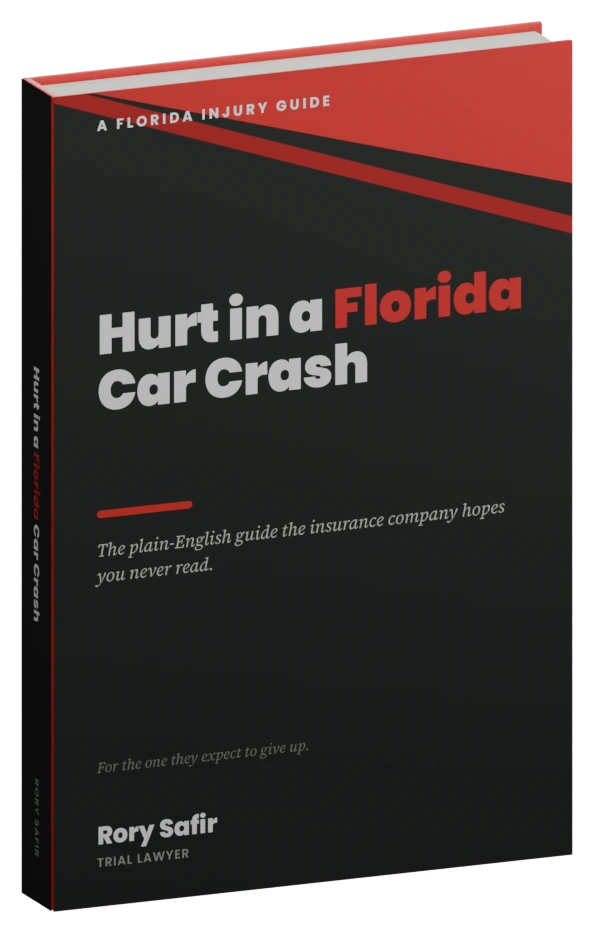
The book
Hurt in a Florida Car Crash
The insurance company’s playbook, the 14-day PIP rule, and Florida’s two-year deadline, in one plain-English book on the hours, days, and weeks after a crash. Free to Tampa Bay crash victims, with the digital edition to read the moment you ask.

About the author
Rory Safir is a Florida injury and criminal defense lawyer and one of a handful of ACS-CHAL Forensic Lawyer-Scientists in the state. He builds injury cases the way he builds a defense, from the evidence up: the crash reconstruction, the records, and the cross-examination of the insurer’s experts.
Keep reading
WRITTEN AND REVIEWED BY
Rory Safir, ACS-CHAL Forensic Lawyer-Scientist
He is the author of The Florida DUI Trial Manual, an NHTSA-qualified instructor in the standardized field sobriety exercises, faculty of the National College for DUI Defense, and a former Assistant Public Defender in the Thirteenth Judicial Circuit.
This post is general information about Florida law as of this writing. It is not legal advice about any specific case.