In Brief
Within a day or two of a crash, the other driver’s insurance company calls, friendly and helpful, asking for a quick recorded statement. The short answer is no. This post covers why they call so early, what that statement really does to a claim, and what to do instead.
On This Page
Within a day or two of a crash, the other driver’s insurance company often calls, friendly and helpful, asking for a quick recorded statement to process the claim. It sounds routine. It is not. That call is one of the most consequential moments in the early life of a claim, and the timing is deliberate.
If you were hurt in a St. Petersburg or Pinellas County crash, start with my St. Petersburg car accident lawyer page. For other kinds of injuries, see my St. Petersburg personal injury lawyer page.
The short answer
You are generally not required to give a recorded statement to the other driver’s insurance company. That insurer is not on your side, and you have no obligation to help it build its file. Your own insurer is different, since your policy usually includes a duty to cooperate, but even there, the how and the when are worth handling carefully.
Why they call so early
The adjuster calls early because that is when you know the least. You may not yet understand the full extent of your injuries, since many do not surface for days. You are stressed, possibly medicated, and inclined to be polite and minimize. A cheerful “I’m doing okay” or “I didn’t see him coming” gets recorded, and it can be replayed later to argue that your injuries are minor or that the crash was partly your fault. In Florida’s modified comparative negligence system, where your recovery drops with your share of blame, an offhand admission can cost real money.
What to do instead
You can be polite and firm. Tell the adjuster you are not prepared to give a recorded statement and that you or your attorney will follow up in writing. You do not have to answer questions about how you feel, how fast you were going, or who was at fault on the spot. Report the basic facts of the crash, and hold the detailed narrative until you understand your injuries and, ideally, have counsel.
The bigger point
Everything the other side’s insurer does in the early days is aimed at reducing what it pays, and the recorded statement is the clearest example. Slowing that process down is not being difficult. It is protecting a claim you have not yet had the chance to understand.
Handling the insurer’s early moves, the recorded statement request, the quick offer, the friendly questions, is part of protecting the value of a case from day one, and it is work I take off your plate. I deal with the adjusters so you can focus on healing, and I represent injured people, not insurers. If an insurance company is already calling after a crash anywhere across the Gulf Coast, here is how a Florida injury claim works.
Hurt in Florida? Let’s talk about your case.
The insurance company is already working to pay you less. A free strategy session is the fastest way to understand what your claim is really worth.
The book
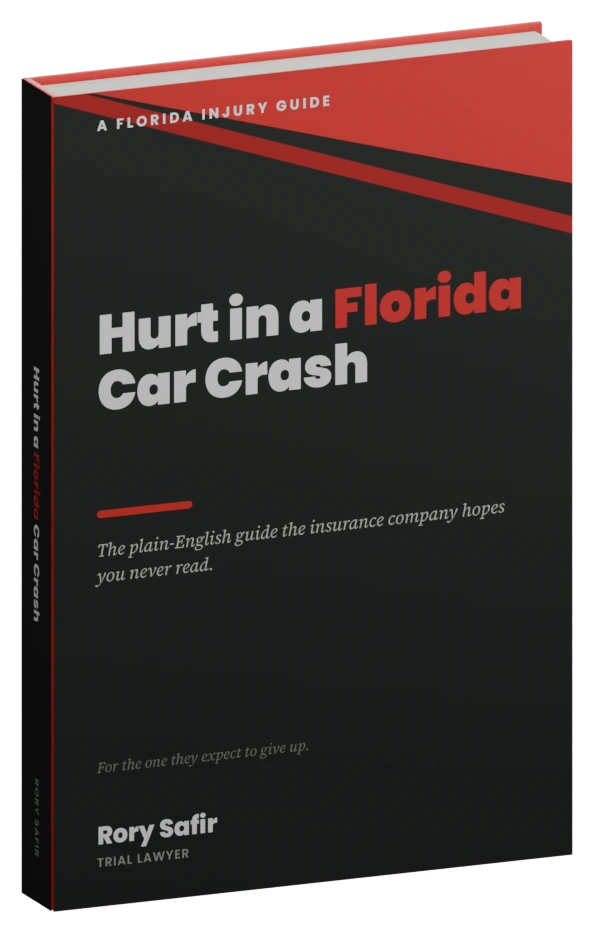
Hurt in a Florida Car Crash
The insurance company’s playbook, the 14-day PIP rule, and Florida’s two-year deadline, in one plain-English book on the hours, days, and weeks after a crash. Free to Tampa Bay crash victims, with the digital edition to read the moment you ask.

About the author
Rory Safir is a Florida injury and criminal defense lawyer and one of a handful of ACS-CHAL Forensic Lawyer-Scientists in the state. He builds injury cases the way he builds a defense, from the evidence up: the crash reconstruction, the records, and the cross-examination of the insurer’s experts.
The Version You Cannot Decline: An Examination Under Oath
Everything above is about the recorded statement, which is a request. There is a second, formal version of the same thing, and it is not a request. It is called an examination under oath, and if you are claiming PIP benefits under your own Florida policy, it is written into the statute.
Section 627.736(6)(g) says an insured seeking benefits “must comply with the terms of the policy, which include, but are not limited to, submitting to an examination under oath.” Then it adds the sentence that decides cases: “Compliance with this paragraph is a condition precedent to receiving benefits.”
Condition precedent is doing all the work in that sentence. It does not mean attending is a good idea, or that skipping it looks bad. It means the obligation to pay does not arise until you have complied. A claim can end because a date was missed, without anybody ever reaching the question of whether you were hurt. Florida’s appellate courts have treated the requirement that way, and the reasoning in those cases does not ask the insurer to show it was harmed by the absence. Miss a deadline in most areas of law and the other side has to prove prejudice. That is not how this one has been read.
So treat the notice like a filing deadline rather than correspondence. Put it on a calendar the day it arrives, and speak to a lawyer before the date rather than after it.
The limits that run the other way
The same paragraph carries two protections that are easy to miss, and both are in the statute rather than in anybody’s argument.
The questioning has a boundary. The scope “is limited to relevant information or information that could reasonably be expected to lead to relevant information.” An examination under oath about a car crash is not an open license to inventory your life.
And an insurer cannot use them as a routine obstacle. A carrier that, as a general business practice as determined by the Office of Insurance Regulation, requests examinations under oath without a reasonable basis is subject to the unfair insurance trade practices statute. The tool is in the statute for the carrier, and so is the limit on abusing it.
None of that changes the practical advice, which stays simple. Go, be accurate, and have somebody in your corner who has read the policy and the statute before you sit down. The examination is survivable. Ignoring the letter is the part that is hard to fix.
Keep reading
WRITTEN AND REVIEWED BY
Rory Safir, ACS-CHAL Forensic Lawyer-Scientist
He is the author of The Florida DUI Trial Manual, an NHTSA-qualified instructor in the standardized field sobriety exercises, faculty of the National College for DUI Defense, and a former Assistant Public Defender in the Thirteenth Judicial Circuit.
This post is general information about Florida law as of this writing. It is not legal advice about any specific case.