In Brief
Isaiah’s Law took effect July 1, 2026, aimed at drivers who never should have been on the road. If an unlicensed driver hit you, the license status matters less to the claim than people expect. The real problem is that unlicensed usually means uninsured, and the person who lent the car may share the liability. Here is how the pieces fit.
On This Page
One of the roughly ninety new Florida laws that took effect on July 1, 2026, is aimed squarely at a problem many injured drivers already know too well. Known as Isaiah’s Law, House Bill 35 adds driving without a valid license to the list of offenses that can push a driver into habitual traffic offender status, which carries far steeper consequences once a person racks up enough of them in a five year window. It is a criminal and licensing change on its face, but it lands right in the middle of personal injury law, because a crash caused by an unlicensed, suspended, or revoked driver is one of the most common and most frustrating situations we see on Tampa Bay roads.
If you were hurt in a St. Petersburg or Pinellas County crash, start with my St. Petersburg car accident lawyer page. For other kinds of injuries, see my St. Petersburg personal injury lawyer page.
Why the driver’s license status matters to your claim
A traffic violation does not automatically decide who pays in a civil case, but it can become powerful evidence. In Florida, a driver’s violation of a traffic law is treated as evidence of negligence, so a driver who was on the road with no valid license, and who then caused your crash, hands you a strong starting point. The new habitual offender designation matters because it often signals a driver with a long history of suspensions, prior crashes, or impaired driving, and that history can shape the insurance analysis, the settlement value, and the litigation strategy in your case.
The real problem: unlicensed drivers are often uninsured
Here is the practical trap. A driver with no valid license frequently has no valid insurance either, which means the at fault driver may have nothing to pay a judgment. That is exactly the situation your own coverage is built for. In Florida, your personal injury protection covers an early layer of your medical bills no matter who was at fault, and your uninsured or underinsured motorist coverage can step in when the driver who hit you had no insurance or not enough. Checking every policy that could apply, yours, a household relative’s, and any employer coverage if the driver was working, is one of the first things worth doing.
When the person who lent the car can be liable
There is often a second place the money can come from. Florida treats a car as a dangerous instrumentality, so the owner who hands the keys to someone they knew or should have known was unfit to drive, including someone with no license or a suspended one, can share responsibility through what the law calls negligent entrustment. When an unlicensed driver was behind the wheel of someone else’s car, the owner’s role is worth a hard look, because it can open coverage the driver alone does not have.
What to do after a crash with an unlicensed driver
Get medical care the same day, since the record ties your injuries to the crash and starts the fourteen day clock that Florida’s no fault system puts on personal injury protection benefits. Make sure a crash report is written and that the officer notes the driver’s license status. Get the name of the vehicle’s owner, not just the driver. And be careful about giving the other side’s insurer a recorded statement before you have talked to a lawyer, because the first questions are aimed at fault and coverage.
A crash caused by an unlicensed or suspended driver looks discouraging at first, because the person who hurt you may seem to have nothing. In practice, the fuller picture, your own coverage, the owner who lent the car, and the driver’s record now amplified by the new habitual offender law, is often better than it first appears. If an unlicensed driver injured you anywhere in Pinellas County or across the Gulf Coast, I map every source of recovery before the insurer starts narrowing them. Learn how I handle Florida car accident claims.
Hurt in Florida? Let’s talk about your case.
The insurance company is already working to pay you less. A free strategy session is the fastest way to understand what your claim is really worth.
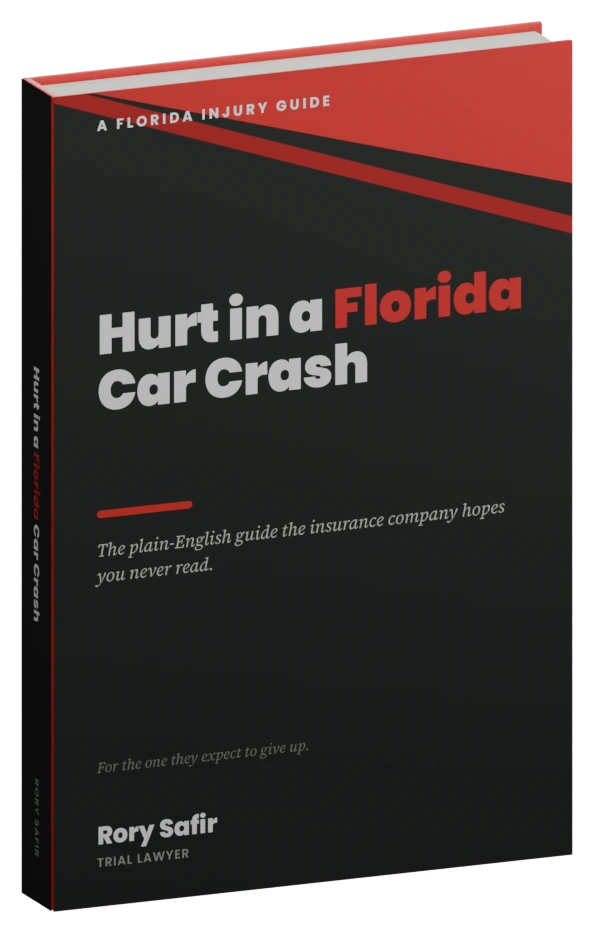
The book
Hurt in a Florida Car Crash
The insurance company’s playbook, the 14-day PIP rule, and Florida’s two-year deadline, in one plain-English book on the hours, days, and weeks after a crash. Free to Tampa Bay crash victims, with the digital edition to read the moment you ask.

About the author
Rory Safir is a Florida injury and criminal defense lawyer and one of a handful of ACS-CHAL Forensic Lawyer-Scientists in the state. He builds injury cases the way he builds a defense, from the evidence up: the crash reconstruction, the records, and the cross-examination of the insurer’s experts.
Keep reading
Further Reading
- HB 35 (2026), Isaiah’s Law, with its history and text, Florida Senate
- Fla. Stat. 322.03, Drivers must be licensed, full text, Online Sunshine
WRITTEN AND REVIEWED BY
Rory Safir, ACS-CHAL Forensic Lawyer-Scientist
He is the author of The Florida DUI Trial Manual, an NHTSA-qualified instructor in the standardized field sobriety exercises, faculty of the National College for DUI Defense, and a former Assistant Public Defender in the Thirteenth Judicial Circuit.
This post is general information about Florida law as of this writing. It is not legal advice about any specific case.