
In Brief
After a shooting at an apartment complex or a parking garage, the person who pulled the trigger is often never caught, or has nothing to pay. Negligent security law asks a different question: did the property owner make the crime foreseeable and easy. Foreseeability, the apartment presumption, and why the evidence disappears fast.
On This Page
After a shooting at an apartment complex, a nightclub, or a parking garage, the coverage focuses on the person who pulled the trigger, and rightly so. But the criminal is often never caught, or has nothing to pay, and that is not where the story ends for the victim. Florida law requires a property owner to provide reasonable security against crime the owner should have seen coming, and when the owner does not, the injured person can hold the property responsible. In a place as dense as Tampa Bay, with busy nightlife districts and countless apartment communities, these cases are more common than people realize.
Foreseeability is the heart of the case
A negligent security case rises or falls on foreseeability, because a property owner’s duty to protect people from the criminal acts of a third party turns on whether that crime was foreseeable. Foreseeability is built from the history of the property and the area around it, the prior robberies, assaults, and shootings the owner knew about or should have known about from police calls and incident reports. A property with a documented pattern of violence and thin security is where these cases are strongest, because the owner had every reason to act and chose not to. Proving that pattern, and matching it against the security the owner provided, is the work.
The apartment presumption is a hurdle, not a wall
Florida gives apartment and other multifamily owners a specific defense that families should understand up front. An owner that provides the security measures the statute lists, things like adequate lighting, working locks, and cameras, earns a rebuttable presumption against liability for a third party’s crime. Two things keep that from ending a case. It is rebuttable, so proof that the measures were absent, broken, or plainly inadequate to the known risk can overcome it. And it applies only to multifamily residential, not to hotels, bars, retail stores, or parking operations, which have no such presumption at all. Whether the statute even applies, and whether the owner met it, is an early and decisive question.
Two sources of recovery, worlds apart
There are usually two parties at fault in these cases, the attacker and the property owner who let the danger stand, and they could not be more different when it comes to recovery. The attacker is often never identified or has no assets, while the property owner carries insurance and had both the duty and the power to prevent a foreseeable crime. That is why a well built negligent security case focuses on the owner’s failure, not just the criminal’s act.
The evidence disappears quickly
Surveillance video is often overwritten in days, incident reports get filed away, and broken locks and dark lots get quietly fixed after the fact. So the early moves matter. Preserve the property’s video and incident reports, get the police report number, and photograph the lighting, the broken locks or gates, and any missing cameras before they are repaired. A prompt demand that the owner preserve this evidence is frequently what keeps a strong case from becoming an unprovable one.
I spent years in the criminal courts, so I understand how these crimes happen and how the evidence around them is built, and I use that to prove what a property owner should have seen and failed to prevent. I move fast to lock down the video, the reports, and the prior crime history, I hold the owner to the duty the law imposes, and I represent the people harmed by preventable violence, not the properties or their insurers. If you were hurt by a crime that a property owner should have guarded against anywhere across the Gulf Coast, the case is often stronger than it first feels. Learn how I handle Florida negligent security claims.
Hurt in Florida? Let’s talk about your case.
The insurance company is already working to pay you less. A free strategy session is the fastest way to understand what your claim is really worth.
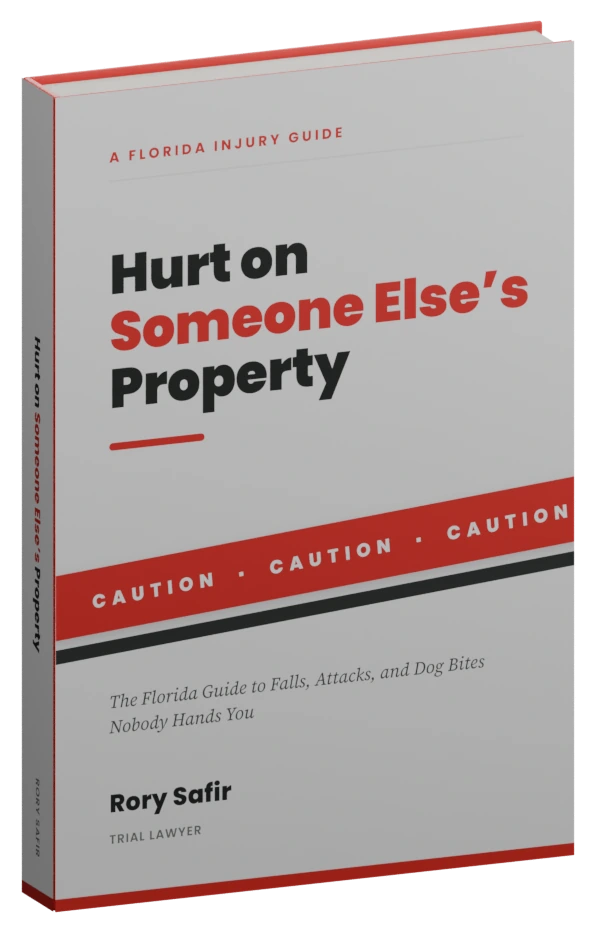
The book
Hurt on Someone Else’s Property
My plain-English book on Florida premises cases has a full chapter on negligent security: what property owners owe you, the records that prove what they knew, and the evidence race that starts the day you are hurt. Free to Tampa Bay residents, with the digital edition to read the moment you ask.

About the author
Rory Safir is a Florida injury and criminal defense lawyer and one of a handful of ACS-CHAL Forensic Lawyer-Scientists in the state. He builds injury cases the way he builds a defense, from the evidence up: the crash reconstruction, the records, and the cross-examination of the insurer’s experts.
Keep reading
WRITTEN AND REVIEWED BY
Rory Safir, ACS-CHAL Forensic Lawyer-Scientist
He is the author of The Florida DUI Trial Manual, an NHTSA-qualified instructor in the standardized field sobriety exercises, faculty of the National College for DUI Defense, and a former Assistant Public Defender in the Thirteenth Judicial Circuit.
This post is general information about Florida law as of this writing. It is not legal advice about any specific case.