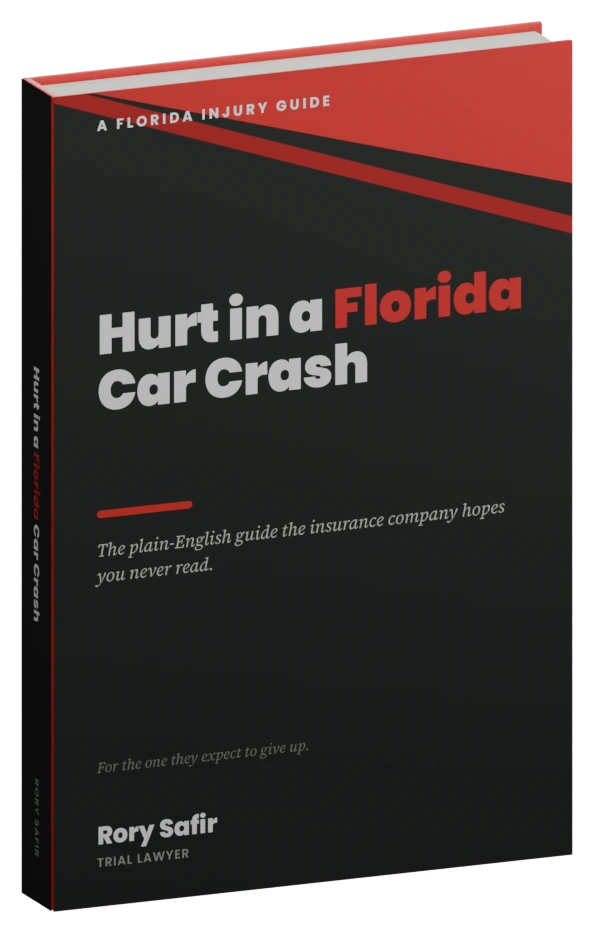
After a crash in Florida, the first money on the table is your own. No-fault means your Personal Injury Protection pays your early medical bills and part of your lost wages no matter who caused the wreck. It also means there are deadlines and limits that quietly cost people their benefits when no one warns them in time.
The rules are not complicated, but they are unforgiving, and the insurer has no duty to remind you of the one that protects you. Here is how PIP works, where it runs out, and how you get to the coverage that pays for a serious injury.
Under section 627.736, PIP pays your early medical bills and part of your lost wages no matter who caused the wreck. Two rules decide how much you really get: the 14-day deadline to start care, and whether a provider finds an emergency medical condition.
What PIP pays, and the deadline that controls it
Florida requires most drivers to carry at least $10,000 in PIP. It pays a share of your medical care and lost wages from the first day, before anyone decides who was at fault.
| Item | Detail |
|---|---|
| Medical | Eighty percent of reasonable and necessary medical expenses, up to the $10,000 limit. |
| Lost wages | Sixty percent of lost income, within the same $10,000 limit. |
| Death benefit | A $5,000 benefit for surviving family. |
| The 14-day rule | Initial medical care must be obtained within 14 days of the crash, or PIP benefits are forfeited. |
| Emergency medical condition | The full $10,000 is available only if a qualifying provider finds an emergency medical condition; otherwise the cap is $2,500. |
PIP pays regardless of fault. It is first-layer coverage, not the ceiling on what a serious injury is worth.
PIP is where an auto claim starts, and treating it as where the claim ends leaves real money on the table. I make sure clients get the early care the fourteen-day rule requires and that the emergency-condition question is handled right, because those two rules quietly control how much no-fault coverage you keep. I represent injured people, not insurance companies, and once PIP has done its limited job, I take the case to the at-fault driver for everything PIP was never meant to cover.
PIP and no-fault rules reward a lawyer who reads the records and the statute closely, and close reading is simply how I work. I am an ACS-CHAL Forensic Lawyer-Scientist who spent years defending DUI cases, so I know how the physical evidence of a crash, the data a vehicle records, and any impairment evidence are built and attacked when a claim moves beyond no-fault. I represent injured people, not insurance companies, and I came up in the courtroom as a public defender, tried numerous cases, and cross-examined witnesses constantly. Because I am willing to put a case in front of a jury, which is often what moves an insurer to pay fair value, the carrier cannot count on me folding at the PIP stage. I handle your case personally, from the first call through trial. Learn more about my background.
The two rules that quietly decide your PIP
Two rules inside the PIP statute catch people off guard, and both can cost real money if they are missed. The first is the fourteen-day rule. Under section 627.736, Florida Statutes, PIP medical benefits are available only if you get initial care within fourteen days of the crash, so waiting to see whether the pain fades can quietly forfeit the coverage you paid for. The second is the emergency medical condition determination, which decides how much PIP you receive. If a qualified provider finds that you had an emergency medical condition, your medical benefits can reach the full $10,000. If no such finding is made, those benefits are capped at $2,500, a large difference that turns on paperwork and diagnosis rather than on how hurt you really are. Getting prompt care from providers who understand these rules protects your health and the benefits themselves.
When PIP is not enough
Ten thousand dollars disappears fast against a real injury. When your losses run past PIP, the path forward depends on the severity of the injury. If it meets the serious-injury threshold, you can pursue the at-fault driver for the full measure of your harm, including pain and suffering. Your health insurance may cover treatment in the meantime, and your own uninsured-motorist coverage can step in when the other driver has little or no insurance. Putting those pieces together in the right order is part of protecting the value of your case.
Where PIP stops
It is just as important to know what PIP does not do. It pays a share of medical bills and lost wages, and it does not pay for pain and suffering, the human cost of a serious injury, at all. PIP also runs out quickly in a real injury case, since $10,000 does not go far against surgery, imaging, and months of treatment. To reach compensation beyond those limits, including for pain and suffering, you have to step outside the no-fault system and pursue the at-fault driver, which requires meeting Florida’s permanency threshold. Understanding that PIP is a first layer, not the whole recovery, is the difference between settling for what no-fault pays and pursuing what the injury is truly worth.
The deadline
For a crash on or after March 24, 2023, Florida gives you two years to file suit under Fla. Stat. 95.11(5)(a). That window is shorter than the old four-year rule, and the proof that wins these cases fades faster than the clock runs, so it is best to move early.
Common Questions
What does Florida PIP cover?
Personal Injury Protection pays eighty percent of your reasonable and necessary medical expenses and sixty percent of your lost wages, up to the $10,000 limit, plus a $5,000 death benefit. It pays regardless of who caused the crash, which is why Florida is called a no-fault state for these first-dollar medical benefits.
What is the 14-day rule?
Under Fla. Stat. 627.736 you must get initial medical care within 14 days of the crash. Miss that window and you forfeit your PIP benefits entirely. It is the single most common way people lose coverage they were entitled to, so see a provider quickly even if you feel only sore at first.
Why did I only get $2,500 in PIP?
The full $10,000 is available only if a qualifying provider determines you had an emergency medical condition. Without that finding, your PIP is capped at $2,500. The emergency-medical-condition determination is often the difference between adequate and inadequate coverage, and it has to come from the right provider.
My PIP ran out and I'm still hurt. What now?
PIP is only the first layer. If your injury meets the serious-injury threshold, you can pursue the at-fault driver for everything beyond PIP, including pain and suffering. Your own health insurance and any uninsured-motorist coverage may also come into play, and coordinating them correctly protects your recovery.
Does PIP pay if the crash was my fault?
Yes. PIP is no-fault, so it pays your medical and wage benefits up to the limit regardless of who caused the crash. Fault matters when you step outside PIP to pursue the other driver, not for your own PIP benefits.
Related: Florida car accident overview, Is Florida PIP repealed?, Serious injury threshold, and About Rory Safir.
In the News
This page is general information about Florida law, not legal advice, and it does not create an attorney-client relationship. The governing statute is Fla. Stat. 627.736 (no-fault and PIP), with the serious-injury threshold in 627.737 and the two-year limitations period in 95.11(5)(a). Insurance and tort law change, and the description here reflects June 2026. Every case is different, and past results do not guarantee a similar outcome. The hiring of a lawyer is an important decision that should not be based solely on advertisements.