Florida is one of the most dangerous states in the country to ride a motorcycle. The state sees roughly nine thousand motorcycle crashes and close to six hundred rider deaths every year, helped along by year-round riding weather and crowded roads, and a motorcyclist is far more likely to be killed in a crash than someone in a car. When a rider goes down, there is no cage, no airbag, and no second chance.
Florida is dangerous for riders
The danger is not the rider’s recklessness, whatever the stereotype says. Florida’s own transportation studies have found that in most crashes between a car and a motorcycle, the driver of the larger vehicle was at fault, usually for turning across a rider’s path or pulling out without looking. Year-round riding, heavy traffic, and drivers who do not watch for motorcycles combine to make our roads, and the Tampa Bay region in particular, hard places to ride.
These cases are won by reconstructing the crash and proving the driver’s fault, often against the tired refrain that the rider came out of nowhere, which is the kind of evidence work I built my career on. A motorcycle case is a science case, and that is where I am at my strongest. Learn more about my background.
A motorcycle crash is a negligence case with a twist
A rider has all the rights and all the duties of any other driver, so a motorist who failed to yield, turned left across a rider’s path, changed lanes without looking, or simply was not paying attention is responsible for the harm. The negligence is ordinary. What is not ordinary is the insurance, because Florida treats motorcycles very differently from cars, in ways that cut both for and against the rider.
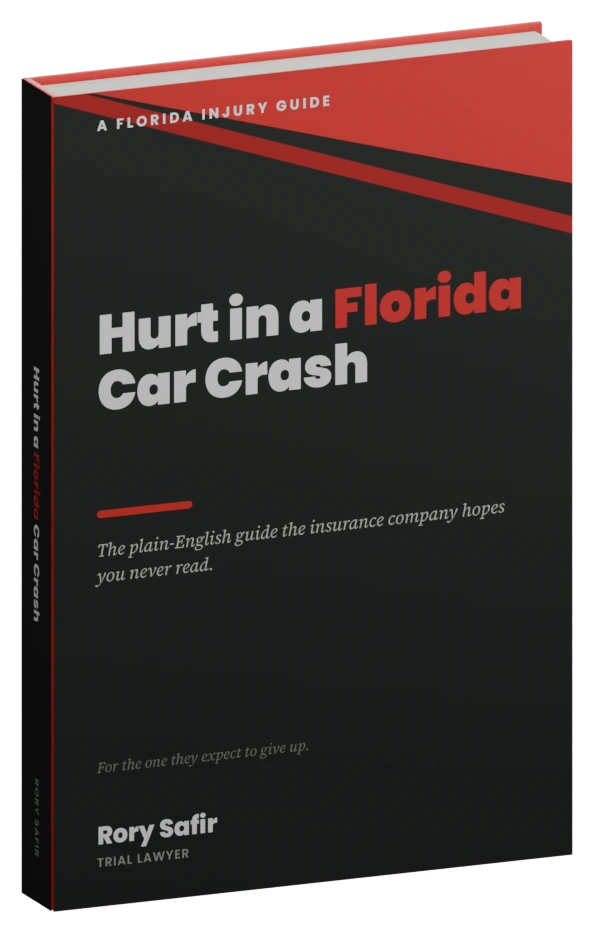
The book
Hurt in a Florida Car Crash
The insurance company’s playbook, the 14-day PIP rule, the serious injury threshold, and Florida’s two-year deadline, in one plain-English book on the hours, days, and weeks after a crash. Free to Tampa Bay crash victims, with the digital edition to read the moment you ask.
The no-fault gap, and the hidden upside
Motorcycles are excluded from Florida’s no-fault system, so there is no Personal Injury Protection to pay your first medical bills, and you cannot buy standard no-fault coverage even if you want it. That is the downside. The upside is real and often overlooked: because you are outside the no-fault system, the permanent-injury threshold that blocks many car-crash victims does not apply to you, so you can pursue the at-fault driver for full damages, including pain and suffering, without having to prove a permanent injury first. Your own uninsured motorist coverage also matters enormously, because Florida does not require drivers to carry bodily injury coverage and a large share are uninsured. We cover all of this on the insurance and no-fault page.
Motorcycles are left out of Florida’s no-fault system, so there is no PIP. The same exclusion means the permanent-injury threshold that limits many car-crash victims does not apply to you, so you can pursue full damages without first clearing it.
The injuries are catastrophic
A rider absorbs the force of a crash with their body and then with the road. The result is frequently a traumatic brain injury, a spinal injury, broken bones, and severe road rash, the kinds of harm that change a life. Those injuries, and how insurers try to shrink them, are covered on our serious injuries pages.
How insurers blame the rider
The defense reflex is to blame the biker. You were speeding, you were lane splitting, you were not wearing a helmet, you came out of nowhere. Most of these arguments weaken against the law and the evidence, because many adults may ride legally without a helmet, because the driver still owed a duty to look, and because reconstruction usually shows a rider who was visible and a driver who was not watching. Knowing the blame is coming, and taking it apart, is the work of the case.
The bias every rider’s case has to beat
There is an unfair assumption built into these cases that a rider has to overcome before anything else, and pretending it is not there does not help. Many adjusters and jurors walk in believing motorcyclists are reckless, that a person on a bike was probably speeding, weaving, or asking for trouble, and the defense works hard to feed that belief. It is usually wrong, most riders are careful precisely because they know how exposed they are, and it colors how a claim is valued from the first phone call. Beating it is part of the job, and it is not done with argument alone. It is done with evidence: the reconstruction that shows the car turned across the rider’s path, the data and witnesses that establish the rider’s speed and lane position, and a clear account of a driver who simply did not look. Replacing the lazy story about a reckless biker with a documented account of what happened is often what turns a lowball evaluation into fair treatment, and it is where a case like this is won.
How a motorcycle case is built
Each of these threads has its own page.
A motorcycle case is a fight on two fronts, the crash itself and the assumption that the rider must have been at fault, and I take on both. I build the reconstruction and the record that show what the driver did, and I make full use of the rules that favor an injured rider, the freedom from the injury threshold and every layer of coverage a serious case needs. I represent injured riders and their families, not the drivers who did not see them, and I do not let a client be shortchanged because a jury walked in with the wrong idea about people on motorcycles.
Common Questions
Is a motorcycle crash a normal negligence case in Florida?
Yes, with a twist. A rider has the same rights and duties as any other driver, so a motorist who turned left across your path, failed to yield, or never looked is responsible for the crash. What is different is the insurance side: motorcycles are left out of Florida's no-fault system, which changes how you recover and, in one important way, works in your favor.
Does my own insurance pay my medical bills like it would in a car crash?
No. Florida's no-fault Personal Injury Protection coverage does not apply to motorcycles, and you cannot get it even from your own car policy in most cases. That means there is no automatic medical coverage after a motorcycle crash, so your recovery usually runs through the at-fault driver, your own uninsured motorist coverage, health insurance, or any medical-payments coverage you added.
Do I have to prove a permanent injury to recover for pain and suffering?
No, and this surprises people. The permanent-injury threshold that limits car-crash victims comes from the no-fault system, and because motorcyclists are outside that system it does not apply to you. A rider can pursue the at-fault driver for full damages, including pain and suffering, without first clearing that threshold.
The driver said they never saw me. Is that a defense?
It is the opposite of a defense; it is an admission. Drivers have a duty to look for motorcycles, and 'I did not see the bike' usually means the driver was not paying attention or failed to look twice before turning or pulling out. Florida's own studies find that in most car-and-motorcycle crashes, the driver of the larger vehicle was at fault.
How long do I have to bring a claim?
For most Florida injury claims the deadline is two years from the date of the crash. Because a motorcycle case depends on proving the other driver's fault rather than tapping automatic coverage, the early evidence matters even more, and the sooner the case is reviewed the more can be preserved.
Related: How an injury claim works, Serious injuries, Car accidents, and All personal injury practice areas.
This page is general information about Florida law, not legal advice, and it does not create an attorney-client relationship. Florida’s motorcycle helmet and eye-protection rules appear in section 316.211 of the Florida Statutes, lane use in section 316.209, the no-fault and Personal Injury Protection rules in section 627.736, the serious injury threshold in section 627.737, comparative negligence in section 768.81, and the deadline to file in section 95.11. Every case is different, and past results do not guarantee a similar outcome. The hiring of a lawyer is an important decision that should not be based solely on advertisements.