Every breath test result depends on a number you never agreed to. To turn the alcohol in your breath into a blood-alcohol reading, the Intoxilyzer 8000 multiplies by an assumed blood-to-breath ratio of 2,100 to 1. That ratio is treated as a constant. It is not.
As an ACS-CHAL Forensic Lawyer-Scientist who sits on the National College for DUI Defense (NCDD) National Task Force on alcohol and drug testing devices, I take this assumption apart, because for many people it is the single reason a reading lands over the limit.
What the Partition Ratio Is
When you drink, alcohol moves from your blood into the air in your lungs at a rate that depends on your physiology. The partition ratio is the conversion factor between the two. A breath machine cannot measure your blood. It measures your breath and multiplies by an assumed ratio to estimate what your blood would show. Florida’s machine uses 2,100 to 1 for every person who blows into it.
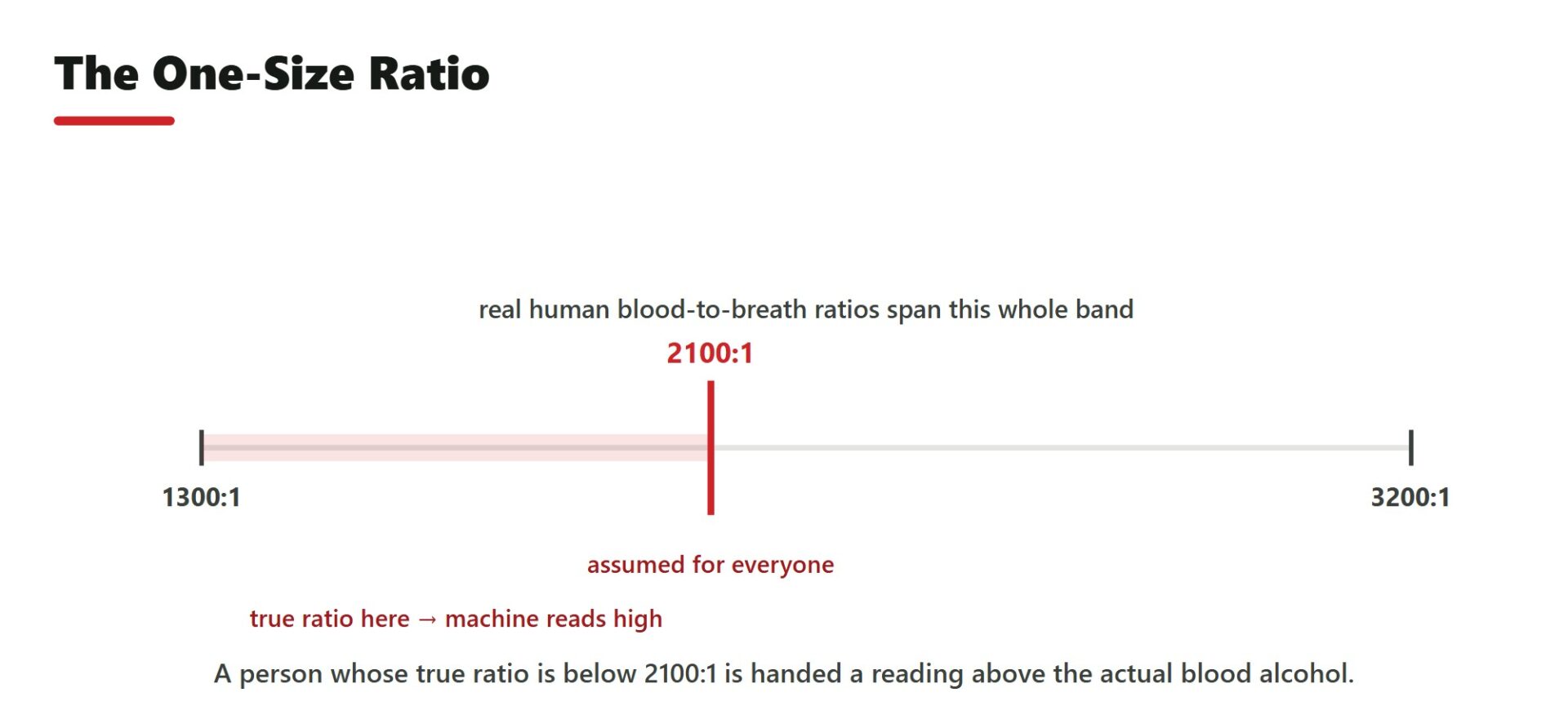
The machine multiplies your breath alcohol by a single number, 2,100 to 1, to estimate your blood alcohol. Real people fall across a wide range. When your true ratio sits below 2,100, the machine reports more alcohol than you have.
Do not miss this
A breath reading at or above 0.08 also starts the 10-day license clock.
A breath result over the limit triggers an administrative suspension on top of the criminal case. You have 10 days from the arrest to demand a formal review hearing with the DHSMV in Clearwater, which protects your license and can secure a 42-day permit. We file that request the same day you hire us. Call or text (727) 761-4318.
Real People Are Not Average
The 2,100 to 1 figure is a population average chosen decades ago. Dr. Kurt Dubowski, one of the most cited researchers in the field, concluded that wide individual variations from the population mean partition values exist, and that it is impossible or infeasible to convert a breath alcohol concentration into the simultaneous blood alcohol concentration with forensically acceptable certainty. Breath temperature, breathing pattern, sex, and the timing of your last drink all move the ratio. When a person’s true ratio sits below 2,100 to 1, the machine reports a blood-alcohol level higher than the one they actually have.
It Even Changes Within You
Your own ratio is not fixed. It shifts as you move from absorbing alcohol to eliminating it, and it changes with your breath temperature. A reading taken while you are still absorbing, with a slightly elevated breath temperature, can sit well above your true blood-alcohol level. This is one reason the timing of the test matters so much, which is the heart of rising BAC and breath temperature.
Why This Matters in Your Case
A jury can understand this. The State’s number looks exact, and the science underneath it is an average applied to a person who may be nothing like average. Showing the jury that the 2,100 to 1 assumption may not fit you, with the records and the testimony to back it, turns a hard number into a real question.
Where 2,100 to 1 Comes From
To turn a breath measurement into a blood-alcohol number, the machine assumes a fixed relationship between the alcohol in your breath and the alcohol in your blood: 2,100 parts in the blood for every 1 part in the breath. That figure is a population average chosen decades ago to be conservative. It is baked into the instrument and applied to everyone, from a small person who drank on an empty stomach to a large person who ate a full meal. The machine does not learn your ratio. It assumes it.
Studies put real ratios across a broad band. When your true ratio is below 2,100 to 1, the machine converts your breath into a blood number that is higher than your actual level.
Your Ratio Is Not the Average
Real blood-to-breath ratios vary from person to person and within the same person across a night, and the timing is what matters most. Once alcohol has finished being absorbed, measured ratios tend to sit above 2,100 to 1, which works in favor of the person being tested. A traffic stop does not happen in that tidy condition. While alcohol is still being absorbed, the ratio runs lower, and a reading taken in that window can credit your breath with more blood alcohol than it represents. Dubowski’s own conclusion is the one that matters here, that it is often impossible to determine whether the post-absorptive state has been reached at any given time. The State’s number assumes a condition it usually cannot establish.
What Pushes a Reading Up
Body temperature, breathing pattern, the phase of absorption, and individual physiology all shift the real ratio away from the assumed value. That is why the partition ratio rarely stands alone. It travels with breath temperature, breathing pattern, and the margin of error, each of which can move a borderline reading. We present the assumption for what it is, a one-size-fits-all number that the science says does not fit everyone.
The partition ratio is the assumption the whole breath number rests on, and it is one I know how to take apart. The machine did not measure the ratio in your body. It borrowed an average and applied it to you. The published research shows how much that ratio moves from one person to the next, that it moves most while alcohol is still being absorbed, and that the State often cannot establish which side of that line someone was on when they blew. That is the gap worth making the State account for, because the case rests on a value it never measured.
I started out as an Assistant Public Defender in Florida’s Thirteenth Judicial Circuit, in Tampa, and today I am one of six ACS-CHAL Forensic Lawyer-Scientists in Florida and a Faculty member of the National College for DUI Defense, with forensic training in how these instruments work. A breath result is an estimate produced by a machine, and I read its calibration history, its agreement checks, and the assumptions built into the number, so I can show a jury where it does not hold up. Learn more about my background.
Questions About the Partition Ratio
What is the partition ratio in a breathalyzer?
It is the conversion factor a breath machine uses to turn the alcohol in your breath into an estimated blood-alcohol level. Florida’s Intoxilyzer 8000 assumes a ratio of 2,100 to 1 for everyone who blows into it.
Is the 2,100 to 1 ratio accurate for me?
It may not be. It is a population average. Real ratios vary from person to person and within the same person. When your true ratio is below 2,100 to 1, the machine reports more alcohol than you have.
What changes a person’s partition ratio?
Breath temperature, breathing pattern, red blood cell volume, sex, and whether you are still absorbing alcohol or eliminating it can all move your ratio away from the assumed value.
Can the partition ratio be used to challenge my breath test?
Yes. When the facts suggest your true ratio differs from the machine’s assumption, that difference can be presented to the jury, sometimes with expert testimony, as a reason to doubt the reading.
Related: the main breath test defense page, how we challenge a breath test, and how the Intoxilyzer 8000 works. See also the assumption the Intoxilyzer 9000 inherited.
From the Trial Manual
The twenty-one-hundred-to-one ratio is a population average sitting at the low end of the human range, which means a person below it gets a reported number higher than the true blood value. This is a weight argument, not an exclusion one: it does not throw out the result, it shows the number rests on an average the State never measured on this person, and a ratio that can shift within a single day. Confirm the assumed ratio against the current Florida machine before you put the figure to a witness.
That note is written for lawyers. It is from The Florida DUI Trial Manual, App. B, Deposition Question Banks.
From the blog: what the machine assumed about your body that night.
This page is general information, not legal advice, and it does not create an attorney-client relationship. Breath testing in Florida is governed by Fla. Stat. 316.1932 and 316.1934 and the Florida Administrative Code chapter 11D-8. Procedures and rules change, and every case turns on its own facts. Past results do not guarantee a similar outcome.