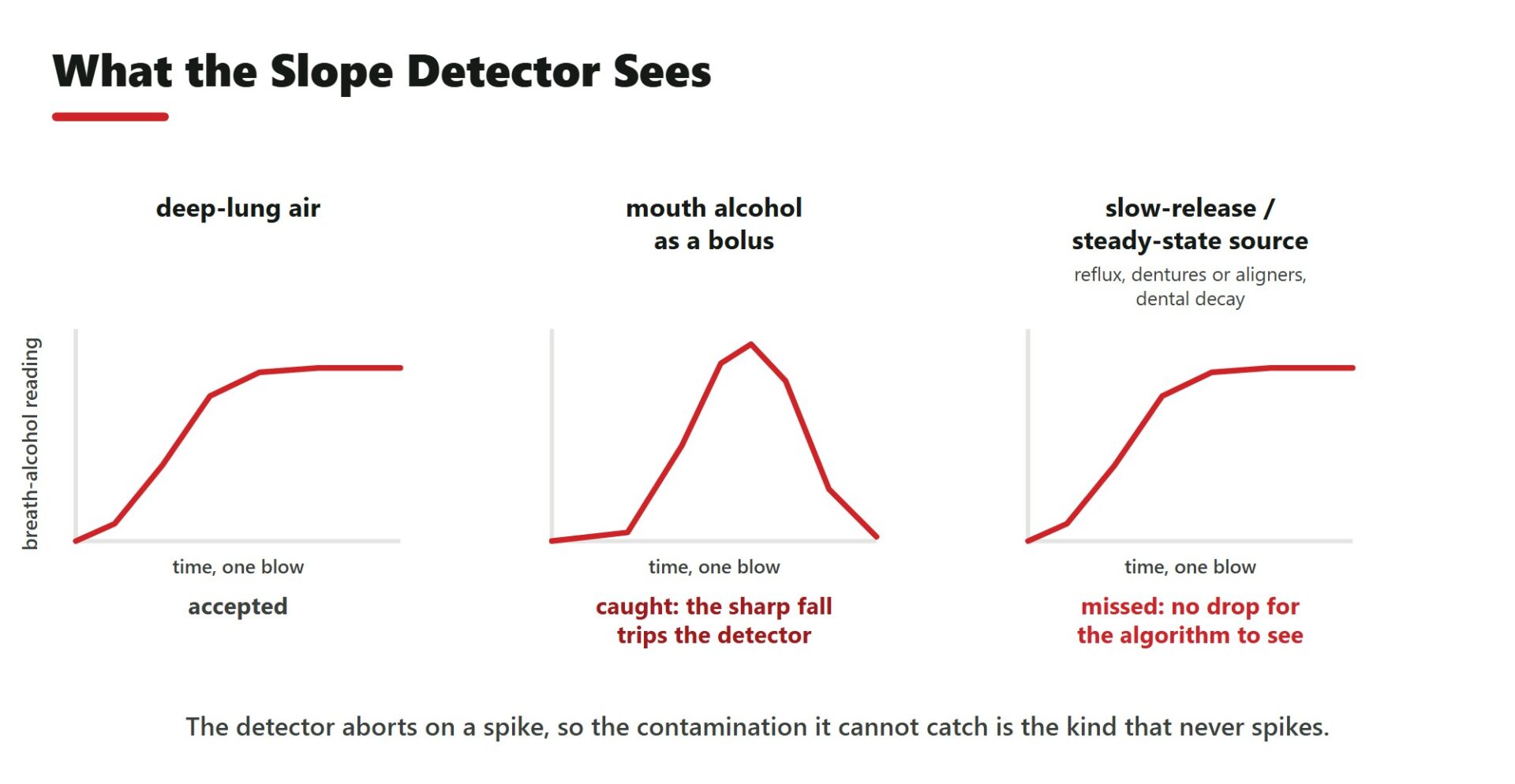
A reliable breath sample has a shape. As deep lung air reaches the Intoxilyzer 8000, the alcohol concentration rises and then levels off into a plateau. The machine watches that shape with a slope detection system, and the shape is one of the things that separates a real reading from a contaminated one.
Mouth alcohol breaks the pattern. Instead of a slow rise to a plateau, it produces a sharp spike that falls away as the mouth clears. The slope detector is supposed to see that falling profile and reject the sample. The defense question is whether it did.
What the Slope Detector Watches
The Intoxilyzer 8000 accepts a breath sample only when it meets three criteria: enough time, enough volume, and the right slope. Slope is the rate at which the alcohol concentration changes while you blow. The machine tracks the voltage coming off its infrared detector and looks for a sample that rises and then settles. A pressure switch holds the reading for several seconds while the microprocessor watches that rate of change. A slow rise to a plateau signals deep lung air. A spike that falls away signals something else.
A clean sample of deep lung air climbs and levels off. Mouth alcohol enters the chamber at a much higher concentration, so it spikes early and then falls. That falling, negative slope is what the detector is built to catch and reject.
Do not miss this
A breath reading at or above 0.08 also starts the 10-day license clock.
A breath result over the limit triggers an administrative suspension on top of the criminal case. You have 10 days from the arrest to demand a formal review hearing with the DHSMV in Clearwater, which protects your license and can secure a 42-day permit. We file that request the same day you hire us. Call or text (727) 761-4318.
Why Mouth Alcohol Looks Different
Deep lung air arrives steadily, so a clean sample climbs and plateaus. Mouth alcohol sits in the mouth and airway at a much higher concentration, so it hits the chamber early and hard, then drops as it dissipates. That produces a spike followed by a falling, or negative, slope. When the machine sees that, it is supposed to print SLOPE NOT MET and abort the test rather than report a number. Where that mouth alcohol comes from, from reflux to dental work, is covered on the mouth alcohol page.
Where the Defense Lives
The safeguard is only as good as its execution. A slope detector can accept a sample that was still partly contaminated, and the detailed slope data is not always printed on the affidavit you receive. We look at the sample’s profile, the codes the machine logged, and the conditions of the test, including anything in the 20-minute window that could have introduced mouth alcohol. A reading that cleared the slope check is not automatically a clean reading.
Why This Matters in Your Case
Slope detection ties the machine’s own design to a human reality: reflux, dental work, and a rushed observation period happen. When the science and the records suggest mouth alcohol reached the chamber, the slope data is where it shows, and that gives a jury a concrete reason to question the number. This works hand in hand with the 20-minute observation period.
How Slope Detection Works
As you exhale, the instrument watches how the alcohol concentration changes over the course of the breath. A true sample climbs and then levels off as deep lung air arrives, giving a rising curve that flattens into a plateau. Mouth alcohol behaves differently. Because it is a concentrated pocket that empties quickly, it produces a sharp early peak that then falls, a decreasing slope. The software is built to notice that falling slope and flag the sample, on the theory that a real breath does not behave that way.
The shape the machine is looking for
Slope detection is really about the shape of your breath over the few seconds of the test. As you blow, the alcohol reading is supposed to climb and then flatten into a plateau, which is the signature of deep-lung air arriving steadily. That rise-and-plateau shape is what the machine is built to accept. Mouth alcohol behaves differently. It tends to come in as a sharp spike, a quick rise and then a fall, because it is a small pocket of alcohol near the mouth rather than a steady stream from the lungs, and the slope detector is supposed to recognize that spike and reject the sample. When a reading does not show the expected shape, the machine can flag it as Slope Not Met and refuse it, and that flag is written into the electronic record. The shape of the sample, in other words, is itself a piece of evidence, and it is one the raw data preserves.
The detector compares the shape of your exhale to what a true breath should look like. A peak that falls away signals mouth alcohol, and the sample should be rejected.
Where It Fails
Slope detection is a useful check, not a guarantee. It can miss mouth alcohol that is small, that arrives at the wrong moment in the breath, or that blends into the curve rather than forming an obvious peak. It also depends on the instrument working as intended and on its settings. A passing sample is not proof that mouth alcohol was absent. It only means the software did not catch a falling slope, which is a narrower thing than a clean breath.
What We Request
We ask for the breath-flow and slope data the instrument captured, not just the final number, so the shape of your exhale can be examined. Read together with the observation period and the possibility of mouth alcohol, that data shows whether the safeguards did their job in your test or simply did not fire.
The slope detector is often described as the machine’s built-in defense against mouth alcohol, and I treat it as a safeguard with limits rather than a guarantee. I look at the shape of your samples and at whether the machine flagged any slope problems, because a reading that did not rise and plateau the way deep-lung air should is a reading worth questioning. I know how this system is supposed to work and where it can be fooled, and I go to the underlying data rather than trusting that the safeguard caught everything it was meant to.
I started out as an Assistant Public Defender in Florida’s Thirteenth Judicial Circuit, in Tampa, and today I am one of six ACS-CHAL Forensic Lawyer-Scientists in Florida and a Faculty member of the National College for DUI Defense, with forensic training in how these instruments work. A breath result is an estimate produced by a machine, and I read its calibration history, its agreement checks, and the assumptions built into the number, so I can show a jury where it does not hold up. Learn more about my background.
Questions About Slope Detection
What is slope detection in a breathalyzer?
It is the Intoxilyzer 8000’s check on the shape of your breath sample. A valid sample’s alcohol concentration rises and then levels off, and the machine watches the rate of change to confirm that pattern.
How does slope detection relate to mouth alcohol?
Mouth alcohol produces a sharp spike that then falls, a negative slope. The slope detector is designed to catch that profile and reject the sample, printing SLOPE NOT MET and aborting the test.
Does passing the slope check mean my test was accurate?
Not necessarily. The detector can still accept a partly contaminated sample, and the full slope data is not always on the printout, so the result is worth examining.
Can the slope data be reviewed in my case?
Yes. We look at the machine’s logged codes and the sample profile, along with the observation period and your medical history, to see whether mouth alcohol affected the reading.
Related: the main breath test defense page, how we challenge a breath test, and mouth alcohol. See also how the 9000 handles the same problem.
Does the number match your night? The BAC estimator runs what you say you drank through both the Widmark equation and the more accurate Watson body-water model, as ranges rather than false-precision numbers, then sets the result against what the machine printed. A reading well above that range is a reason to pull the instrument records.
This page is general information, not legal advice, and it does not create an attorney-client relationship. Breath testing in Florida is governed by Fla. Stat. 316.1932 and 316.1934 and the Florida Administrative Code chapter 11D-8. Procedures and rules change, and every case turns on its own facts. Past results do not guarantee a similar outcome.