
A breath result is printed as a single, exact-looking number. Every measurement ever made carries uncertainty, and a breath test is no exception. The honest way to read a 0.08 is as a range, not a point.
When the reported number sits close to the legal limit, that uncertainty can be the whole case. The true value may fall on the other side of 0.08.
Every Measurement Has a Margin of Error
In any laboratory, a measurement is reported with its uncertainty, the band around the result where the true value is likely to sit. Forensic science standards call for exactly that. A breath machine prints a clean number and hides the band. That does not mean the band is not there.
A result reported just over the limit carries a band of uncertainty around it. When part of that band falls below 0.08, the true value may have been under the legal limit. The size of the band depends on the instrument and the conditions, and it is not printed on the card.
Do not miss this
A breath reading at or above 0.08 also starts the 10-day license clock.
A breath result over the limit triggers an administrative suspension on top of the criminal case. You have 10 days from the arrest to demand a formal review hearing with the DHSMV in Clearwater, which protects your license and can secure a 42-day permit. We file that request the same day you hire us. Call or text (727) 761-4318.
Florida’s Own Rule Admits the Spread
Florida requires two breath samples, and it treats them as valid when they agree within 0.020 of each other. That tolerance is the State’s own acknowledgment that the same person, on the same machine, minutes apart, produces different numbers. A result reported as 0.08 carries that built-in spread.
The state’s own paperwork concedes the spread
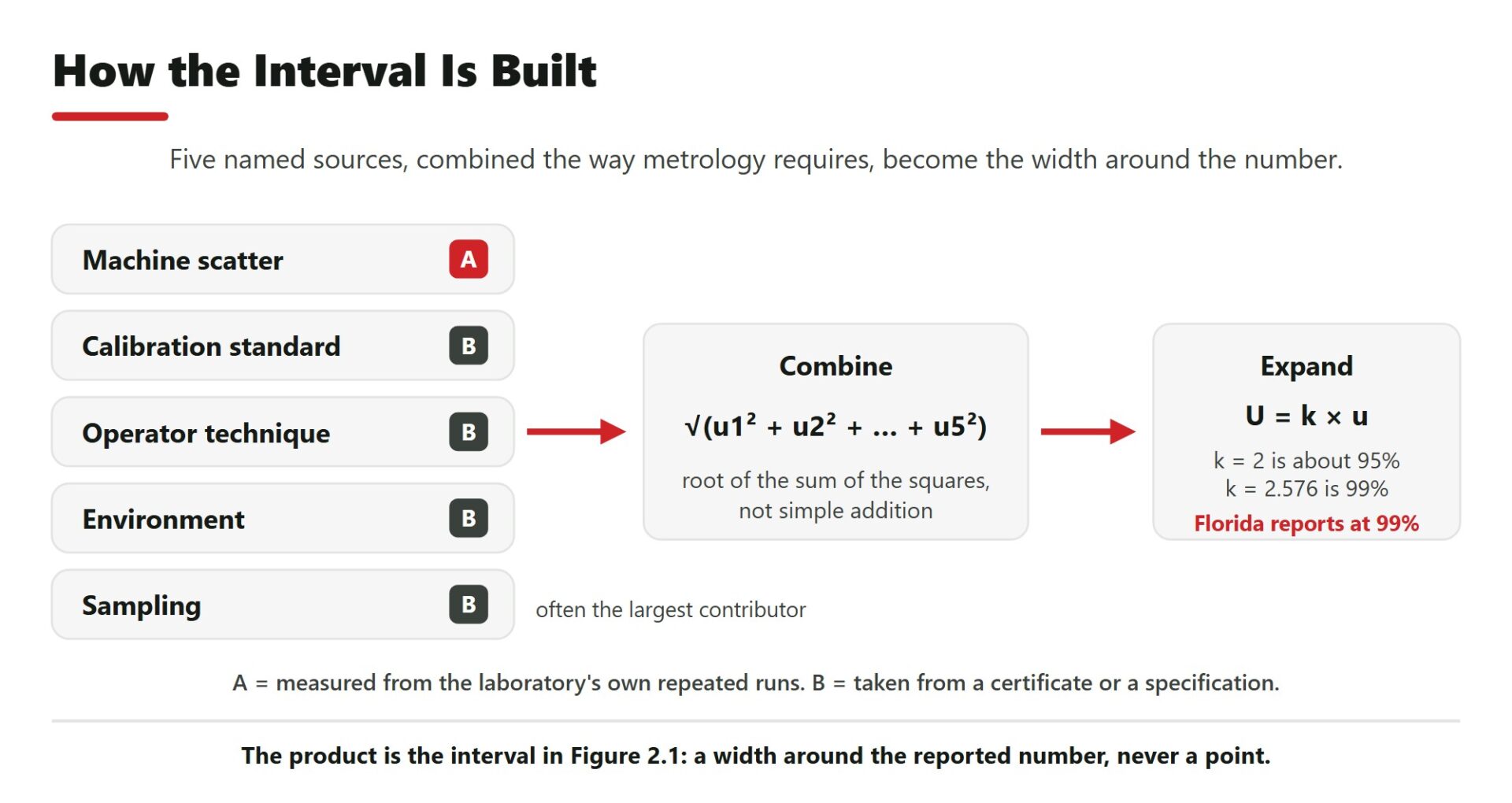
You do not have to take the margin on faith, because the state puts it in writing. FDLE’s calibration certificate for a breath instrument reports a measurement uncertainty for the machine, a plus-or-minus band around its readings, stated at a high level of confidence. That is the testing program itself saying a reported number is a range, not a single exact point. It sits right alongside the agreement rule already discussed, where the state expects two readings of the same person, minutes apart, to differ and builds a tolerance for exactly that. A system that expects its own readings to spread has already conceded the number is not a precise, single truth, and near a legal line that spread is not academic, it can be the difference in your case.
What Widens the Band
Several things push the uncertainty wider. Radio frequency interference from nearby radios or electronics can affect the reading. Your blood composition, including the proportion of red blood cells, changes the relationship between blood and breath. Breath temperature and the assumed partition ratio add their own error. Each one moves the true value away from the printed number.
Why This Matters in Your Case
When the State’s number is close to 0.08, the margin of error can mean the true value was under the limit. Presenting the result as the range it really is, with the records and the science to support it, gives a jury room for reasonable doubt.
The Two-Sample Rule Is an Admission of Spread
Florida requires a valid breath test to capture two separate samples, and it accepts the result only if the two readings agree within 0.02 of each other. That tolerance is built into the rule for a reason. The state itself expects two breaths from the same person, minutes apart, to disagree by as much as 0.02. A method that can disagree with itself by that margin is not delivering a single exact value. The agreement window is the program’s own admission that a breath number carries spread.
When the margin of error around a reported value reaches below 0.08, the true level may have been under the limit, and the burden is on the state to prove it was over.
A Range, Not a Point
Every measuring instrument has a margin of error, and a breath instrument is no exception. Calibration, the condition of the machine, and the agreement tolerance all contribute spread. An honest way to read a breath result is as a value plus or minus an amount, not as a single exact figure. The number printed on the card is the center of that window. Whether the window stays above 0.08 is a real, answerable question, and the answer can decide a per se case.
Near the Limit It Decides the Case
Florida’s limit is a hard line at 0.08, and the law treats a number at or above it very differently from one below. When a reported value sits close to the line and the margin of error dips beneath it, the state is asking a jury to convict on a figure that may have been under the limit. The defense does not have to prove the level was under 0.08. The state has to prove it was over, and an honest accounting of the margin of error can make that proof much harder. It pairs naturally with the partition ratio and breath temperature, which push in the same direction.
A breath result looks like a hard, exact number, and the science and the state’s own paperwork both say it is a range. I point to FDLE’s reported uncertainty and to the 0.020 agreement rule, because both are the state admitting its readings carry spread. When your number sits close to a legal line, I make sure the jury sees the whole band around it and not just the single figure, since the honest question is not what the machine printed but where your true level fell.
I started out as an Assistant Public Defender in Florida’s Thirteenth Judicial Circuit, in Tampa, and today I am one of six ACS-CHAL Forensic Lawyer-Scientists in Florida and a Faculty member of the National College for DUI Defense, with forensic training in how these instruments work. A breath result is an estimate produced by a machine, and I read its calibration history, its agreement checks, and the assumptions built into the number, so I can show a jury where it does not hold up. Learn more about my background.
Questions About the Margin of Error
Are breathalyzers accurate?
An evidentiary breath instrument is precise, which is not the same thing as accurate for the person blowing into it. It will reliably report nearly the same figure twice, and it still rests on population averages for the blood to breath ratio, breath temperature, and breathing pattern. The question in a given case is not whether the machine is broadly reliable. It is how far the assumptions built into that particular reading could sit from the person who produced it.
Does a breath test have a margin of error?
Yes. Every measurement carries uncertainty. A breath result is best understood as a range around the printed number, not a single exact value.
What is the breath test margin of error in Florida?
Florida does not print an uncertainty band on the result, but its own rule allows the two required breath samples to differ by up to 0.020 and still count, which reflects the machine’s built-in variability. The real uncertainty depends on the instrument and the conditions.
What can increase the error in a breath reading?
Radio frequency interference, blood composition, breath temperature, and the assumed partition ratio can all widen the gap between the printed number and your true level.
Can the margin of error help my case?
Yes. When your result is close to 0.08, accounting for measurement uncertainty can show that your true level may have been under the legal limit.
Does a breath result have a margin of error?
Yes, and the state acknowledges it. FDLE’s calibration certificate reports a measurement uncertainty for the instrument, and the rules require two samples to agree only within 0.020, which is a built-in tolerance for spread. Near a legal line, that margin can put a result on both sides of the line.
Related: the main breath test defense page, how we challenge a breath test, and the partition ratio. See also the uncertainty figure the 9000 prints.
Every case and study behind this analysis is indexed publicly in the Florida DUI Reference, with most linked straight to the opinion on CourtListener or the paper on PubMed.
From the Trial Manual
Build the near-limit file before the hearing, not at it. Obtain the uncertainty statement for the specific instrument in your case, and the calibration certificate that carries the expanded uncertainty, its coverage factor, and the confidence level that factor represents. At the hearing, attach that reported uncertainty to your client’s number, widen it for the sources a real subject test adds, and put the only question that decides the per se element: does the band cross 0.08?
That note is written for lawyers. It is from The Florida DUI Trial Manual, Ch. 2, Measurement Uncertainty.
Does the number match your night? The BAC estimator runs what you say you drank through both the Widmark equation and the more accurate Watson body-water model, as ranges rather than false-precision numbers, then sets the result against what the machine printed. A reading well above that range is a reason to pull the instrument records.
This page is general information, not legal advice, and it does not create an attorney-client relationship. Breath testing in Florida is governed by Fla. Stat. 316.1932 and 316.1934 and the Florida Administrative Code chapter 11D-8. Procedures and rules change, and every case turns on its own facts. Past results do not guarantee a similar outcome.