A DUI case is not one decision but a chain of them. Each link, from the reason for the stop to the validity of the test, is a place to challenge the State’s proof.
The Stop Is the First Domino
Every DUI case starts with one decision: the choice to pull you over. That decision is also the most overlooked place to win, because if the stop was unlawful, the courtroom remedy reaches almost everything that came after it. The driving pattern, the field sobriety exercises, the officer’s observations, the breath or blood result, and even a refusal can be suppressed as fruit of an illegal stop. A case that looks airtight at the breath machine can come apart at the moment the lights came on.
That is why the stop is the first thing I examine in a DUI, before the test, before the exercises, before anything else. The deep Fourth Amendment law on stops lives in our search and seizure section. This page is about how those rules play out in a DUI specifically.
What Makes a DUI Stop Lawful
An officer needs a lawful reason to stop you, and in a DUI that reason is usually one of two things: a traffic infraction the officer witnessed, such as speeding, a broken light, or an improper lane change, or a reasonable suspicion, built on specific and articulable facts, that the driver is impaired. A hunch is not enough. Florida measures the stop by an objective standard, asking whether the facts in the record justified it, not what the officer was thinking, a test the Florida Supreme Court set out in Dobrin v. Department of Highway Safety and Motor Vehicles, 874 So. 2d 1171 (Fla. 2004).
The officer’s private motive does not control. Under Whren v. United States, 517 U.S. 806 (1996), a stop is valid if there was probable cause of a traffic violation, even if the officer’s real interest was looking for a DUI. That cuts both ways. It means a pretext argument alone rarely wins, and it also means the State has to prove the violation it claims justified the stop. If the supposed infraction does not hold up, the stop falls with it. The traffic stops and pretext page covers this in depth.
Free guide No. 01
The Beginning of a DUI Case
Arrested for DUI in Florida? The clock on your license started the night you were arrested. This free guide explains the stop, the arrest, and your critical first 10 days. One request unlocks the whole Safir Guides library.
The Driving Pattern Is Not as Damning as It Sounds
Officers lean on a familiar list of driving cues, weaving, drifting, wide turns, braking without reason, and driving well under the limit. Those cues come from roadside research, and they are far softer than they get treated. Weaving within a single lane, on its own, is often not enough to justify a stop, and many of the cues describe driving that sober, tired, or distracted people do every day. Florida courts have upheld stops where weaving was paired with something more, as in Ingram v. State, 928 So. 2d 423 (Fla. 1st DCA 2006), where the driver weaved within the lane and then ran completely off the road, along with other signs of impairment. The question is always whether the whole picture rose above a hunch, and the dash and body camera usually tell that story better than the report.
The Anonymous Tip Stop
A growing number of DUI stops begin with a 911 caller reporting a possible drunk driver. A tip like that can support a stop, but only if it carries enough reliability, which usually means the officer corroborates it before pulling anyone over. An anonymous report, without the officer confirming the described driving or some detail that shows the tipster knew what they were talking about, can be too thin to justify the stop. Where the stop rests on a bare tip and nothing more, that is an opening.
When a Traffic Stop Becomes a DUI Investigation
Most DUI stops do not start as DUI stops. They start as a routine traffic stop that the officer extends into an impairment investigation. The law allows that, but only so far. A stop can last no longer than the time reasonably needed to handle the reason for it, and it can be prolonged only if the officer develops a reasonable suspicion, on articulable facts, that the driver is impaired. Holding a driver to fish for a DUI, after the reason for the stop is finished and without that added suspicion, is an unlawful detention. Our prolonged detention page walks through where that line sits.
| Stage | What the law requires | Where it fails |
|---|---|---|
| The stop | Reasonable suspicion of a violation or of impairment | A hunch, a miscalled infraction, or weaving within one lane alone |
| The detention | No longer than the stop’s purpose, unless DUI suspicion arises | Holding a routine stop open to fish for a DUI |
| The arrest | The officer must witness the elements, or an exception applies | An arrest built on a civilian account the officer never confirmed |
A defect at any stage can suppress the evidence that followed it.
The Arrest Has Its Own Rule
Florida limits when an officer can make a warrantless arrest for misdemeanor DUI. As a general matter the officer has to personally witness the elements, meaning the driving or the actual physical control plus the impairment, with two main exceptions, a crash the officer is investigating and the fellow officer rule, where several officers’ observations combine. This is why a DUI built on a bystander’s account of driving, which the officer never confirmed, is vulnerable. It also connects directly to the situation where police never saw anyone drive at all. The actual physical control page covers that scenario and the defenses that come with it.
Why This Matters to the Rest of Your Case
The stop is an advantage that nothing downstream can replace. Win a suppression motion on the stop and the State usually loses the exercises, the test, and the refusal in one stroke, because all of it flowed from a seizure that should never have happened. Lose sight of the stop and you are left fighting the breath result on its own terms, which is harder ground. I work the case from the first second of contact precisely because that second often decides everything after it.
Related: Reasonable suspicion for a stop, DUI checkpoints and roadblocks, Field sobriety exercises, Breath test defense, Actual physical control, and Welfare-check stops.
I started out as an Assistant Public Defender in Florida’s Thirteenth Judicial Circuit, in Tampa, and today I am one of six ACS-CHAL Forensic Lawyer-Scientists in Florida. Every DUI I take gets rebuilt from the first contact forward, the stop, the exercises, the arrest, and the test, because a problem at the front of the case reaches everything that comes after it. Learn more about my background.
Listen
Not every DUI case starts with a driving pattern. A recent episode of my podcast covers a Hillsborough case that began with a parked truck and a call about a man passed out behind the wheel, and it turns on the difference between an officer checking on someone and an officer investigating them. The deep dive walks the moment a welfare check ends and what has to exist for anything after it to be lawful, in the caselaw edition of Reasonably Safir.
Listen
The testimony supporting a DUI stop: Show Your Work, the September 18, 2026 caselaw edition of Reasonably Safir. Audio, opinions, and full transcript.
Listen
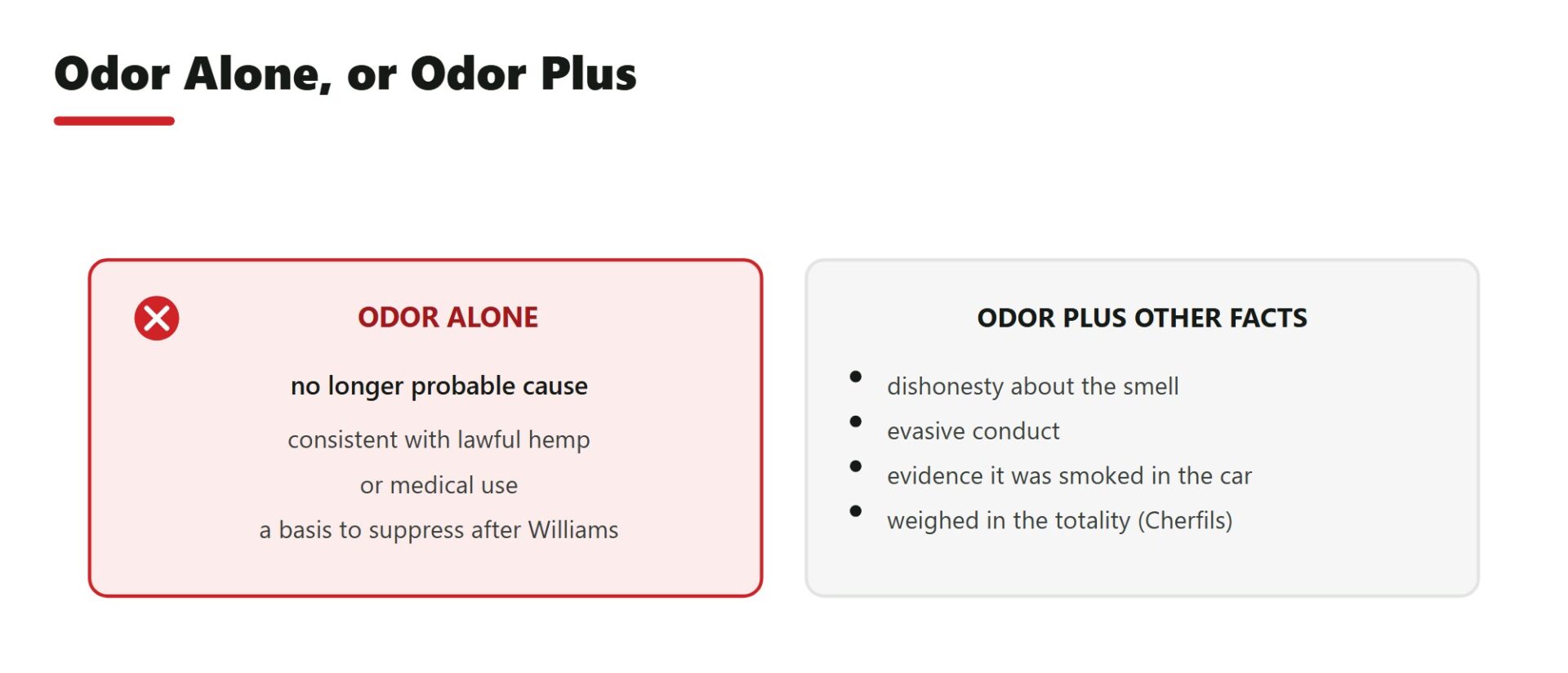
A recent episode of my podcast covers two First District traffic stop decisions from the same day: one on ordering a driver out of the car so a drug dog can work, and one on the smell of burned cannabis as probable cause. It’s in the caselaw edition of Reasonably Safir.
Common Questions
Can the police pull me over for a DUI without seeing a traffic violation?
Only with reasonable suspicion of impairment based on specific facts, not a hunch. A stop usually rests on a witnessed traffic infraction or on articulable signs of impaired driving. Florida judges the stop by an objective standard from Dobrin v. Department of Highway Safety and Motor Vehicles, asking whether the record justified it.
Is weaving enough to justify a DUI stop?
Often not by itself. Weaving within a single lane, standing alone, is frequently too thin, and many driving cues describe what tired or distracted sober drivers do. Florida courts have upheld stops where weaving was paired with more, such as leaving the road and other signs, as in Ingram v. State.
What happens if my DUI stop was illegal?
If the stop was unlawful, the evidence that followed it can be suppressed as fruit of the illegal stop. That can include the field sobriety exercises, the officer's observations, the breath or blood result, and even a refusal. A successful motion on the stop often takes down the whole case.
Can an officer hold me to investigate a DUI after a routine traffic stop?
Only as long as the stop's original purpose reasonably takes, unless the officer develops a reasonable suspicion of impairment on articulable facts. Extending a finished traffic stop to fish for a DUI, without that added suspicion, is an unlawful detention.
Does it matter that the officer really just wanted to check for a DUI?
Under Whren v. United States, the officer's private motive does not invalidate a stop that was supported by probable cause of a traffic violation. The flip side is that the State still has to prove the violation it relied on, and if that does not hold up, neither does the stop.
From the Trial Manual
Start the motion by fixing the moment of seizure. Lay the stop out on a timeline and mark the exact point where a reasonable person would no longer feel free to leave; that point sets what the officer had to justify and what he can be held to. Measure every later step, the request to step out, the exercises, the arrest, from that mark, and where the record shows the impairment questions began only after the traffic business was done or reasonably could have been, you have the added-time ground the prolongation rule protects.
That note is written for lawyers. It is from The Florida DUI Trial Manual, Ch. 18, The Stop.
The video and the policy are both public. Where each Tampa Bay agency keeps them, including the St. Petersburg police General Orders in full: the recording policy, the hospital procedure behind a blood draw, and the search and evidence rules.
From the blog: the detection script police follow, and where it breaks, the grading started before you stepped out of the car.
This page is general information about Florida law, not legal advice, and it does not create an attorney-client relationship. The lawfulness of a stop and an arrest turns on the Fourth Amendment and on Florida statutes including sections 316.193 and 901.151, and the decisions discussed here are fact-specific. Outcomes depend on the particular record, deadlines are short, and the law changes, so confirm current requirements with an attorney. Past results do not guarantee a similar outcome.