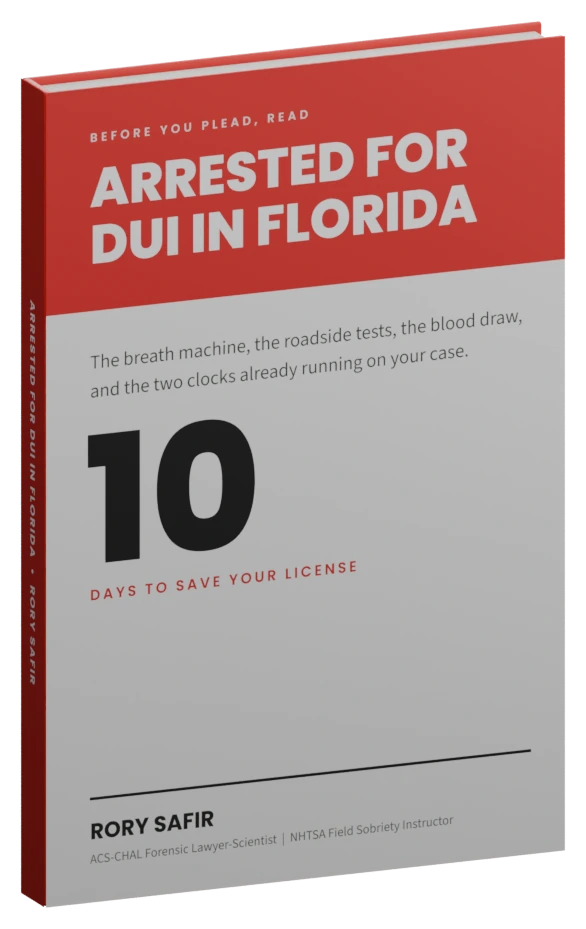

A Florida DUI arrest starts two cases at once. The license case runs through the Department of Highway Safety and Motor Vehicles, and the criminal case runs through the county court. They have different deadlines, and winning one does not end the other.
Step through the stages below to see what happens at each one, when it happens, and the rule behind it. Tap a stage on the timeline or use the arrows.
Criminal case (county court)
License case (DHSMV)
-
The stop and the arrest
Both cases
When: Day 0
An officer needs a lawful reason to stop the car and probable cause to make a DUI arrest. You are not legally required to perform roadside field sobriety exercises, and declining them is not a crime. After a lawful arrest, Florida’s implied consent law asks for a breath, blood, or urine test. Refusing a lawful breath or urine test is a crime of its own, on top of a license suspension.
Rule: Fla. Stat. ss. 316.193, 316.1932 and 316.1939
Read more: Florida Implied Consent and DUI Test Refusal
-
Booking and release
Criminal case (county court)
When: The first hours
A person arrested for DUI cannot be released until the person is no longer impaired, the breath or blood alcohol level is below 0.05, or 8 hours have passed since the arrest. For many misdemeanors a bond can be posted from the jail on a standard schedule. Anyone still held sees a judge at first appearance within 24 hours of arrest, where the judge explains the charge and sets the terms of release.
Rule: Fla. Stat. s. 316.193(9); Fla. R. Crim. P. 3.130 and 3.131
Read more: Bond and Pretrial Release in Florida
-
The 10-day window
License case (DHSMV)
When: Day 0 to Day 10
The citation the officer hands you is also your notice of suspension and a temporary permit to drive. The permit expires at midnight on the 10th day after the notice was issued. Within those 10 days you can demand a formal review hearing, ask for a paper-only informal review, or take the waiver review for an immediate hardship license. The waiver review gives up the hearing, and it is open only to a first DUI with no prior DUI conviction, DUI license suspension, or commercial license disqualification. Letting the 10 days pass gives up the right to challenge the suspension. The suspension itself runs 6 months for a first result of 0.08 or higher and 1 year for a first refusal, and longer after an earlier suspension.
Rule: Fla. Stat. s. 322.2615(1)(b); s. 322.271(7)
Read more: The 10-Day Decision After a DUI
Read more: Florida DUI License Deadline Checker
-
The formal review hearing
License case (DHSMV)
When: Scheduled within 30 days of the request
The Department must schedule the hearing within 30 days after it receives the request, or the suspension is invalidated. A hearing officer, not a judge, decides a short list of questions set by the statute, such as whether the officer had probable cause and whether the result was 0.08 or higher or a test was refused. The hearing does not decide guilt. If the arresting officer or the breath technician is subpoenaed and fails to appear, the suspension is invalidated.
Rule: Fla. Stat. s. 322.2615(6), (7), (9) and (11)
Read more: The DUI Formal Review Hearing
-
Arraignment
Criminal case (county court)
When: After the formal charge is filed
Arraignment is where the court reads the formal charge and asks for a plea. When a lawyer files a written plea of not guilty at or before arraignment, the arraignment is waived. The clerk also gives notice that a conviction means the court will suspend or revoke the driver license.
Rule: Fla. R. Crim. P. 3.160(a); Fla. Stat. s. 316.193(8)
-
Discovery
Criminal case (county court)
When: After the formal charge is filed
The defense can choose to take part in discovery by filing a Notice of Discovery. Within 15 days after it is served, the prosecutor must disclose the names of people who know about the case, the police reports, any statements by the accused, test results and other scientific reports, whether there was a search, and the papers and objects the State plans to use. Choosing discovery also obliges the defense to share some of its own material. Apart from all of that, the prosecutor must disclose information that tends to show the accused is not guilty.
Rule: Fla. R. Crim. P. 3.220(a) and (b)
-
Pretrial motions
Criminal case (county court)
When: Before trial
A motion to suppress asks the court to exclude evidence obtained through an unconstitutional stop, search, or seizure. It is decided at a hearing where the officers testify. In a DUI case the evidence that matters most, such as the test result or a statement, usually comes from a search or a seizure.
Rule: Fla. R. Crim. P. 3.190; Fourth Amendment; Art. I, s. 12, Fla. Const.
Read more: The Motion to Suppress
-
The speedy trial clock
Criminal case (county court)
When: 90 days for a misdemeanor
Without a demand, the State has 90 days to bring a misdemeanor to trial and 175 days for a felony, counted from the formal charge. In DUI and other criminal traffic cases, when the clock starts is set by a traffic court rule that changes on January 1, 2027, so ask how it is being counted in your case. When the time runs out, the defense files a notice, the court holds a hearing within 5 days, and unless the court finds a reason the rule allows, the State then has 30 days to begin trial. A continuance asked for by the defense generally waives or extends the time.
Rule: Fla. R. Crim. P. 3.191(a) and (o); Fla. R. Traf. Ct. 6.160
Read more: The Speedy Trial Right in Florida
-
Plea or trial
Criminal case (county court)
When: After discovery and motions
A case can end in a dismissal, a plea, a trial, or, in counties that offer one, a diversion program. Whether to accept a plea or go to trial is the client’s decision, made with the lawyer’s advice.
Read more: The Florida DUI defense page (diversion programs by county)
-
Sentencing on a first DUI
Both cases
When: Only after a conviction
For a first DUI with a level under 0.15 and no passenger under 18, the statute sets a fine of $500 to $1,000, up to 6 months in jail, probation of up to 1 year with at least 50 hours of community service, a 10-day vehicle impoundment, and DUI school with an evaluation. The court also revokes the driver license for 180 days to 1 year. Florida courts cannot withhold adjudication on a DUI.
Rule: Fla. Stat. ss. 316.193(2)(a), (4), (5) and (6); s. 322.28(2)(a)1; s. 316.656
Read more: DUI Suspension and Revocation Calculator
What this page is not
This page walks through the usual order of a first DUI case in Florida. Real cases do not always follow it: some steps happen together, some are skipped, and local practice differs from county to county. It is general information, not legal advice, and it does not create an attorney client relationship. Rules checked against the Florida Statutes and the Florida Rules of Criminal Procedure in November 2026.