The field sobriety exercises can look damning in a police report and mean very little once you understand how they work. Their accuracy was only ever measured under controlled conditions with trained administrators following the procedure exactly, and a real roadside is not that. Under State v. Meador, 674 So. 2d 826 (Fla. 4th DCA 1996), the physical exercises come in only as the officer’s lay observations, which is the right frame for everything on this page.
There are five places a result comes apart, and this gate takes each in turn: how the exercise was administered, who you are physically, where and when it happened, how the clues were counted, and how far the science behind the eye test reaches. In most cases more than one applies.
Any one of these can pull a result away from the controlled conditions under which the exercises were validated. In a real case there is usually more than one.
Unreliable does not mean excluded
In Florida the exercises usually reach the jury even when there were real problems with them, and the problems go to weight rather than admissibility. That is not a dead end. It means the work happens at cross-examination and in closing, where a specific, well-explained deviation from a national standard becomes reasonable doubt a jury can hold onto.
Four places the reliability breaks down
Reliability comes apart in several places, and a DUI defense works each of them. The first is administration, because the standardized battery holds whatever validity it claims only when the officer follows the protocol he was trained on, and the agency’s own manuals once warned in bold that changing any element compromises the result. The second is conditions, because the studies were run on a level, dry, well lit surface, while the shoulder of a road at night, in the cold, with traffic going by, is a different world. The third is scoring, because a clue is a yes or no checkbox rather than a measurement, the thresholds are low, and a single extra mark can move you across the line. The fourth is the science itself, because horizontal gaze nystagmus is treated as scientific evidence in Florida and has many causes that have nothing to do with alcohol.
The legal frame ties these together. In State v. Meador, the court let officers describe roadside performance as a lay observation while recognizing that there is no reliable numerical correlation between that performance and impairment, and it held that horizontal gaze nystagmus is scientific evidence that needs a proper predicate before a jury hears it. Florida does not throw out an imperfect roadside investigation on its own, so the deviations usually go to the weight a jury should give the evidence rather than to whether the jury hears it at all. That is where a trained cross-examination does its work, and as an NHTSA field sobriety instructor I can show the jury where the officer left the standard.
I started out as an Assistant Public Defender in Florida’s Thirteenth Judicial Circuit, in Tampa, and today I am one of six ACS-CHAL Forensic Lawyer-Scientists in Florida and an NHTSA-qualified field sobriety instructor. I was trained to administer this battery and to teach the officers who give it, so I can stand in front of a jury and show the exact point where the roadside exercises in your case left the standard. Learn more about my background.
The five challenges, in depth
Questions About Reliability
Why are field sobriety tests considered unreliable?
Because their accuracy depends on perfect administration under controlled conditions, and a real roadside rarely provides that. Officer deviations, medical conditions, the surface and lighting, scoring mistakes, and the limits of the eye test all chip away at the result.
Are the tests still used if they are unreliable?
Yes. In Florida the exercises usually come in as evidence even when there were problems, and those problems go to how much weight the jury should give them. That is why the challenge happens at cross-examination and in argument.
What is the single biggest weakness?
Administration. The exercises are only valid when given exactly as trained, so a deviation from the standardized procedure is often the strongest point, especially when explained by someone who teaches the procedure.
Does a low score mean I was impaired?
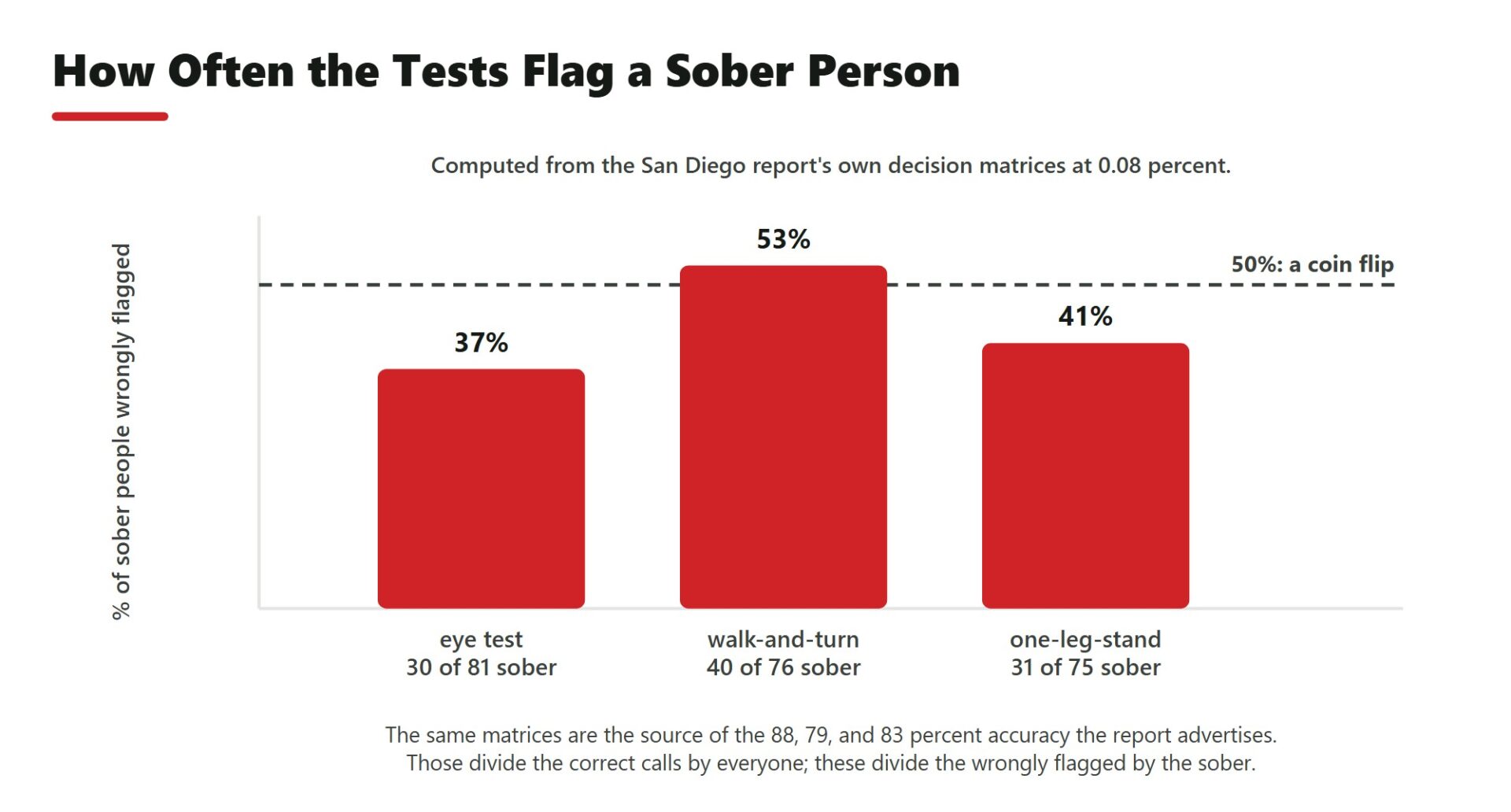
Not necessarily. A clue is a checkbox, not a measurement, and many sober people produce clues because of nerves, the surface, footwear, age, or a medical issue. The original studies misclassified a sizable share of people even when done right.
How do you build the challenge?
I work through each of these five areas against the video and the report, isolate the ones that apply to you, and present them so the jury sees a few minutes of imperfect roadside performance for what it is.
Related: the three standardized tests, the non-standardized exercises, the NHTSA standard, field sobriety in your case, and the field sobriety overview.
This page is general information, not legal advice, and it does not create an attorney-client relationship. Field sobriety exercises in Florida are governed by case law including State v. Meador, 674 So. 2d 826 (Fla. 4th DCA 1996), and by section 316.193, Florida Statutes. Procedures and rules change, and every case turns on its own facts. Past results do not guarantee a similar outcome.