If you were attacked on someone’s property, two legal cases were born that night. The State opened one: the prosecution of your attacker. The other belongs to you: a civil claim against the property whose security failures let it happen. Most victims are told plenty about the first and nothing about the second, and almost nobody explains how the two feed each other. That is this page.
What the criminal case gives your civil case
A prosecution generates evidence no civil lawyer could affordably create: police reports and body camera footage from the first minutes, crime scene photographs, witness statements taken while memories were fresh, detective work connecting the attacker to the property, and sworn testimony. A conviction, and in most circumstances a guilty plea, can come into the civil case as powerful proof of what happened. Even charging documents and probable cause affidavits map the event in detail. For the foreseeability side, the same criminal justice system holds the property’s history: calls-for-service, prior arrests at the address, and the pattern that shows what the owner should have seen coming.
What the criminal case cannot do for you
It cannot compensate you. Restitution orders exist, and as a victim you have the right to seek one, but they are limited to the defendant’s ability to pay, which is usually nothing. The prosecutor represents the State, not you, and outcomes serve public interests: a plea that resolves the docket may say little about your losses. The civil case against the property owner, and its insurance, is where medical bills, lost income, and the human damage actually get addressed.
Your rights inside the prosecution
Florida’s victim rights amendment, adopted as Marsy’s Law, gives crime victims enforceable rights: to be notified of proceedings, to be heard at critical stages, to confer with the prosecution, to restitution, and to certain privacy protections. Exercising those rights takes attention, because busy systems honor them unevenly. Part of my job in these cases is making sure the prosecution treats you as a participant rather than a file number, while the civil case moves on its own track.
The timing traps between the two cases
Waiting for the criminal case to finish feels natural and is usually a mistake. Your civil deadlines run regardless, generally two years for the negligence claim against the property, and the property’s video and records erode long before any verdict. There are also strategic wrinkles: an attacker with charges pending will invoke the Fifth Amendment in civil discovery, which cuts both ways, and coordinating what happens when requires someone watching both boards. The cases should run in parallel, deliberately.
Why a criminal defense background changes this work
I spent my early career as an Assistant Public Defender in Tampa, trying cases inside the same system that is now prosecuting your attacker. I know how police reports get written and what they leave out, how prosecutors evaluate cases, what a plea posture signals, and how to read a criminal court file the way a radiologist reads a film. Most injury lawyers visit that world as tourists. I lived in it, and in a negligent security case, where the entire claim is built from crime records, that is not a biography point. It is the method. Learn more about my background.
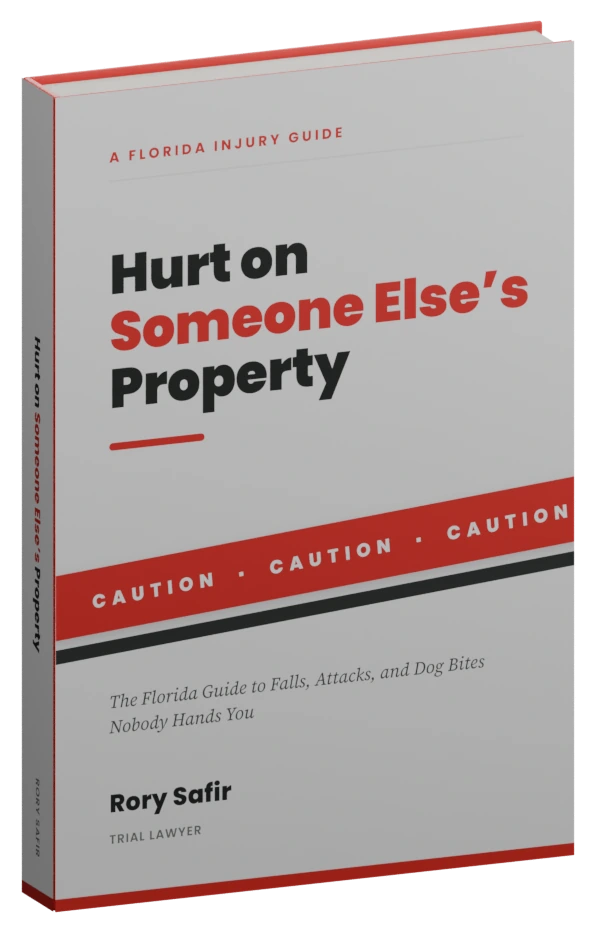
The book
Hurt on Someone Else’s Property
My plain-English book on Florida premises cases has a full chapter on negligent security: what property owners owe you, the records that prove what they knew, and the evidence race that starts the day you are hurt. Free to Tampa Bay residents, with the digital edition to read the moment you ask.
Common Questions
Do I need the attacker to be convicted before I can sue the property?
No. The civil case is independent, runs on a lower burden of proof, and can succeed even where no one was arrested. A conviction or guilty plea helps and can often be used as evidence, but it is not a prerequisite.
Should I wait until the criminal case ends?
Usually not. The civil claim against the property generally must be filed within two years, and critical evidence like surveillance video disappears within days or weeks. The right move is nearly always to start the civil case promptly and coordinate the two tracks.
Can I get money through the criminal case instead?
Restitution can be ordered, and you have the right to request it, but collection is limited to what the defendant can pay. Compensation that actually matches serious injuries almost always comes from the civil case against the property and its insurance.
What are my rights while the prosecution is pending?
Under Florida’s victim rights amendment you are entitled to notice of proceedings, the chance to be heard, conferral with the prosecutor, restitution, and privacy protections. These rights are real but must be asserted, which is part of what I handle.
What if my attacker claims the Fifth Amendment in my civil case?
That is common while charges are pending, and it is manageable. In a civil case, unlike a criminal one, a jury may generally draw an adverse inference from that silence, and the case against the property does not depend on the attacker’s testimony anyway.
Related: Negligent security overview, Foreseeability and prior crime, Sexual assault on commercial property, Wrongful death after an attack, and About Rory Safir.
Free guide No. 23
Attacked on Someone Else’s Property
The civil case nobody tells crime victims they have: foreseeability, the apartment presumption, the evidence race, and the deadlines, in plain English. Free, and one request unlocks the whole Safir Guides library.
This page is general information about Florida negligent security law, not legal advice, and it does not create an attorney-client relationship. Foreseeability and causation in Florida negligent security claims are governed by case law, including Sanders v. ERP Operating Ltd. Partnership, 157 So. 3d 273 (Fla. 2015), applied with Fla. Stat. 768.81 and 95.11. The duty arises from special relationships recognized in Florida tort law. Every case is different, and past results do not guarantee a similar outcome. The hiring of a lawyer is an important decision that should not be based solely on advertisements.