The hazard did not appear the moment you arrived. The stairwell light had been out for weeks. The railing had been loose for months. The walkway had been crumbling since before you ever set foot on it. Then it caught up with you, and a condition the owner had every chance to fix became your injury.
The owner will say it was an isolated problem it never noticed. Keeping the property safe was the owner’s job, and that job includes looking for trouble, not waiting for someone to get hurt by it. When an owner lets a known or findable hazard sit, the neglect is the case.
The duty is ongoing, not occasional
An owner who invites the public or tenants onto a property owes a continuing duty to keep it in a reasonably safe condition and to inspect for dangers a careful owner would catch. That duty does not switch off between complaints. Florida courts have held that an owner is responsible for conditions it knew about and conditions it should have discovered through reasonable inspection, which means a hazard that festered in plain sight is hard for an owner to disown.
When a property is allowed to fall into disrepair and someone gets hurt, that is a premises case I know deeply, and I am a member of the National Association of Premises Liability Attorneys with real trial depth in these matters. I represent injured people, not insurance companies. My roots are in the courtroom as a public defender, where I tried numerous cases and cross-examined witnesses again and again, and I bring that same courtroom experience to holding a negligent owner accountable. Insurers pay fair value when they believe a lawyer will try the case, and I will. I handle your case myself, from the first phone call all the way through trial. Learn more about my background.
The records tell the story
An inadequate-maintenance case is built from the paper the owner generated, or failed to generate. Almost every apartment complex, store, and commercial building has rules for inspecting and repairing the property, because insurers push them to keep those rules. When the rules exist, the case narrows to two questions: what did the rules require, and did the owner really follow them. We chase the inspection logs, the work orders, the repair history, and the prior complaints about the same condition, because the distance between a written maintenance policy and the owner’s real practice is where these cases are won.
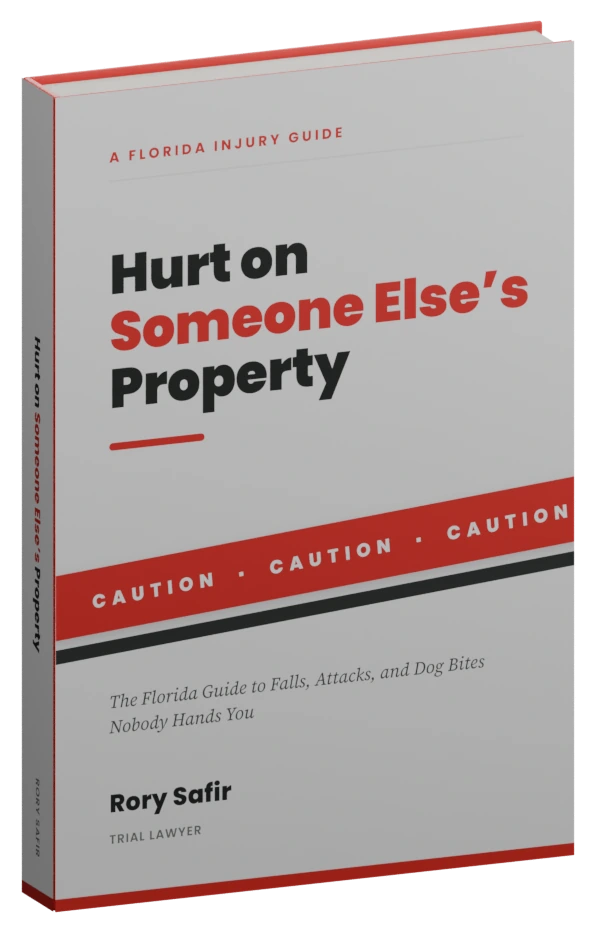
The book
Hurt on Someone Else’s Property
The evidence race, the notice fight, the owner’s records, negligent security, and dog bites, in one plain-English book on the days and weeks after you are hurt on someone else’s property. Free to Tampa Bay residents hurt on someone else’s property, with the digital edition to read the moment you ask.
The deadline
For a premises incident on or after March 24, 2023, Florida gives you two years to file suit, under Fla. Stat. 95.11(5)(a). That window is shorter than it used to be, and the proof that wins these cases moves faster than the legal clock, so a demand to preserve records and footage should go out early.
A permanent defect is a different case than a spill
Florida premises cases fork by the kind of hazard, and a maintenance case sits on the more provable side of that fork. A temporary substance on a store floor, a spill or a dropped grape, runs through Fla. Stat. section 768.0755, which makes the injured person prove the business knew about the substance or that it sat there long enough that the business should have known. A permanent feature of the property is different. A cracked walkway, a broken wheel stop, a loose stair tread, an unmarked step-down, a deteriorated handrail, or a failed transition strip is part of the premises itself, and the owner is charged with knowing the condition of its own property. That path runs on the common-law duty to maintain rather than on the transitory-substance notice burden, which is one reason the same fall is sometimes better pleaded as a static defect. Florida courts have treated a change in elevation on a walking surface as a maintenance question a jury can decide (Hilliard v. Speedway Superamerica, LLC, 766 So. 2d 1153 (Fla. 4th DCA 2000)). Sorting the hazard correctly at the outset decides which burden you carry and how the case is presented.
The uneven-floor-levels battleground
The single most common fight in a static-defect case is over uneven floor levels, and Florida law starts from a rule that favors the property owner, then carves out the exceptions that decide real cases. The general rule, running back to Matson v. Tip Top Grocery Co., 151 Fla. 247, 9 So. 2d 366 (1942), is that it is not negligence to maintain steps or uneven floors and there is no duty to warn of an obvious level change that is not dangerous in itself, and the Florida Supreme Court reaffirmed that a difference in floor levels alone is not a failure of reasonable care (Schoen v. Gilbert, 436 So. 2d 75 (Fla. 1983)). The case is won in the exceptions. Accompanying circumstances can turn a change in level into a dangerous condition that must be warned of (Casby v. Flint, 520 So. 2d 281 (Fla. 1988)), and a duty to warn arises where an uncommon design or an optical illusion hides the drop from a person paying reasonable attention (Kupperman v. Levine, 462 So. 2d 90 (Fla. 4th DCA 1985)). Poor lighting, a distraction the owner created, a broken or deteriorated feature rather than a designed step, and a hidden or disguised edge are what move a case out of the general rule and into a jury’s hands.
The maintenance rules a property is supposed to follow
A property owner does not get to invent its own definition of safe. Recognized standards describe how walking surfaces, stairs, and common areas are built and kept up, and how small a change in level is allowed before it has to be beveled, ramped, or marked, and those standards come into a case as evidence of what reasonable care required rather than as automatic liability. The proof of a maintenance failure usually lives in the owner’s own paper, the inspection schedule and whether anyone followed it, the work orders that show how long a known defect sat unrepaired, prior incident reports at the same spot, and the maintenance policy the company wrote and then did not honor. A business that has a rule and ignores it is often the whole case, because a jury understands the difference between a company that did not know and a company that knew and did nothing. Building the case means getting those records into the open and holding the owner to the standard it was supposed to meet, whether it wrote that standard itself or the industry did.
A property that let a permanent hazard sit and injured someone almost always has the records that prove it, and finding and reading those records is the work I focus on. I came up as a public defender taking apart the government’s paperwork, and as one of a small number of Florida attorneys trained as a forensic lawyer-scientist, and I bring that same scrutiny to a company’s inspection logs, its work orders, and the maintenance policy it wrote and did not follow. I represent injured people, not property owners or their insurers, and I hold an owner to the standard it was supposed to meet rather than the one it wishes applied.
Common Questions
What counts as inadequate maintenance?
Letting a known or discoverable hazard persist instead of fixing it. Burned-out stairwell lighting, a loose or broken railing, a leaking roof that pooled water, a failed lock, a deteriorating walkway, or a hazard the owner was told about and never addressed. The injury comes from neglect over time, not a one-second spill.
How is this different from a slip-and-fall on a spill?
A slip on a temporary substance runs through the notice statute, so the fight is over what the business knew about that spill. An inadequate-maintenance case runs on the owner's ongoing duty to inspect and maintain the property, so the question is whether the owner had a reasonable system to find and fix problems and really followed it.
The owner says it never knew about the problem. Does that end my case?
Not necessarily. The duty owed to an invitee includes inspecting for hazards a careful owner would have found. Florida courts have held that an owner is charged with conditions it should have discovered through reasonable inspection, not only the ones it really knew about, so 'we did not know' is often the beginning of the argument, not the end.
What proof matters most in a maintenance case?
The maintenance and inspection records, the work orders and repair history, any prior complaints about the same condition, and the gap between what the owner's written maintenance policy promised and what the owner really did. A policy the owner wrote and then ignored is often the strongest part of the case.
How long do I have to file?
Generally two years from the date you were hurt, under Fla. Stat. 95.11(5)(a), for incidents on or after March 24, 2023. Conditions get repaired once a claim is expected, so documenting the hazard early matters.
Related: Premises liability overview, Trip and fall cases, Personal injury overview, and About Rory Safir.
Do I have to prove the owner knew about the broken condition?
For a permanent defect, you do not carry the same notice burden as a spill case. A cracked walkway, a broken step, or a failed handrail is part of the property, and an owner is charged with knowing and maintaining the condition of its own premises, so the fight is usually about whether reasonable inspection and upkeep would have caught and fixed the danger. That is a different question than whether the owner knew a temporary substance was on the floor, and it is often easier to prove because the defect did not appear in the last five minutes.
This page is general information about Florida premises liability law, not legal advice, and it does not create an attorney-client relationship. The governing authorities include the common-law duty to maintain, Fla. Stat. 768.81 (comparative fault), and 95.11(5)(a) (two-year limitations). Every case is different, and past results do not guarantee a similar outcome. The hiring of a lawyer is an important decision that should not be based solely on advertisements.