You were walking where anyone would walk. A parking lot, a sidewalk, a set of stairs you had used before. There was a broken edge, an unmarked step, or a crack you could not have seen, and there was nothing where you expected solid ground. The fall was over in a second, and the harm can last for years.
The owner will say you should have watched where you were going. What the owner will not volunteer is that the broken walkway or missing handrail had been that way for a long time, and that keeping the property safe was its job, not yours. We build the case that fixes the owner with knowing the condition of its own property.
Why a trip case is built differently
A trip on a permanent defect is a different kind of case than a slip on a spill, and the difference decides what you have to prove. A spill is a transitory substance, so it runs through the notice statute and its hard “knew or should have known” burden. A broken or defective permanent feature is better pleaded as a static defect under the owner’s common-law duty to keep the property in a reasonably safe condition, which keeps the case off that notice burden entirely, because an owner is charged with knowing the permanent condition of its own premises.
| Compared | Slip on a substance | Trip on a defect |
|---|---|---|
| The hazard | A temporary spill or dropped item. | A permanent broken feature of the property. |
| What you prove | The business knew or should have known, under Fla. Stat. 768.0755. | The owner failed its duty to maintain a safe property. |
| The notice burden | Central to the case. | Avoided, since the owner is charged with knowing its own permanent premises. |
A trip and fall on a broken walkway, an uneven step, or a hidden hazard is a premises case I know well, and I am a member of the National Association of Premises Liability Attorneys with a heavy trial background in these claims. I represent injured people, not insurance companies. I built my skills in the courtroom as a public defender, where I tried numerous cases and cross-examined witnesses constantly, and I bring that same readiness to proving a property owner should have fixed the danger. Insurers move toward fair value when they see a lawyer prepared to try the case to a jury, and that is exactly what I am prepared to do. I handle your case personally, from the first call through trial. Learn more about my background.
Proving the defect
A photograph the client took identifies the location, but a scene visit identifies the defect, so we measure the change in level, the slope, the riser heights, the surface, and the lighting, and we document the condition from several angles. Historical street-level imagery can show the broken feature predated the fall, which helps charge the owner with knowing about it. Many recognized safety standards for walking surfaces treat a change in level as small as a quarter inch as a hazard that should be ramped, beveled, or marked, and where a building or accessibility code was violated, that violation is strong evidence the owner failed to keep the property safe. Florida-specific codes and standards are the yardstick, and we ground any standard in the Florida code before it goes into a filing.
The book
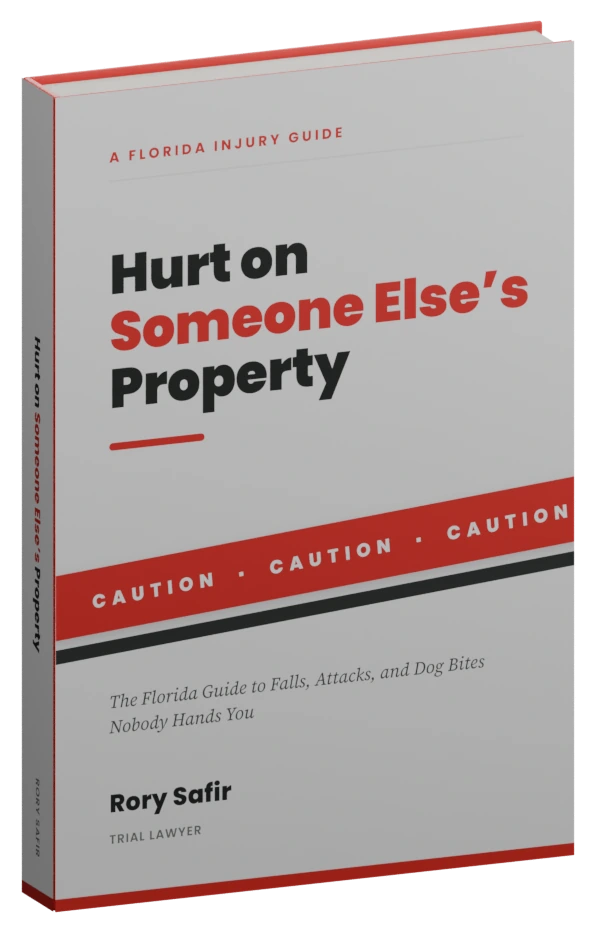
Hurt on Someone Else’s Property
The evidence race, the notice fight, the owner’s records, negligent security, and dog bites, in one plain-English book on the days and weeks after you are hurt on someone else’s property. Free to Tampa Bay residents hurt on someone else’s property, with the digital edition to read the moment you ask.
The owner’s choices, not bad luck
Corporate owners like to treat every fall as an unavoidable event and blame the customer, the weather, or fate. The honest framing is different. The owner chose its inspection schedule, chose whether to repair a known defect, and chose whether to enforce its own maintenance rules. A broken handrail or a deteriorated walkway did not appear the moment you arrived. It was a condition the owner had time to find and fix and did not.
The measurements that prove a trip hazard
A trip case usually turns on a defect you can put a tape measure to, and the walkway-safety standards are specific. Under consensus standards such as ASTM F1637, a change in level as small as a quarter inch is a recognized trip hazard, a rise between a quarter and a half inch has to be beveled, and anything greater needs a ramp or a step. Stairs carry their own rules, including tight limits on how much one step can vary from the next (the building code and NFPA 101 allow no more than three-eighths of an inch across a flight) and handrails set 34 to 38 inches high and shaped so a falling hand can grip them. When a sidewalk lip, a broken tread, or an out-of-spec step is what put you down, those numbers turn a vague claim into a measured violation. Many of the same features are also governed by accessibility law: the ADA Standards for Accessible Design and ANSI A117.1 set requirements for ramp slopes, thresholds, handrails, and detectable warnings, so a noncompliant ramp or a missing handrail can be both a trip hazard and an accessibility violation. More on how we prove a walkway was unreasonably dangerous.
The deadline
For a fall on or after March 24, 2023, Florida gives you two years to file suit, under Fla. Stat. 95.11(5)(a). If a city, county, or other government body owns the walkway or building, a separate written-notice step applies under Fla. Stat. 768.28 and the clock is tighter. A defect can be repaired quickly once an owner knows a claim is coming, so measuring and documenting it early matters.
Common Questions
How is a trip-and-fall different from a slip-and-fall in Florida?
It comes down to the hazard. A slip on a temporary substance, like a spill, runs through the notice statute, so the fight is over what the business knew. A trip on a permanent broken feature, like a cracked walkway or an unmarked step, runs on the owner's duty to keep the property safe and skips that notice burden, because the owner is charged with knowing the permanent condition of its own property.
What counts as a static or structural defect?
A permanent feature of the property that was allowed to become dangerous: a cracked or uneven walkway, an unmarked step-down, a broken wheel stop in a parking lot, a pothole, a missing or failing handrail, or poor lighting that hid the hazard. The defect was there before you arrived, and the owner had a duty to find and fix it.
The owner says the step or curb was obvious. Does that defeat my case?
Not on its own. Florida courts have treated some uneven floors and ordinary curbs as open and obvious, which can limit the duty to warn, but the separate duty to keep the property reasonably safe survives, and whether a condition was dangerous enough to be unreasonable is usually a question for the jury. Under Fla. Stat. 768.81 your own share of fault reduces recovery, and more than fifty percent at fault recovers nothing, so the obviousness argument is really a fight over the fault percentage.
Do I need an expert in a trip-and-fall case?
Often, yes. The owner will usually admit the condition existed and then argue it was not unreasonably dangerous. An engineering or safety expert can measure the change in level, the slope, the riser heights, and the lighting, and explain how recognized walking-surface standards and the building or accessibility code treat that condition. We retain that expert early, so the defect can be measured and documented close in time to the fall.
How long do I have to file a trip-and-fall claim in Florida?
For a fall on or after March 24, 2023, you generally have two years from the date you were hurt, under Fla. Stat. 95.11(5)(a). If a city, county, or other government body owns the property, a separate written-notice step applies under Fla. Stat. 768.28 and the timeline is tighter, so a public sidewalk or building calls for fast action.
Related: Premises liability overview, Slip and fall cases, Personal injury overview, and About Rory Safir.
This page is general information about Florida premises liability law, not legal advice, and it does not create an attorney-client relationship. The governing authorities include the common-law duty to maintain, Fla. Stat. 768.0755 (which governs the separate transitory-substance case), 768.81 (comparative fault), 95.11(5)(a) (two-year limitations), and 768.28 (claims against government). Every case is different, and past results do not guarantee a similar outcome. The hiring of a lawyer is an important decision that should not be based solely on advertisements.