
A crime at an Arcadia store, bar, motel or apartment complex can sometimes be traced back to an owner who knew about trouble and didn’t act. If you were hurt that way, you may have a claim against the owner, even when the attacker has no money or was never caught.
Getting the DeSoto records
If the DeSoto County Sheriff’s Office took the call, it handles public records requests and offense reports, and it has a victim advocate. Ask for the report number. The earlier calls to that same address are what show what the owner knew.
When the victim is partly blamed
Insurers argue comparative fault in these cases. Under section 768.81, any share of fault put on you reduces the award, and more than 50 percent bars recovery. Since 2023, section 768.0701 also lets the jury weigh the attacker’s fault. I build the case around the owner’s choices so those arguments have less to hold on to. If it happened at an apartment complex with five or more units, expect the owner to raise the presumption in section 768.0706, which it has to prove it earned.
Close to home
An Arcadia case is filed in the Twelfth Judicial Circuit at the DeSoto County Courthouse in Arcadia, generally within two years. Video and repairs move faster than that, so I send preservation letters early for the video, the incident reports and any guard or staffing records. Photograph the scene yourself too, before anything gets repaired.
See also the DeSoto County negligent security page.
More DeSoto County pages: DUI and criminal defense, nursing home abuse in Arcadia, assisted living abuse in Arcadia, and dog bites in Arcadia, or the DeSoto County personal injury overview.
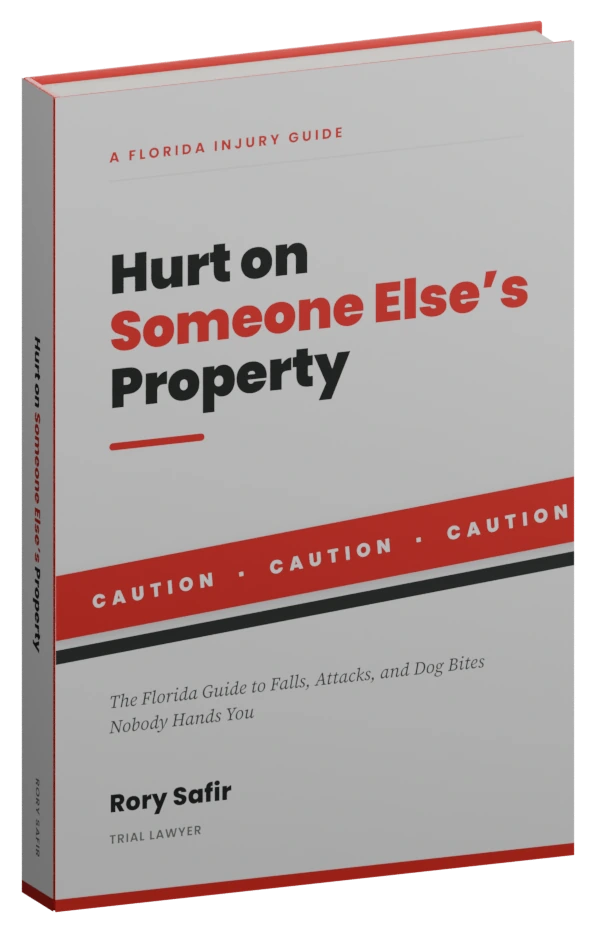
The book
Hurt on Someone Else’s Property
The evidence race, the notice fight, the owner’s records, and why many of these cases end up filed as lawsuits, in one plain-English book on the days and weeks after a fall. Free to Tampa Bay residents, with the digital edition to read the moment you ask.
Common Questions
Do I have a case if my attacker was never caught?
Possibly. The claim is against the property owner, not the attacker, and it turns on the owner’s failure to guard against foreseeable crime. An arrest is not required.
How is foreseeability proven?
Police calls-for-service to the address, the property’s own incident reports, and crime in the surrounding blocks establish what the owner knew or should have known.
The property says it had security. Does that end it?
No. The question is whether the security was reasonable against the known risk and whether it was actually working. A camera that did not record and a guard post that sat empty are failures wearing the costume of security.
Related reading: negligent security, foreseeability and prior crime, and about Rory Safir.