DeSoto County, centered on Arcadia, is rural and close-knit, with a smaller set of commercial properties than the busy Gulf Coast counties, but slip-and-fall injuries happen here just the same, in the grocery and dollar stores, the gas stations and restaurants, the government buildings, and the rental housing that make up daily life. When a property owner’s carelessness causes a fall, Florida law gives the injured person a way to recover, but the law puts a real burden on the injured person to prove it, and this page explains how these cases work in DeSoto.
What a Florida slip-and-fall claim requires
What you have to prove in a Florida slip-and-fall
Florida law makes these cases harder than people expect, and understanding why is the key to winning one. Under Florida Statute 768.0755, if you slip and fall on a transitory foreign substance, something like a spill, a leak, or tracked-in water, in a business, you have to prove the business had actual or constructive knowledge of the hazard and should have fixed it. Actual knowledge means someone there knew. Constructive knowledge, the harder and more common path, means the condition existed long enough that a reasonable business would have found it, or that it happened with enough regularity to be foreseeable. That is why the timing evidence matters so much: the surveillance footage showing how long a spill sat there, the inspection and sweep logs, the maintenance records, and any history of similar incidents. The business usually controls that evidence, so getting it takes persistence. You can read more on our Florida premises liability overview.
Where falls happen in DeSoto County
DeSoto’s fall hazards are the everyday ones. The grocery stores, dollar stores, gas stations, and restaurants in and around Arcadia present the same spill and hazard risks as anywhere, and because the community is smaller, the evidence in a case, the security footage, the incident report, the maintenance records, often comes down to a single store’s practices. Rental housing raises questions of unsafe stairways, broken walkways, and neglected common areas, and the county’s public buildings and its well-known annual events and rodeo bring crowds onto surfaces that have to be kept safe. A fall on someone else’s property is the same legal question here as in a city: did the owner know, or should they have known, and did they fail to act. Each property carries its own duties and its own evidence, and knowing how these falls happen is part of building the case.
Where your DeSoto case is heard, and getting care
DeSoto County sits in Florida’s Twelfth Judicial Circuit, so a fall lawsuit is generally filed in the DeSoto County civil court in Arcadia. Most claims resolve through insurance long before a lawsuit is necessary, but the cases that settle for full value are prepared from the start as if they will be tried. Medical care matters even more in a rural county, where the most serious injuries can mean a transfer from DeSoto Memorial Hospital to a trauma center in a neighboring county, and prompt, consistent care both protects your health and creates the record that connects your injuries to the fall. Gaps or delays in treatment are among the first things an insurer uses to minimize a claim.
The injuries these cases involve
Falls cause serious injuries far more often than people assume. Broken hips and wrists, especially in older adults, can be life-altering and sometimes never fully heal. Head injuries and traumatic brain injuries happen when someone strikes the floor or a fixture on the way down, and back and spine injuries from a hard fall can mean surgery and lasting pain. Shoulder and knee injuries are common as people try to catch themselves. In older residents, a single fall can trigger a long decline, which is one reason these cases are often worth far more than an insurer’s first offer suggests. Documenting the full medical picture, and connecting it to the fall, is central to protecting the value of the case.
Comparative fault and what to do after a fall
Businesses and their insurers routinely argue that you were not watching where you were going, because Florida applies comparative fault and every share of blame they shift onto you lowers what they pay, and past a certain point can bar the claim. Answering that with evidence is central to the case. A few steps right after a fall protect both your health and your claim: report the fall to the business and ask for a written incident report, photograph the hazard and the scene before it is cleaned up, get the names of any witnesses and employees, keep the shoes and clothing you were wearing, and get medical care promptly. Be careful about giving a recorded statement or accepting a quick settlement before you know the full extent of your injuries. The evidence that proves these cases disappears fast, so acting quickly matters.
A slip-and-fall case is won on proof of notice, the surveillance footage and its timestamps, the inspection and sweep logs, the maintenance records, and the history of prior incidents, and on prying that evidence out of the business that controls it and cross-examining the people who wrote it. That records-driven, detail-heavy work is exactly what I have built my career on. I represent injured people, not the businesses or their insurers, and I came up in the courtroom as a public defender, trying cases and cross-examining witnesses constantly, so I am ready to take a case to a jury when that is what fair value requires. I handle each case personally, and I know the courts and the community here. Learn more about my background.
Common Questions
Do I have a case if I fell in a DeSoto County business?
Possibly. Under Florida law you generally have to prove the business had actual or constructive knowledge of the hazard and failed to fix it, which turns on evidence like surveillance footage, inspection logs, and prior incidents. A review of the specific facts is the way to know.
What do I have to prove in a Florida slip-and-fall?
For a fall on a spill or similar substance in a business, Florida Statute 768.0755 requires you to prove the business knew or should have known about the hazard and should have remedied it. Constructive knowledge is shown by how long the condition existed or that it happened with regularity.
How long do I have to file after a DeSoto County fall?
For most fall injury claims the deadline is now two years from the date of the fall, shortened from four by a 2023 change in the law. Because the evidence in these cases disappears quickly, an early review is especially important.
Where would my DeSoto County slip-and-fall case be heard?
DeSoto County is in Florida’s Twelfth Judicial Circuit, so a lawsuit would generally be filed in the DeSoto County civil court in Arcadia. Most claims resolve through insurance before a lawsuit is needed, but preparing the case as if it will be tried is what protects its value.
What will a DeSoto County slip-and-fall case cost me?
These cases are handled on contingency, so you pay no attorney’s fees unless there is a recovery, and case costs are advanced rather than paid up front. The first strategy session is free.
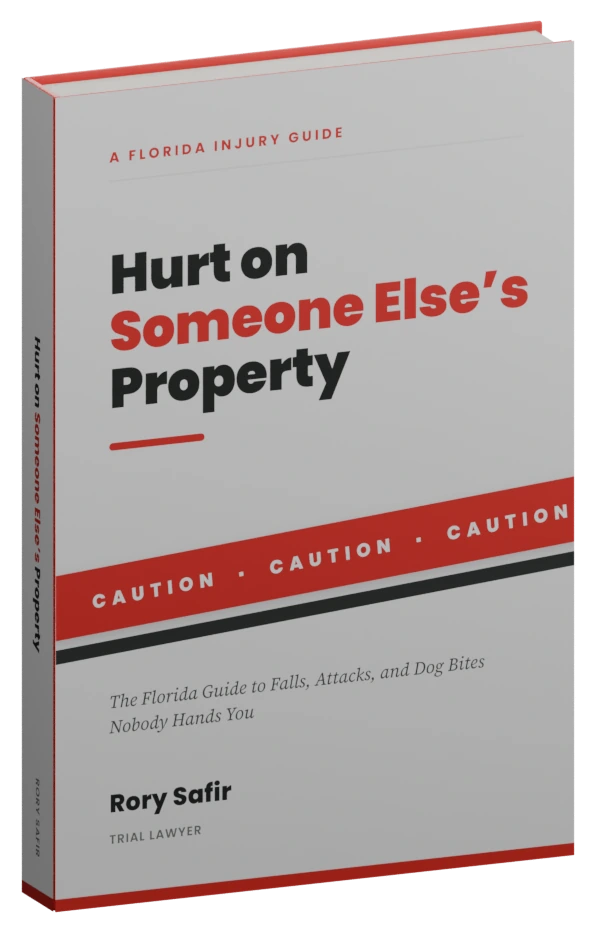
The book
Hurt on Someone Else’s Property
The evidence race, the notice fight, the owner’s records, and the honest truth that many of these cases have to be filed as lawsuits, in one plain-English book on the days and weeks after a fall. Free to Tampa Bay residents, with the digital edition to read the moment you ask.