A fall in a Hillsborough County store, restaurant, or parking lot starts a race most people never know is running. The business wrote the incident report to protect itself, the camera loop is recording over the proof, and the spill or the broken step gets fixed by morning. Florida law is honest about these cases and so am I: a fall alone is not automatically a case, the injured person must prove what the business knew, and the proof lives in the business’s own records. I represent people hurt in falls across Hillsborough County, and I wrote a plain-English book on how these cases really work.
The supermarket rule: what the business knew
For a fall on a transitory substance, the spill, the tracked-in rain, the dropped produce, Florida requires proof that the business knew about the hazard or should have known because it sat long enough or happened regularly. That is why the condition of the spill is evidence, why the inspection and sweep logs matter, and why the video against the logs is often the whole case. Falls on permanent features, the broken step, the bad lighting, the unmarked change in elevation, skip the what-did-they-know fight, because a business is charged with knowing its own building.
Where Hillsborough County falls happen
Hillsborough’s falls cluster where its crowds do: the retail miles of Dale Mabry and Brandon’s mall district, the grocery chains serving Carrollwood, Town ’N’ Country, and New Tampa, the Ybor and SoHo bars and restaurants where spilled drinks meet worn tile, and the apartment complexes whose common areas answer to the same duty of reasonable care as any store.
The race, and the deadline behind it
Report the fall before you leave and get the incident report’s existence on record, photograph the exact spot and your shoes, get names, and get medical care that documents the mechanism precisely. Then have a lawyer send the preservation letter that freezes the video and the logs. The lawsuit deadline is generally two years, the comparative fault rules can reduce or bar recovery, and a Hillsborough County case that has to be filed lands in the Thirteenth Judicial Circuit at the George E. Edgecomb Courthouse in downtown Tampa. Many of these cases cannot be settled with a phone call, and the honest ones get built for filing from the start.
The firm serves all of Hillsborough County, with a dedicated Tampa page.
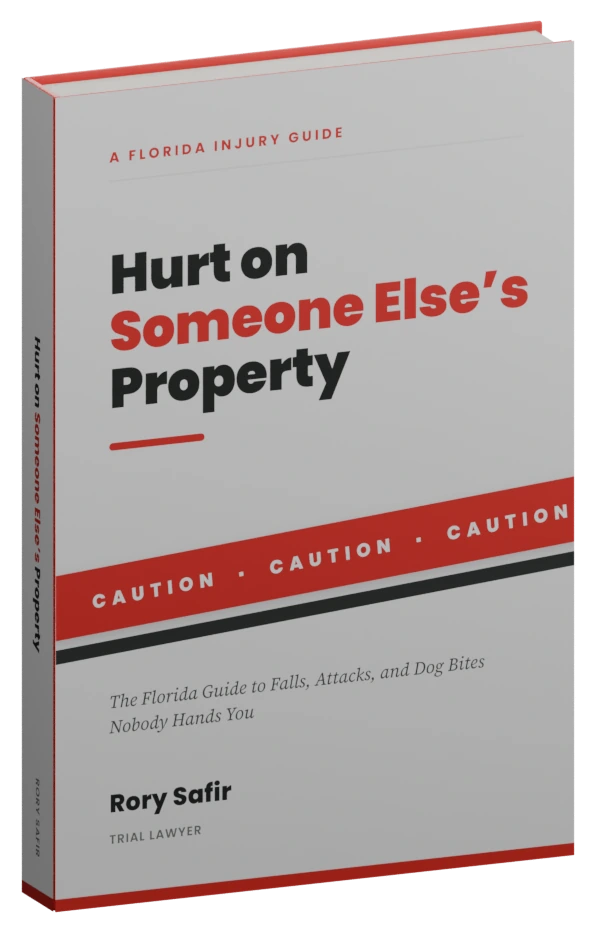
The book
Hurt on Someone Else’s Property
The evidence race, the notice fight, the owner’s records, and the honest truth that many of these cases have to be filed as lawsuits, in one plain-English book on the days and weeks after a fall. Free to Tampa Bay residents, with the digital edition to read the moment you ask.
Common Questions
Is a fall in a store automatically a case?
No. There is no no-fault coverage for falls, and Florida makes the injured person prove the business knew or should have known about the hazard. The cases that win are built on the business’s own records: the video, the sweep logs, and the prior complaints.
The store offered to pay my medical bills if I sign something. Should I?
Not before advice. Early releases are priced before anyone knows what the injury really is, and signing one usually ends the case at its cheapest possible moment.
What is the deadline for a Florida slip and fall lawsuit?
Generally two years from the fall. The evidence race is much shorter than that, because video overwrites in days or weeks, which is why early legal help changes these cases.
Related reading: premises liability, slip and fall, proving a dangerous floor, and about Rory Safir.