
After a fall in New Port Richey, the first legal question is who is responsible for the spot where you went down. A store, the landlord that owns the shopping center, a property manager or a cleaning contractor can each play a part, and the claim has to name the right one. I represent people hurt in New Port Richey falls, and I sort that out before anything else.
What a Florida slip-and-fall claim requires
Who answers for the floor
A business that leases a storefront may control what happens inside it, while the owner of the plaza may control the parking lot and sidewalks. A management company or contractor may handle cleaning or repairs. The lease, the maintenance contracts and the work orders show who had the duty for the area where you fell. If the fall happened in a shopping center, note the store name, the closest entrance and anything nearby, like a cart corral or a drain, because that detail helps sort out whose area it was. Keep any letter or email you get from a business or insurer, too, since the sender tells me who thinks they’re responsible. Our page on who is responsible for a fall explains how those pieces fit, and the Florida premises liability overview covers the broader law.
Before naming anyone, I gather the incident report, the camera footage, the inspection logs and the maintenance history, and I send a written request early asking each party to keep them.
Knowledge, under Florida’s statute
For a fall on a transitory foreign substance in a business, section 768.0755 requires the injured person to prove that the business had actual or constructive knowledge of the dangerous condition and should have acted to remedy it. Actual knowledge means someone knew. Constructive knowledge can be proved through circumstantial evidence that the condition existed long enough that a business exercising ordinary care should have known of it, or that it occurred with regularity and was foreseeable.
Falls that don’t involve a substance, like a broken handrail, a dark stairway or uneven pavement, rest on the ordinary duty of care, which the statute says it doesn’t change. In both kinds of case, the evidence comes from the business and the property owner, and much of it can be lost if nobody asks for it.
At the scene, footprints, cart tracks or dirt through a spill can suggest it had been there a while, and a dried ring can too. Photograph it from more than one angle before it’s cleaned, and note whether a wet floor sign was out and where.
The injury, the record and comparative fault
A hard fall can break a hip, wrist or ankle, injure your back or neck, tear a shoulder, or cause a concussion. For an older adult, a hip fracture can mean surgery and a long recovery. Get care promptly and keep every appointment, because the medical records connect your injuries to the fall and gaps in care hand the insurer an argument. Give each doctor the full story of how you fell and everything that hurts, so the chart is complete.
Keep everything that shows what the fall cost: medical bills, pharmacy receipts, mileage to appointments and a note from your employer about time off. Write a few lines each week about your pain and the things you’ve had to stop doing. Those notes help show what the injury did to your life, and they’re far easier to keep now than to rebuild later.
The insurer will also look for ways to blame you. Florida’s comparative fault statute, section 768.81, lowers your recovery by the share of fault assigned to you, and if you’re more than 50 percent at fault for your own injury, you recover nothing. Report the fall and ask for a written incident report, photograph the hazard before it’s fixed, get names from witnesses and employees, and keep your shoes and clothing. If deputies responded, the Pasco Sheriff’s Office handles public records requests. Hold off on recorded statements and quick settlements until you know the full extent of your injuries. Don’t post about the fall online, and if an adjuster calls, you can refer them to me.
West Pasco Judicial Center, and two years to file
New Port Richey is in Pasco County, part of the Sixth Judicial Circuit, and West Pasco cases are heard at the West Pasco Judicial Center, 7530 Little Road, which handles civil cases among others. A negligence suit generally has to be filed within two years, under section 95.11(5)(a). That window is generally the outer limit, and footage won’t last nearly that long. The Sixth Circuit’s circuit civil division takes disputes over $50,000, and once a suit is filed, each defendant answers written questions and produces records, and employees can be deposed under oath about the area where you fell.
Plenty of fall claims resolve through insurance before a lawsuit is necessary, but I prepare each one from the start as though it will be tried. I’m paid on contingency, so I don’t collect a fee unless you recover. My clients are injured people, not businesses or insurers, and I personally handle every case. Learn more about my background.
The book
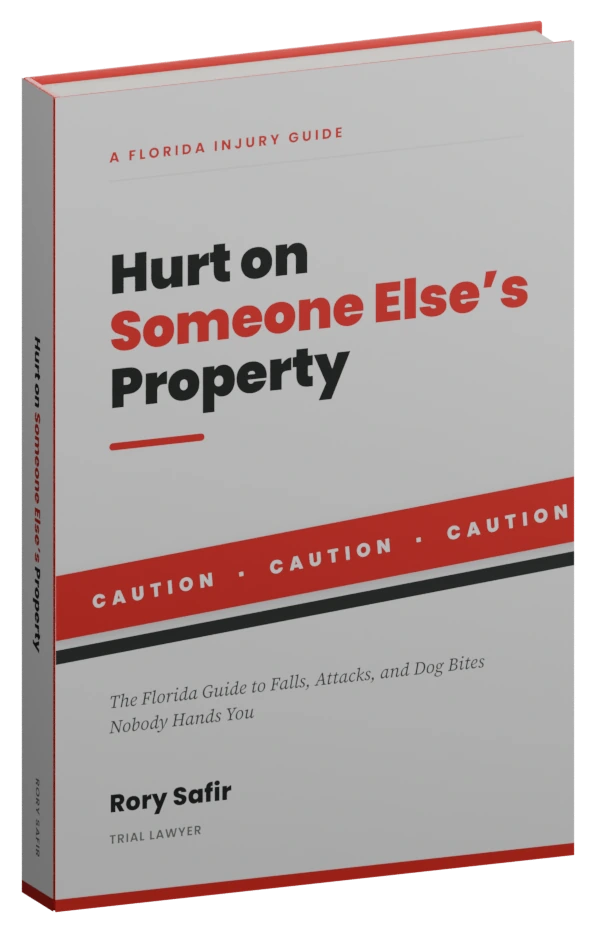
Hurt on Someone Else’s Property
The evidence race, the notice fight, the owner’s records, and why many of these cases end up filed as lawsuits, in one plain-English book on the days and weeks after a fall. Free to Tampa Bay residents, with the digital edition to read the moment you ask.
Common Questions
Do I have a case if I fell in a New Port Richey business?
Possibly. Under Florida law you generally have to prove the business had actual or constructive knowledge of the hazard and failed to fix it, which turns on evidence like surveillance footage, inspection logs, and prior incidents. A review of the specific facts is the way to know.
What do I have to prove in a Florida slip-and-fall?
For a fall on a spill or similar substance in a business, Florida Statute 768.0755 requires you to prove the business knew or should have known about the hazard and should have remedied it. Constructive knowledge is shown by how long the condition existed or that it happened with regularity.
How long do I have to file after a New Port Richey fall?
For most fall injury claims the deadline is now two years from the date of the fall, shortened from four by a 2023 change in the law. Because the evidence in these cases disappears quickly, an early review is especially important.
Where would my New Port Richey slip-and-fall case be heard?
New Port Richey is in Pasco County, part of Florida’s Sixth Judicial Circuit, so a lawsuit would generally be filed in the Pasco County civil court. Most claims resolve through insurance before a lawsuit is needed, but preparing the case as if it will be tried is what protects its value.
What will a New Port Richey slip-and-fall case cost me?
These cases are handled on contingency, so you pay no attorney’s fees unless there is a recovery, and case costs are advanced rather than paid up front. The first strategy session is free.