When a drug case has no number to lean on, the State often turns to a Drug Recognition Expert. The title sounds like a scientist, but it describes a police officer who completed a standardized course in a twelve-step evaluation. The evaluation ends in the officer’s opinion about which of seven drug categories you were on, and a toxicology test is then said to confirm it. Understanding how that opinion is built is how you take it apart.
This section walks through the evaluation step by step and shows where each part can be questioned. As an NHTSA Standardized Field Sobriety Test instructor who has completed Drug Recognition Expert evaluation and trial-techniques training on the NHTSA DRE curriculum, I know the twelve-step protocol, the face sheet, and the symptomatology matrix the State’s officer relies on. See what the Lawyer-Scientist training covers.
What the Evaluation Involves
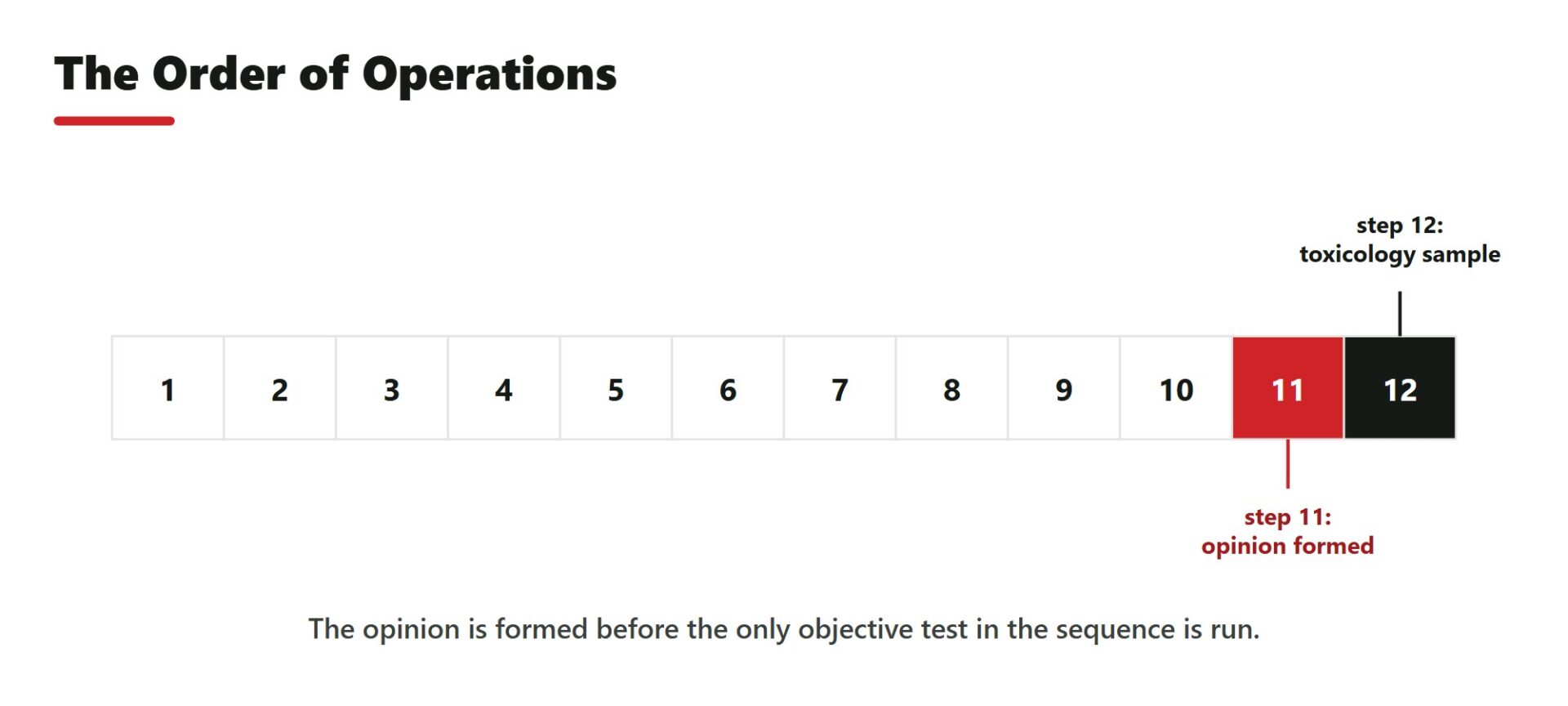
The drug evaluation is a fixed sequence of twelve steps. Most of them are observations and simple checks: a breath alcohol test, an interview with the arresting officer, eye examinations, divided-attention exercises, pulse and blood pressure readings, pupil sizes in different light, and a look for injection sites. Near the end, at step eleven, the officer states an opinion about the drug category. Only at step twelve does a chemical test enter the picture. The order matters, because the opinion is formed before the laboratory result is known.
How a drug case is built when there is no number. Each stage feeds the next, and the officer’s opinion is reached before the lab result returns.
Why this section is different
I do not read the drug recognition evaluation from the outside. I teach the field exercises it contains, and I have completed Drug Recognition Expert evaluation and trial-techniques training on the NHTSA DRE curriculum, so I know the twelve-step protocol, the face sheet, and the symptomatology matrix the officer was taught to use. That is what lets me show a court where the observations do not add up to the opinion.
Where It Breaks Down
Each part of the evaluation has a soft spot, and the pages below take them in turn.
ARIDE Is Not DRE Training
Many of the officers who name a drug category in a Florida report did not complete the DRE program at all. They completed ARIDE, Advanced Roadside Impaired Driving Enforcement, which its own manual describes as a stand-alone, 16-hour course built to bridge basic field sobriety training and the DRE school. The manual is plain about the limit: the training “will not qualify or certify an individual as a DRE,” and an officer who completes it “does not have the training required to support the selection of a specific drug category.” Those sentences are from the February 2023 curriculum edited April 2025, Session 1 page 10 and Session 5 page 21, and they are the curriculum setting a boundary on its own graduates rather than a court ruling.
So the first question in a drug case is not what the officer concluded but which course the officer sat, which edition, and what beyond that course supports the conclusion. An ARIDE-trained officer can still describe what they saw and can still testify. What the manual withholds is the foundation for the category opinion, and that is the gap I put in front of the court. The full walk through the manual, quoted with page numbers, is in the post on what ARIDE training says about itself.
How the Opinion Reaches a Jury
At trial the officer is offered as someone with specialized knowledge, and the opinion comes in as expert testimony. Florida screens that testimony under section 90.702, which asks whether the method is reliable and reliably applied. That gives the defense two moments to act: a motion to exclude or limit the opinion before trial, and cross-examination in front of the jury on training, error, the flexibility of the matrix, and the bias built into the order of the steps. The goal is to keep the officer from dressing an interpretation up as a measurement, and to make sure the jury hears what the evaluation can and cannot show.
I started out as an Assistant Public Defender in Florida’s Thirteenth Judicial Circuit, in Tampa, and today I am one of six ACS-CHAL Forensic Lawyer-Scientists in Florida and a Faculty member of the National College for DUI Defense. I work both the science and the procedure in your case the way the State’s own analysts and officers are trained to, and I show a jury the exact point where the evidence does not hold up. Learn more about my background.
Questions About the Drug Recognition Expert
Is a Drug Recognition Expert really an expert?
A DRE is a police officer who completed a standardized course in a twelve-step evaluation. The title is a job description, not a medical or scientific qualification. The officer is not a physician, pharmacologist, or toxicologist, and the opinion is an officer's interpretation of signs, not a laboratory finding.
What does the evaluation produce?
An opinion that you were impaired by one of seven drug categories. The officer checks your eyes, pulse, blood pressure, pupil sizes, and balance, compares them to a chart of expected signs, and names the category that fits best. A toxicology test is then said to confirm the opinion, although the opinion is reached first.
Can the DRE opinion be kept out of my trial?
It can be challenged. Florida screens expert testimony under section 90.702, and a drug recognition opinion can be tested for reliability, limited in scope, or excluded. Even when it comes in, the method's weaknesses are fair game on cross-examination.
Why does it matter that you teach these tests?
Because the evaluation is only as good as how it was performed, and knowing the protocol from the inside shows where it went wrong. I teach the field exercises and I have trained in the drug recognition protocol, so I read the face sheet and the matrix the way the officer was taught to, and I can show a court where the steps do not support the conclusion.
Does a DRE opinion plus a positive test prove impairment?
Not by itself. The opinion is an interpretation and the test shows exposure, so stacking them does not close the gap to impairment at the time of driving. Each piece has to be examined on its own, which is what the pages in this section do.
Related pages: Drugged driving overview, presence is not impairment, and how drugs are tested.
Related: whether a breathalyzer detects weed.
This page is general information, not legal advice, and it does not create an attorney-client relationship. Drug DUI in Florida is governed by Fla. Stat. 316.193, section 877.111, and chapter 893, and expert testimony is governed by Fla. Stat. 90.702. Procedures and rules change, and every case turns on its own facts. Past results do not guarantee a similar outcome.