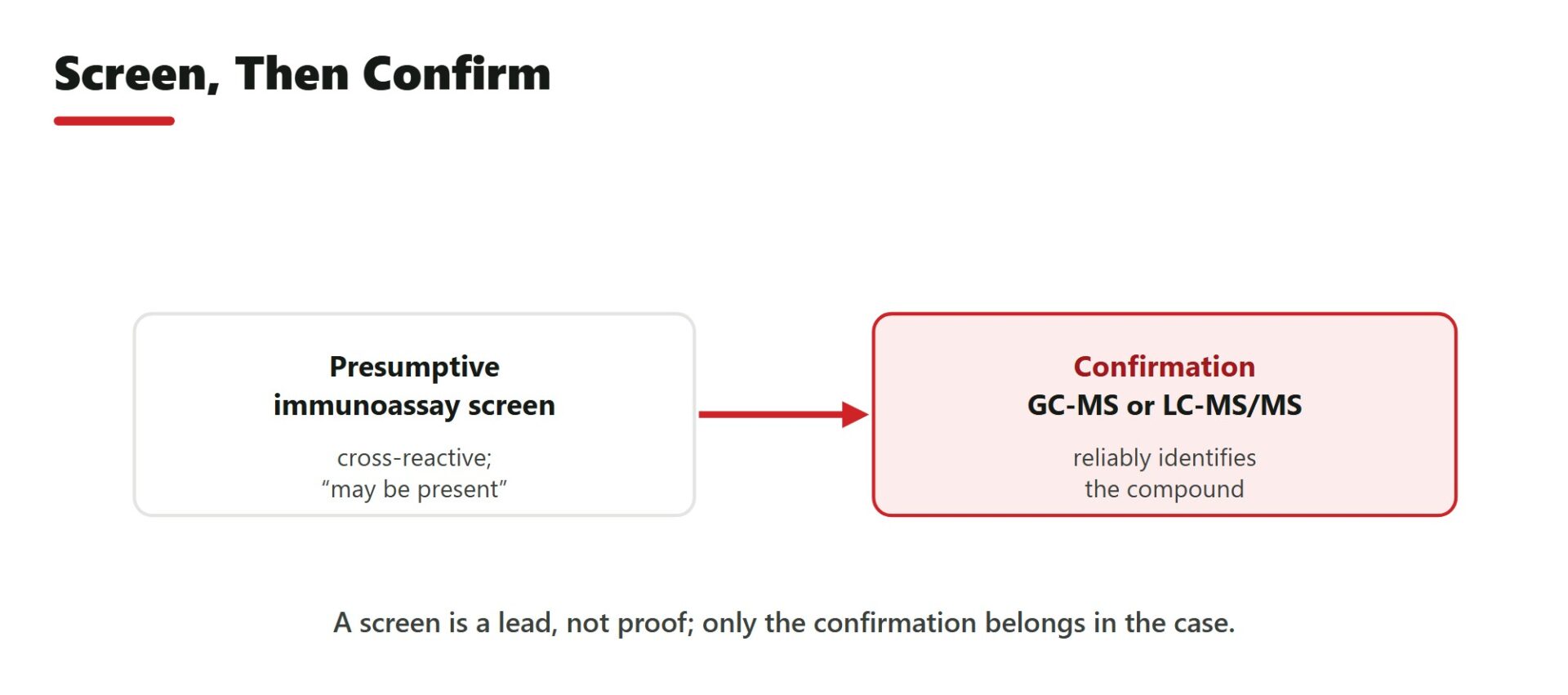
Drug testing is a two-step process, and the two steps are not equal. A presumptive screen comes first, fast and cheap, and it suggests whether something might be present. A confirmation comes second, slower and far more specific, and it identifies what is present. The State sometimes blurs the two, but the distinction is central, because a screen alone cannot reliably name a drug.
A screen is a presumptive test that can cross-react and flag the wrong thing. Only a specific confirmatory method identifies the substance, and a screen alone should never stand as proof.
The Screen Is a Question, Not an Answer
An immunoassay screen works by reacting to a class of substances. That speed comes at a cost: it can react to things that merely resemble the target, a feature called cross-reactivity, and it reports against a cutoff that the laboratory selects. Both of those mean a screen can flag the wrong thing or call a borderline sample positive. A screen is a reason to look closer, and treating it as a finding is a mistake the defense should not let pass.
This is what I was trained for in a drug case. I studied forensic chromatography at the bench, so I do not stop at the word “positive” on a report, I go to the method, the controls, the calibration, and the raw data behind it. A presumptive screen dressed up as a finding is one of the most common overreaches I see, and it is one of the easiest to expose once someone knows what a real confirmation is supposed to look like. I make the State prove identity the right way before anyone talks about what a drug did or did not do to your driving.
I started out as an Assistant Public Defender in Florida’s Thirteenth Judicial Circuit, in Tampa, and today I am one of six ACS-CHAL Forensic Lawyer-Scientists in Florida and a Faculty member of the National College for DUI Defense. I work both the science and the procedure in your case the way the State’s own analysts and officers are trained to, and I show a jury the exact point where the evidence does not hold up. Learn more about my background.
| Screen (immunoassay) | Confirmation (GC/MS or LC/MS/MS) | |
|---|---|---|
| What it does | Flags a possible category, fast and cheap | Identifies the specific molecule |
| Specificity | Low, with cross-reactivity and false positives | High, by structure and mass |
| What it proves | A question worth confirming, not an answer | Identity, when properly run and validated |
A screen that was never confirmed is a lead, not a finding, and it should never reach a jury as if it were proof.
Confirmation Is Where Identity Comes From
Real identification comes from a specific method such as gas chromatography mass spectrometry, which separates and fingerprints the compound rather than reacting to a class. When a screen is confirmed by such a method, the identity is on solid ground. When it is not, the case is resting on a presumptive result that was never meant to stand alone. The first thing I check in a drug result is whether the screen was confirmed, and whether the confirmation matches.
Where It Breaks for the State
Several failures show up here. A screen reported as if it were a confirmation. A confirmation that names a different substance than the screen suggested. A cutoff that turned a borderline sample into a positive. Each of these is a chemistry problem that exists before any question of impairment, and each can take the foundation out from under a drug case. Reading the laboratory data, rather than the summary, is how those problems come to light.
Cutoffs and Cross-Reactivity
Two technical points decide a lot of screening disputes. The first is the cutoff, the level at which a screen is called positive. Set it in one place and borderline samples read positive, set it in another and they do not, so the same sample can be reported differently depending on a threshold chosen by the laboratory. The second is cross-reactivity, the tendency of a presumptive test to respond to substances that resemble the target, including some ordinary medications and foods. Those two features are why a screen is a starting point rather than an answer. When a case leans on a screen that was never confirmed, or when the confirmation does not match what the screen suggested, the chemistry itself is in dispute before impairment is ever reached.
What a real confirmation is supposed to include
Confirmation is a discipline, not just a second test, and it leaves a paper trail I know how to read. A sound result rests on a validated method, on calibration against known standards, and on positive and negative controls run alongside the sample, so the lab can show the instrument was behaving on that day. Laboratories that take this seriously work to the ISO/IEC 17025 standard for testing competence, and a careful one may even run a second confirmatory test. When those pieces are missing, when there is no confirmation behind a screen, no validation behind a method, or no controls behind a number, the result has not earned the weight the State wants to give it. That is a chemistry problem, and it comes before the question of impairment ever arrives.
A Chemistry Problem Before Impairment
It is worth seeing where this fits in a drug case. The screening and confirmation question is about chemistry, whether the laboratory correctly identified the substance at all, and it comes before the separate question of whether any substance impaired the driver. That order is useful, because a case can fail at the first step without ever reaching the second. If the screen was never confirmed, or the confirmation contradicts it, the State has not reliably shown what was present, and the impairment argument has nothing to stand on. Keeping the two questions distinct stops the State from borrowing the credibility of a confirmation it never performed.
Questions About Screening and Confirmation
What is a presumptive screen?
A screen is a fast, inexpensive test, usually an immunoassay, that flags whether a class of substance may be present. It is presumptive, meaning it suggests a possibility rather than establishing an identity, and it is the first step in testing rather than the last.
What is a confirmatory test?
A confirmation uses a specific method, typically gas chromatography mass spectrometry or liquid chromatography mass spectrometry, to identify the actual substance. It is far more reliable than a screen and is what should support any claim that a particular drug was present.
Why can a screen be wrong?
Because screens cross-react, responding to substances that merely resemble the target, and because the cutoff that defines a positive is a choice. Those features can produce false positives, which is why a screen should always be confirmed before it is treated as proof.
Should a screen alone ever convict?
No. A presumptive result that was never confirmed by a specific method is not reliable evidence of identity. If the State leans on an unconfirmed screen, that is a serious weakness in the case.
What if the confirmation does not match the screen?
That is a significant problem for the State. A mismatch between the presumptive result and the confirmatory finding undercuts the reliability of the testing and is a strong point for the defense.
Is a positive drug screen enough to convict me?
It should not be. A screen is a presumptive immunoassay that NHTSA notes lacks specificity, cross-reacts, and can produce false positives, sometimes reacting to inactive metabolites. Identity comes from a confirmation by chromatography and mass spectrometry, run with validated methods and controls. A screen with no confirmation is a lead, not proof.
Related pages: how drugs are tested, interpreting drug concentrations, urine testing in a drug DUI, and gas chromatography.
This page is general information, not legal advice, and it does not create an attorney-client relationship. Drug DUI in Florida is governed by Fla. Stat. 316.193, and chemical testing by Fla. Stat. 316.1932 and 316.1933 and the Florida Administrative Code. Procedures and rules change, and every case turns on its own facts. Past results do not guarantee a similar outcome.