When a Florida crime lab reports your blood alcohol level, that number did not come from a simple meter. It came from an instrument called a gas chromatograph, run by a method called headspace gas chromatography. The method is reliable when it is done right, and it has well-known failure points when it is not. The number on the report is the end of a process, and every step in that process can be examined.
This is the ground where a forensic lawyer-scientist works. With the ACS-CHAL Forensic Lawyer-Scientist credential and hands-on training in chromatography, I read the actual data the instrument produced, the same chromatogram the analyst read, instead of accepting the single number on the cover page. That is what lets a defense meet the State’s expert on equal footing.
The blood never touches the column. The instrument reads the alcohol vapor above the heated sample, separates it, and records a peak.
How the Method Works
A measured amount of blood is sealed in a small vial and heated. As it warms, the alcohol moves out of the liquid and into the air above it, the headspace. A sample of that headspace vapor is injected into the instrument, where it travels through a long, narrow column that separates the different compounds based on how strongly each one interacts with the column. Each compound emerges at a characteristic time, called its retention time, and a detector records it as a peak. The size of the peak corresponds to how much of the compound was present. To keep the measurement honest across runs, the lab adds a fixed amount of an internal standard, commonly n-propanol, to every sample, and the result is read from the ratio of the alcohol peak to the internal standard peak.
The Chromatogram Is the Evidence
The real output of the test is not the number on the report. It is the chromatogram, a graph of detector response over time that shows each peak where it eluted. A competent review reads that chromatogram and asks the questions the report hides. Did the alcohol peak appear at the correct retention time? Was it cleanly separated from its neighbors, or was there a shoulder or a second peak riding on it? Was the peak shape clean, or did it tail in a way that signals a problem? Did the software draw the baseline and measure the area correctly? These are answerable questions, and the answers live in the data.
Each peak should sit at the right time and stand clear of its neighbors. A shoulder on the alcohol peak is a warning that something else may be hiding under it.
Where It Breaks
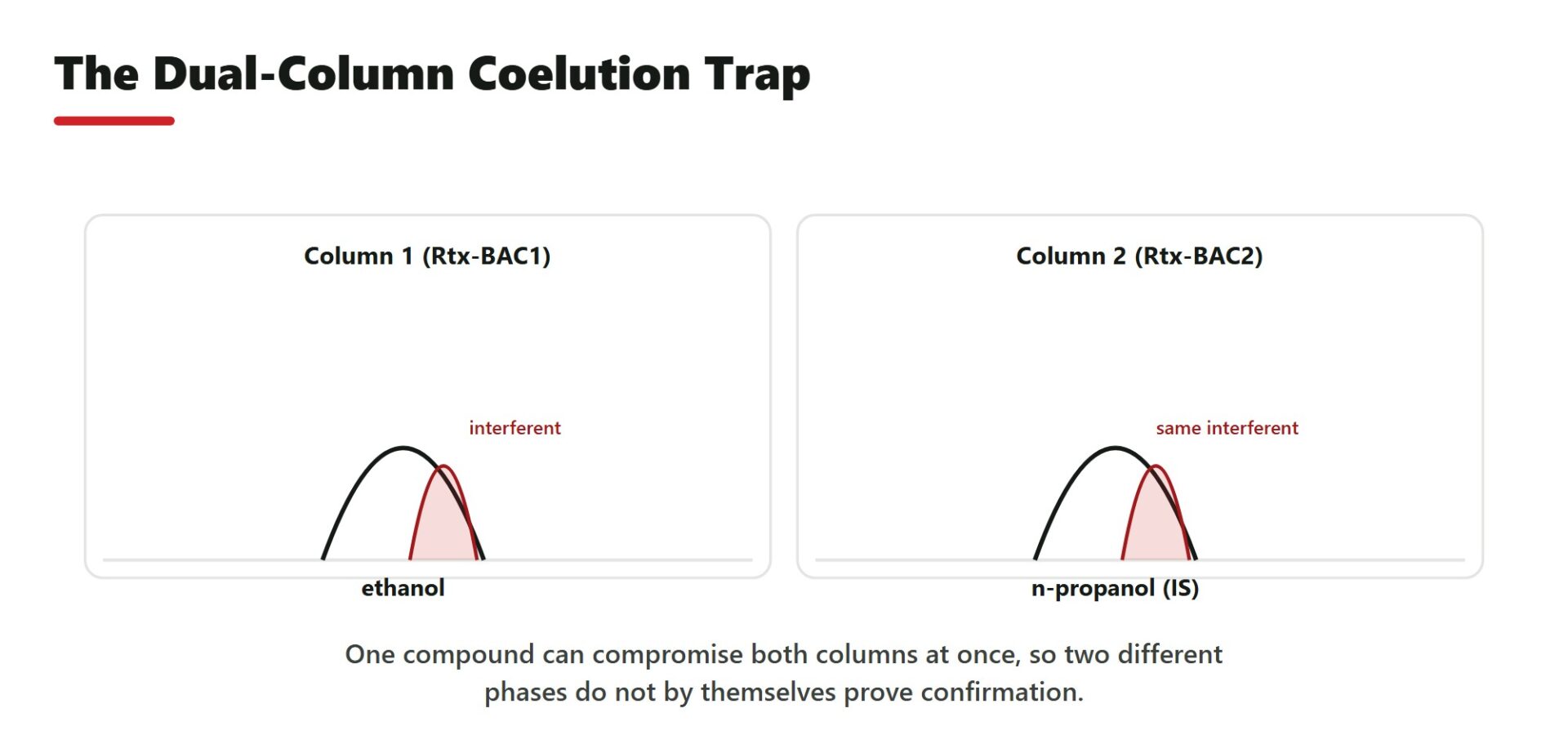
The classic problem is co-elution, where another volatile compound emerges at nearly the same time as alcohol and inflates or distorts the measurement. Substances such as acetaldehyde, acetone, and isopropanol can appear in blood, and if the column does not resolve them from ethanol, they can ride along under the alcohol peak. Other failure points include a peak at the wrong retention time, poor peak shape that signals an instrument issue, integration errors where the software miscounts the area, and problems with the internal standard that throw off the ratio. Best practice guards against several of these by confirming the result on a second column of different chemistry, so a true alcohol peak shows up correctly in two independent separations. When that confirmation is missing or the separation is poor, the identification is open to question.
The safeguards a valid result depends on
A sound ethanol result is not just a peak on a chart, it rests on a few safeguards that either were in place or were not. The first is an internal standard, usually n-propanol, added to every sample so the instrument can correct for the small variations in each injection, because without it the quantity is an estimate resting on the assumption that every injection was identical. The second is confirmation on a second column of different chemistry, so that a different volatile compound cannot ride in at the same moment as ethanol and be counted as ethanol on a single column. When those safeguards are documented and the calibrators and controls check out, a result earns its weight. When they are missing from the record, the number is a claim waiting to be tested, and the raw chromatograms, not the summary page, are where the answer lives.
Why the Credential Matters
Most defense lawyers receive the cover-page number and argue around it. A forensic lawyer-scientist requests the underlying data and reads it. The ACS-CHAL Forensic Lawyer-Scientist program is built on exactly this chemistry, and the chromatography training behind it means the questions to the analyst come from someone who understands the instrument. That changes the cross-examination from a general attack on credibility to a specific, technical inquiry the analyst has to answer on the record.
What We Request
To do this work we ask for more than the report. We request the chromatograms, the raw electronic data files, the method the lab used, the internal standard and its records, the run log showing what ran before and after your sample, and the calibration and quality control for that run. Those last items connect to the calibration and carryover and contamination pages, because the chromatogram has to be read together with the calibration that gave it meaning and the run order that surrounds it.
Why This Matters
A blood alcohol number carries enormous weight in a DUI case, and it is presented as if it were beyond dispute. It is not. It is the output of an instrument and a method with documented failure points, and the data that would reveal a problem is discoverable. Reading that data is the heart of a science-based defense.
This is the machine I trained on. I studied gas chromatography at the bench, so when the State hands over a blood-alcohol number I do not stop at the cover sheet, I go to the chromatograms, the internal standard, the calibrators, and the controls, and I read them the way the analyst should have. A clean-looking number with a messy record behind it is one of the most common problems I find, and it is one most attorneys never look for. I know exactly where to look, and I make the State prove the result the right way.
Questions About Gas Chromatography
How do Florida labs measure blood alcohol?
By headspace gas chromatography. A measured amount of blood is sealed in a vial and heated, the alcohol vapor above the blood is injected into the instrument, a column separates the compounds, and a detector records the alcohol as a peak whose size reflects the amount present.
What is the chromatogram?
It is the instrument’s real output, a graph of detector response over time showing each peak. The reported number is derived from it. Reading the chromatogram reveals whether the alcohol peak appeared at the right time, was cleanly separated, and was measured correctly.
What is the internal standard?
A fixed amount of a reference compound, commonly n-propanol, added to every sample. The result is read from the ratio of the alcohol peak to the internal standard peak, which corrects for run-to-run variation. A problem with the internal standard moves the result.
Can something else be mistaken for alcohol?
It can if the separation is poor. Compounds such as acetaldehyde, acetone, and isopropanol can appear in blood, and if the column does not resolve them from ethanol they can distort the measurement. Confirming on a second, different column guards against this, and its absence is a fair question.
Why does your chromatography training matter?
Because it lets the defense read the same data the analyst read and question it on technical ground. The ACS-CHAL Forensic Lawyer-Scientist credential is built on this chemistry, which turns a general credibility attack into a specific inquiry the analyst must answer.
What do you request to review the test?
The chromatograms, the raw data files, the method, the internal standard records, the run log, and the calibration and quality control for that run. The chromatogram has to be read together with the calibration and the run order around it.
Related: calibration and the internal standard, carryover and contamination, measurement uncertainty, the non-testing analyst, and how we challenge a blood test.
How is blood alcohol measured?
By headspace gas chromatography with flame ionization detection. The instrument identifies a compound by its retention time and measures the amount from the peak area against known calibrators. A valid result also uses an internal standard to correct each injection and a second column to confirm that ethanol, and not another compound, was measured.
From the Trial Manual
Dual-column agreement is what turns a retention time into an identity, so ask in discovery whether both columns were read and whether the two values agreed within tolerance. A number taken off one column alone is a screen dressed up as a confirmation. When you reach for a specific interferent, such as the acetone a fasting or diabetic body makes, confirm it sits in the Florida method’s validated set before you name it to a witness, and keep the close to what the method was never validated to exclude.
That note is written for lawyers. It is from The Florida DUI Trial Manual, App. B, Deposition Question Banks.
This page is general information, not legal advice, and it does not create an attorney-client relationship. Blood testing in Florida is governed by Fla. Stat. 316.1932 and 316.1933 and the Florida Administrative Code chapter 11D-8. Procedures and rules change, and every case turns on its own facts. Past results do not guarantee a similar outcome.