The tube your blood goes into is not empty. A forensic blood-alcohol tube comes with two chemicals already inside, sitting as a fine powder coating the wall of the tube. One keeps the blood from clotting. The other preserves it so the alcohol level does not change after the draw. Neither one can do its job until it dissolves into the blood, and that only happens when the person drawing the blood gently turns the tube over several times right after filling it.
When that simple step is skipped, the safeguards built into the tube never activate. The blood can clot, and the preservative can stay stuck to the glass instead of protecting the sample. A draw that looks routine on video can produce a sample that was unprotected from the very first minute, and the lab will often test it without ever knowing.
The preservative and the anticoagulant arrive as powder. Without gentle inversions to dissolve them into the blood, the sample is left exposed.
What Is Inside the Tube
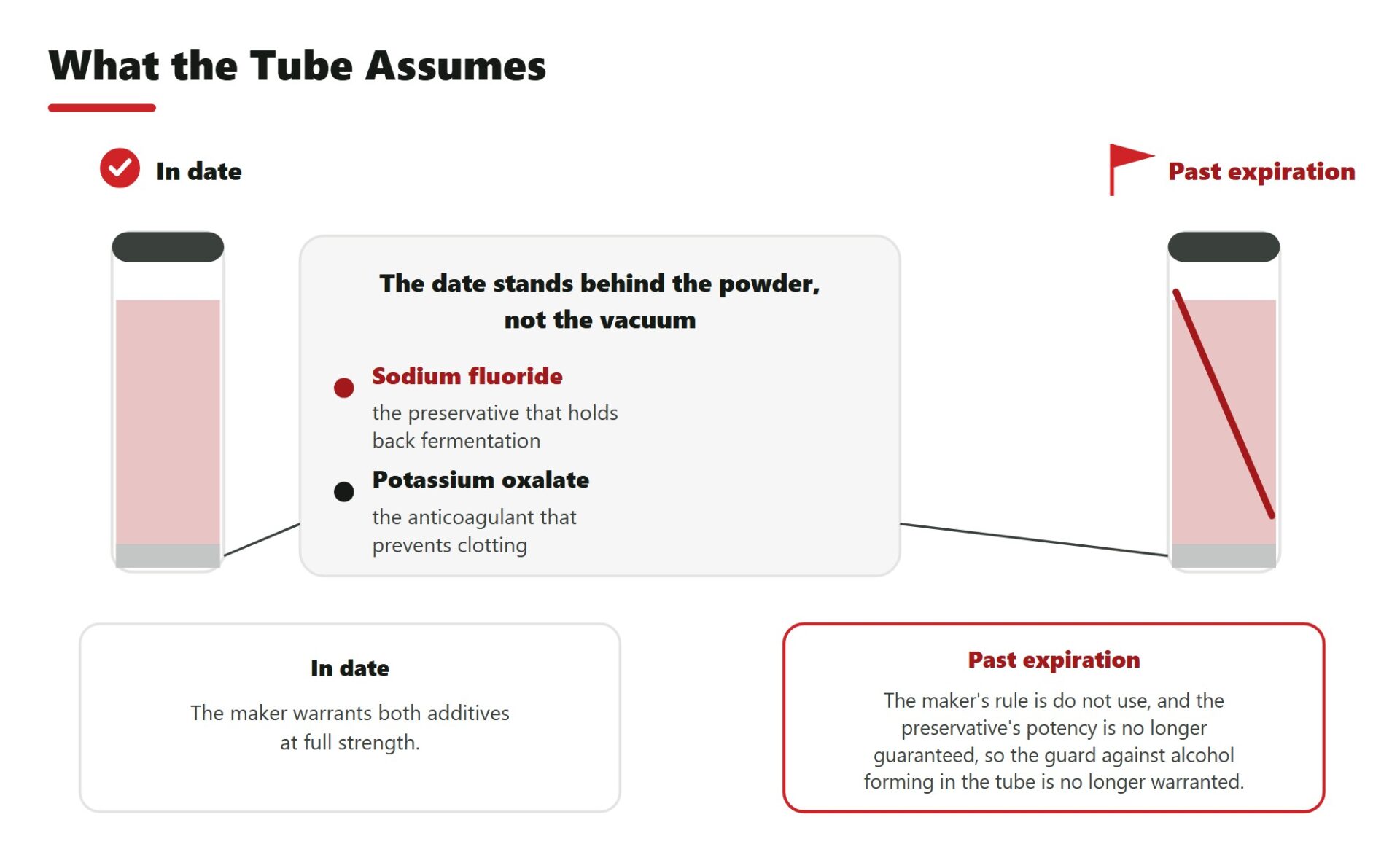
A forensic blood-alcohol tube, commonly a gray-top tube, contains two additives. The first is sodium fluoride, a preservative that stops the biological activity that can change an alcohol reading after the blood is drawn. It suppresses the microbes and the enzyme reactions that can either create alcohol in the tube or consume it. The second is potassium oxalate, an anticoagulant that keeps the blood from clotting. A clotted sample is no longer uniform, so a portion drawn from it for testing may not represent the whole. Both additives are essential, and both depend on being mixed in.
Why Inversions Are Required
The additives are coated on the inside of the tube as a dry powder. They do not dissolve on their own. The manufacturer’s instructions direct the person drawing the blood to invert the tube gently several times right after it fills, commonly eight to ten complete turns, so the powder distributes evenly through the blood. This is part of the basic technique covered on the how blood is drawn page. It takes only a few seconds, and it is the step that turns the chemicals from inert powder into active protection. Skipping it is easy and common, especially in a rushed or unfamiliar setting.
Two powders that only work if they mix
The reason inversions matter comes down to what is waiting in the bottom of the tube. A legal gray-top tube holds two powders, sodium fluoride, roughly 100 mg per 10 mL, which preserves the sample against fermentation, and potassium oxalate, roughly 20 mg, which keeps the blood from clotting. Neither one does anything sitting in a clump at the bottom. They have to dissolve evenly through the whole sample, and that only happens if the person drawing the blood gently inverts the tube several times right after filling it, usually on the order of eight to ten times, rather than shaking it or setting it down. When that step is skipped or rushed, part of the sample is left short on both protections at once, so it is more prone to clot and more prone to ferment, and a result off an unevenly mixed tube carries that doubt with it.
What Happens When the Tube Is Not Mixed
Two things can go wrong, and both hurt the reliability of the result. Without the anticoagulant dispersed, the blood can begin to clot, which makes the sample non-uniform and the eventual measurement unrepresentative. Without the preservative dispersed, the sample is left vulnerable to the biological activity sodium fluoride is supposed to stop, including the microbial fermentation that can generate alcohol after the draw. That fermentation pathway is its own subject on the fermentation page. The point here is that the failure to invert is the upstream cause that lets those later problems take hold.
A few gentle end-over-end turns dissolve the powder into the blood. Skip them and the additives never spread.
The Records That Show It
Whether the tube was inverted lives in the same places as the rest of the draw. The body-worn and dashboard video can show, or fail to show, the drawer turning the tube after filling it. The lab’s notes may record whether the sample arrived with clots, which is a strong sign that the anticoagulant never did its work. A sample noted as clotted or hemolyzed is a flag that the chemistry was disturbed, and it connects to the hemolysis and chain of custody issues we examine in parallel. We request all of it and read it together.
Why This Matters
A blood result is offered to the jury as a careful measurement, and that authority rests on the assumption that the sample was sound from the start. When the tube was never mixed, that assumption fails at the first step, before the sample ever reached the instrument. In Florida cases built on hospital-drawn blood, the question is even sharper, because medical tubes and medical routines are not designed around the forensic preservation rules. Establishing that the safeguards were never activated gives the defense a concrete, science-based reason to challenge the number rather than accept it.
Something as small as how a tube was mixed can sit under a whole blood-alcohol result, and it is exactly the kind of step that gets skipped in the rush of a stop. I ask how the tube was filled and inverted, because a preservative and an anticoagulant that never got distributed cannot do the job the result assumes they did. When the record cannot show the sample was properly mixed, I do not let the number stand as if every safeguard behind it worked.
I started out as an Assistant Public Defender in Florida’s Thirteenth Judicial Circuit, in Tampa, and today I am one of six ACS-CHAL Forensic Lawyer-Scientists in Florida and a Faculty member of the National College for DUI Defense. I work both the science and the procedure in your case the way the State’s own analysts and officers are trained to, and I show a jury the exact point where the evidence does not hold up. Learn more about my background.
Questions About Tube Inversions and the Preservative
What is in a forensic blood-alcohol tube?
Two additives in powder form: sodium fluoride, a preservative that stops the biological activity that can change the alcohol level, and potassium oxalate, an anticoagulant that keeps the blood from clotting. Both have to be mixed into the blood to work.
Why does the tube need to be inverted?
The additives are a dry powder coating the inside of the tube and do not dissolve on their own. The manufacturer directs the drawer to gently invert the tube several times, commonly eight to ten, right after it fills, so the chemicals distribute through the blood and become active.
What happens if they did not invert the tube?
The blood can clot, making the sample non-uniform, and the preservative may never disperse, leaving the sample open to fermentation and other changes after the draw. The result is a sample whose built-in safeguards never engaged.
How would anyone know whether the tube was mixed?
The video may show whether the drawer inverted the tube, and the lab’s notes may record clots, which signal that the anticoagulant did not work. We request the recording, the collection notes, and the lab worksheets and read them together.
Does this apply to blood drawn at a hospital?
It can, and the concern is often greater. Medical staff follow treatment routines rather than the forensic preservation rules, and medical tubes are not always the preserved kit the law contemplates, which raises the chance that the safeguards were not in place.
Can a missing inversion get the result excluded?
It depends on the facts. It can support a challenge to admissibility where the foundation is weak, and at a minimum it goes to the weight the jury should give a result the State presents as precise. A close review of the draw determines how strong the issue is.
Related: how blood is drawn, fermentation, hemolysis, storage and time, and how we challenge a blood test.
Why do the inversions of a blood tube matter?
The gray-top tube holds two powders that have to mix through the blood to work: sodium fluoride, about 100 mg per 10 mL, to prevent fermentation, and potassium oxalate, about 20 mg, to prevent clotting. They distribute only if the tube is gently inverted several times after the draw. Skipping that leaves part of the sample under-protected against both.
This page is general information, not legal advice, and it does not create an attorney-client relationship. Blood testing in Florida is governed by Fla. Stat. 316.1932 and 316.1933 and the Florida Administrative Code chapter 11D-8. Procedures and rules change, and every case turns on its own facts. Past results do not guarantee a similar outcome.