A blood draw in a DUI case is not just a nurse and a needle. It is a regulated procedure with rules about who is allowed to draw the blood, how the skin is prepared, what tube the blood goes into, and how the sample is sealed and documented. Those rules exist because the number that comes out of the lab is only as trustworthy as the sample that went in. When the draw departs from the standard, the reliability of everything downstream is open to question.
Florida sets these requirements in statute and in the Florida Administrative Code, and the crime labs build their procedures on top of them. A forensic review of a blood case starts at the very beginning of that chain, at the moment the blood left the arm, because that is where many problems are born and never noticed.
Each requirement is a standard the State has to meet. Each is also a place a careful review can find a problem the lab never flagged.
Who Is Allowed to Draw Your Blood
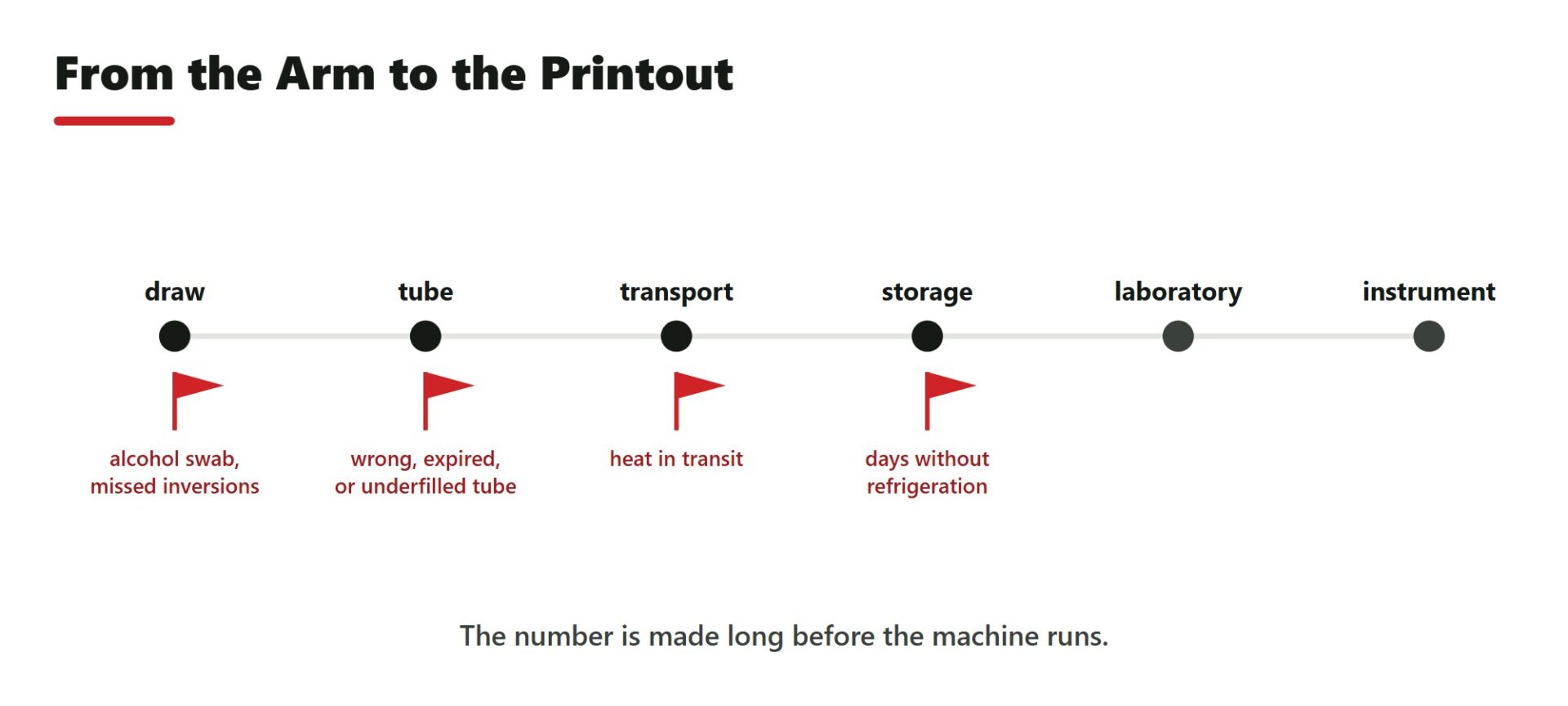
Florida does not let just anyone draw blood for a DUI case. Under Fla. Stat. 316.1932 and 316.1933, the blood must be withdrawn by a person within a defined group, which includes a physician, a registered nurse, a licensed practical nurse, a licensed clinical laboratory technologist or technician, or other personnel authorized by a hospital to draw blood, acting at the request of a law enforcement officer. The reason is straightforward. Drawing blood well takes training, and a poorly performed draw can damage the sample before it ever reaches the lab. When the record does not show that an authorized person performed the draw, that is a foundational gap worth pressing.
The Antiseptic Cannot Contain Alcohol
This one surprises people. Florida Administrative Code Rule 11D-8.012 requires that the skin be cleaned with an antiseptic that does not contain alcohol before the needle goes in. The concern is contamination. An alcohol-based swab introduces the very substance the test is trying to measure right at the puncture site, which gives the defense a clean argument that the sample was tainted at the source. Hospitals reach for an alcohol prep pad by reflex because it is the everyday standard for medical care, and that reflex is exactly how this rule gets broken in forensic draws. The video and the kit documentation often tell the story.
The Right Tube, With the Right Powder Inside
A forensic blood-alcohol sample goes into a specific kind of tube, commonly a gray-top tube, that contains two additives in powder form. One is a preservative, sodium fluoride, which stops microbes and enzymes from changing the alcohol level after the draw. The other is an anticoagulant, potassium oxalate, which keeps the blood from clotting so the sample stays uniform. Both have to be present and in working condition. A tube past its expiration, a tube without preservative, or a medical tube grabbed off a hospital shelf instead of the forensic kit can let the sample drift away from the truth. We cover what the preservative does, and what happens when the tube is not mixed, on the tube inversions and fermentation pages.
It is worth naming what that powder is, because “the right tube” has a specific meaning. The gray-top legal tube carries sodium fluoride, roughly 100 mg per 10 mL, which preserves the sample against fermentation, and potassium oxalate, roughly 20 mg, which keeps it from clotting. A draw into the wrong tube, or a tube missing the preservative, starts the sample off compromised before it ever reaches the lab, which is why the choice of tube is not a detail but a foundation.
Sealed, Labeled, and Documented
After the draw, the sample has to be sealed, labeled, and tracked so that everyone can be sure the blood tested in the lab is the same blood drawn from the arm. Missing seals, a label that does not match, a gap in the paperwork, or a handoff no one recorded all weaken the State’s ability to prove the sample’s integrity. That continuous record is the subject of the chain of custody page, and it is one of the most common places a blood case shows its cracks.
Why These Rules Decide Cases
The State has to lay a foundation before a blood result comes into evidence, which means showing the draw followed the rules and the sample is reliable. When a draw used the wrong antiseptic, the wrong tube, or an unauthorized drawer, that foundation is shaky. In some cases that goes to admissibility and can keep the number out. In others it goes to weight, giving the jury a concrete reason to doubt a result that looks authoritative on its face. In Florida DUI cases built on hospital-drawn blood, these questions come up often, because medical blood is collected for treatment, not for court, and rarely matches what the forensic rules require. Reading the draw records closely is the first step in finding out which problem your case has.
The draw is where a lot of blood cases are quietly won or lost, long before anyone looks at a number. I check who drew the blood, what they cleaned the site with, which tube they used, and whether it was mixed, sealed, and labeled the way it should have been. Each of those steps is a place a good sample can be turned into a bad one, and when the record cannot show they were done right, the result that followed does not deserve to be treated as clean.
I started out as an Assistant Public Defender in Florida’s Thirteenth Judicial Circuit, in Tampa, and today I am one of six ACS-CHAL Forensic Lawyer-Scientists in Florida and a Faculty member of the National College for DUI Defense. I work both the science and the procedure in your case the way the State’s own analysts and officers are trained to, and I show a jury the exact point where the evidence does not hold up. Learn more about my background.
Questions About How DUI Blood Is Drawn
Who is allowed to draw blood in a Florida DUI case?
Florida law limits it to a defined group, including a physician, a registered nurse, a licensed practical nurse, a clinical laboratory technologist or technician, or other hospital-authorized personnel, acting at an officer’s request. If the record does not show an authorized person performed the draw, that is a gap worth challenging.
Is it a problem if they cleaned my arm with an alcohol swab?
It can be. Florida Administrative Code Rule 11D-8.012 requires a non-alcohol antiseptic for the skin before a forensic blood draw, because an alcohol swab can contaminate the sample with the very substance being measured. Hospitals often use alcohol prep pads out of habit, which is how this rule gets broken.
What kind of tube should my blood have gone into?
A forensic sample goes into a tube, commonly a gray-top tube, that contains a preservative and an anticoagulant. If a medical tube was used, or a tube with no preservative or one past its expiration, the sample can change after the draw and the result becomes less reliable.
Does it matter that my blood was drawn at a hospital for treatment?
It can matter a great deal. Medical blood is collected for care, not for court, so it often is not in the right tube, not preserved the same way, and not handled under the forensic rules. That gap opens several lines of challenge, which we explore on the medical blood pages.
What records show whether the draw was done right?
The blood kit paperwork, the lab’s collection notes, the body-worn and dashboard video, and the chain-of-custody documents. Together they show who drew the blood, what antiseptic and tube were used, and whether the sample was sealed and tracked.
If the draw broke a rule, is the result thrown out?
Not always. Some violations go to admissibility and can keep the result out, while others go to the weight the jury should give it. Which one applies depends on the rule that was broken and the facts of your case, which is why a close review matters.
Related: tourniquet and hemoconcentration, tube inversions, fermentation, chain of custody, and how we challenge a blood test.
From the Trial Manual
Two kinds of alcohol, and the rule bars both. The collection rule requires a non-alcohol antiseptic, so any alcohol prep is a departure whatever the kind. The science then turns on the kind: an ethanol prep adds the very substance being measured, and a gas chromatograph cannot separate it from the blood ethanol; an isopropyl prep a chromatograph does separate, so it does not inflate a GC ethanol result, though it still breaks the rule and it interferes with a hospital enzymatic test. Draw the rule departure first, which does not turn on the kind, then let the kind and the testing method decide the science. The concession you want is the gap, that the witness cannot say which antiseptic was used or that the draw kept alcohol out of this sample, not a claim that alcohol got in. Chapter 9 carries the detail.
That note is written for lawyers. It is from The Florida DUI Trial Manual, Part 7, Cross of the Blood Analyst.
This page is general information, not legal advice, and it does not create an attorney-client relationship. Blood testing in Florida is governed by Fla. Stat. 316.1932 and 316.1933 and the Florida Administrative Code chapter 11D-8, including Rule 11D-8.012 on sample collection. Procedures and rules change, and every case turns on its own facts. Past results do not guarantee a similar outcome.