When the State introduces a blood result, it leans on the laboratory’s reputation. The lab is accredited, the argument goes, so the result can be trusted. Accreditation is real and it matters, but it is not a guarantee that your specific test was done right. It is a system of documented requirements, and the records that system generates are discoverable. Those records often tell a more complicated story than the cover page.
Accreditation creates a paper trail: what the lab is approved to do, how it proved its methods work, how it performs on outside tests, and what happened when something went wrong. A defense that knows what to ask for can use that trail to test whether the lab’s general reputation reaches your result.
Accreditation is a documented system. Each box is a record that exists, and each record is something a careful defense can request.
What Accreditation Means
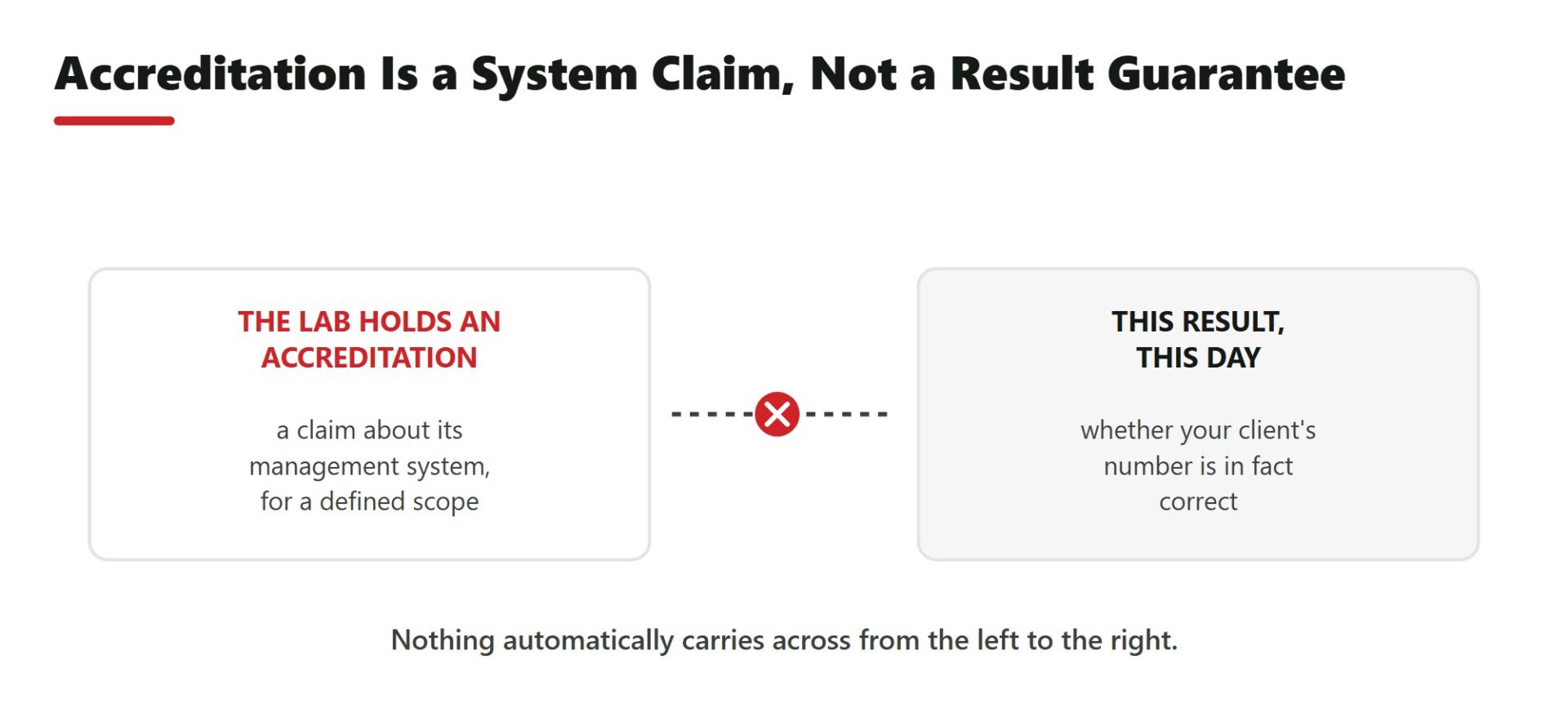
Forensic laboratories are typically accredited to ISO/IEC 17025, the international standard for testing and calibration laboratories, through an accrediting body such as ANAB or A2LA. The standard requires a documented quality management system: validated methods, competent and trained staff, controlled equipment, traceable calibration, ongoing quality control, and a process for handling problems. Accreditation says the lab built that system and passes periodic audits. It does not certify that every individual result is correct, which is the gap a defense examines.
Accreditation is a floor, not a finish line
It is worth being clear about what accreditation does and does not prove, because the State likes to present it as a seal of certainty. A laboratory earns accreditation by showing an assessor that it meets the ISO/IEC 17025 standard, which covers validated methods, traceable calibration, competent analysts, and documented quality control. That is a real bar, and it is a floor rather than a guarantee. It says the lab met requirements on the day it was assessed. It does not say that every step on your specific sample was done right, and it does not cover a method that falls outside the lab’s accredited scope. The difference matters, because a badge on the wall is not the same as a clean record on your case, and the records that show the difference, the validation data, the proficiency-testing results, and the corrective-action files, are exactly what discovery is for.
The Scope of Accreditation
A lab is accredited for specific methods within a defined scope, not for everything it might do. The scope document lists exactly what tests the lab is approved to perform and under what conditions. When a test falls outside the accredited scope, or was run in a way the scope does not cover, the reassurance that accreditation provides does not apply. Reading the scope is a basic and often overlooked step, because the State’s broad claim of an accredited lab has to be matched against what the lab is accredited to do.
Validation and Proficiency Testing
Two kinds of records are especially revealing. Validation studies are the lab’s own proof that a method produces reliable results across the range it is used for, and a validation that did not cover the circumstances of your sample is a weakness. Proficiency tests are outside, often blind, challenges where the lab analyzes samples of known value to show it can get the right answer. A failed or marginal proficiency result, or a pattern of them, is powerful, because it is the lab’s performance measured by someone other than the lab. Both sets of records are discoverable.
Corrective Actions Tell the Story
When something goes wrong in an accredited lab, the system requires it to be documented and addressed through a corrective action. These reports are a candid internal record of errors, near misses, and recurring problems. A corrective action describing an issue with the same instrument, method, or analyst involved in your case is directly relevant. Patterns across many corrective actions can show a lab under strain in ways the polished final report never hints at.
The reassurance of an accredited lab has to be checked against its own records, where the real performance shows.
What We Request
We ask for the certificate and scope of accreditation, the method validation studies, the proficiency test results and history, the internal quality control records, the corrective action reports, the audit findings, the training and competency records for the analyst, and the laboratory’s quality manual. Read together with the chromatography, the calibration, and the measurement uncertainty, these records show whether the lab’s general standing supports your specific result.
Why This Matters
Accreditation is a strong talking point for the State and a thin one if no one looks behind it. The same system that lets a lab claim accreditation requires it to keep records that can undercut a particular result. Knowing the records exist, and knowing how to request and read them, is part of a science-based defense.
When the State points to a lab’s accreditation, I treat it as a starting point rather than an answer. I check that the method used on your sample was inside the accredited scope, I read the validation and proficiency data, and I go to the corrective-action records, because a lab’s own file on where it has gone wrong tells you more than the certificate on the wall. Accreditation earns a lab a baseline of trust, and it does not settle whether your result was measured correctly, which is the only question that matters for you.
I started out as an Assistant Public Defender in Florida’s Thirteenth Judicial Circuit, in Tampa, and today I am one of six ACS-CHAL Forensic Lawyer-Scientists in Florida and a Faculty member of the National College for DUI Defense. I work both the science and the procedure in your case the way the State’s own analysts and officers are trained to, and I show a jury the exact point where the evidence does not hold up. Learn more about my background.
Questions About Lab Accreditation and Discovery
What does it mean that a lab is accredited?
It means the lab built a documented quality system that meets a standard like ISO/IEC 17025 and passes periodic audits. It is a system, not a certification that every individual result is correct, which is the gap a defense examines.
What is the scope of accreditation?
The specific list of methods the lab is approved to perform and the conditions for each. When a test was run outside that scope, the reassurance of accreditation does not reach it.
What are validation and proficiency tests?
Validation is the lab’s proof a method works across its used range. Proficiency tests are outside challenges where the lab analyzes known samples to show it gets the right answer. A weak validation or a failed proficiency test is revealing, and both are discoverable.
What is a corrective action report?
An internal record created when something goes wrong, documenting the problem and the fix. One touching the instrument, method, or analyst in your case is directly relevant, and a pattern across many can show a lab under strain.
Are these records available to the defense?
Yes. The scope, validation studies, proficiency results, quality control, corrective actions, audits, training records, and quality manual are generally discoverable, which is what lets a defense look behind the accreditation.
Does accreditation mean my result is reliable?
Not by itself. It means the lab has a system in place. Whether your specific result is reliable depends on the records for your test, which is why we request and review them.
Related: gas chromatography, calibration, measurement uncertainty, the non-testing analyst, and how we challenge a blood test.
The lab is accredited. Does that mean my result is reliable?
Not by itself. Accreditation to the ISO/IEC 17025 standard shows a lab met requirements at an assessment, which is a floor rather than a guarantee. It does not prove every step on your sample was done correctly, and it does not cover a method outside the lab’s accredited scope. The validation, proficiency, and corrective-action records are what show the real picture.
From the Trial Manual
Before this run, pull the laboratory’s batch and sequence records and any corrective-action file for a prior sample mix-up; the re-rack over capacity, a case number that does not match the incident number, and a look-alike name in the same run become concessions only if the discovery carries them, which is why each is flagged to the record.
That note is written for lawyers. It is from The Florida DUI Trial Manual, Part 7, Cross of the Blood Analyst.
This page is general information, not legal advice, and it does not create an attorney-client relationship. Blood testing in Florida is governed by Fla. Stat. 316.1932 and 316.1933 and the Florida Administrative Code chapter 11D-8. Procedures and rules change, and every case turns on its own facts. Past results do not guarantee a similar outcome.