A blood alcohol result is reported as a single, confident number, something like 0.09. That number hides a fact every scientist knows: no measurement is exact. Every instrument and every method carries a margin of error, which means the true value is not a single point but a range around the reported figure. When the State treats the number as a precise fact, it is leaving out half the picture.
This matters most when the result sits near the legal limit. If the reported number is close to 0.08 and the range of uncertainty reaches below it, then the State cannot be sure the true value was over the line at all. In a system that requires proof beyond a reasonable doubt, that gap is exactly where a careful defense lives.
When the uncertainty range around the reported value reaches below 0.08, the true level may have been under the limit.
Every Measurement Has Uncertainty
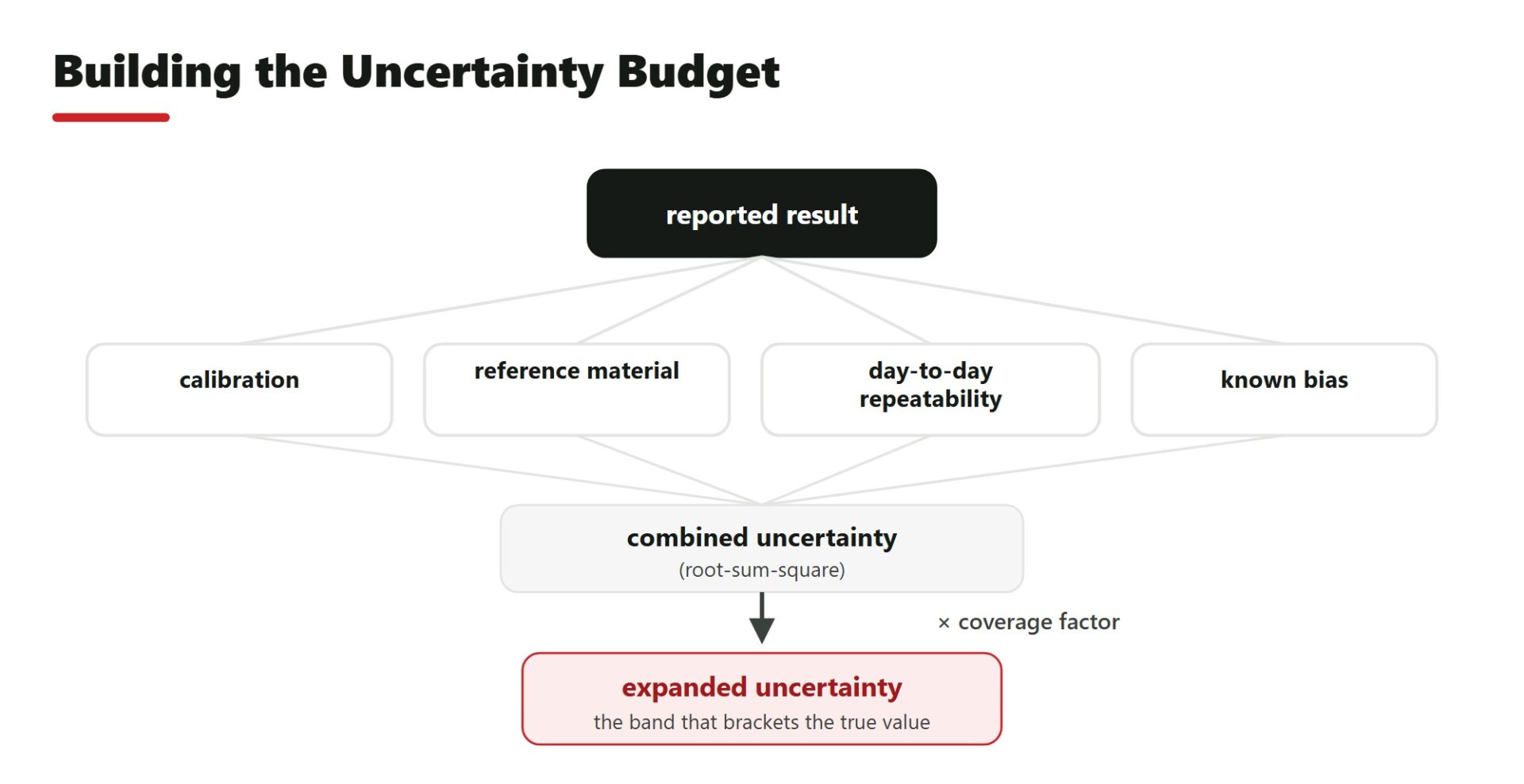
Uncertainty is not a sign that the lab did something wrong. It is a basic property of measurement. Every step, the calibration, the repeatability of the instrument, the small variations in how a sample is handled, contributes a little bit of spread to the result. Good laboratories know this and estimate how large that spread is. The honest way to report a result is not as a single number but as a value plus or minus an amount, with a stated level of confidence.
The Reported Number Is a Range
When a lab estimates its measurement uncertainty, it produces what amounts to a window around the result. A value reported with an expanded uncertainty at a high confidence level means the laboratory expects the true value to fall within that window almost all of the time. The single number on the report is just the center of that window. A result of 0.09 with a meaningful uncertainty might describe a true value anywhere across a small band, and whether that band stays above 0.08 is a real and answerable question.
What the margin looks like at the line
Put a number on it and the point becomes hard to argue with. Say the lab reports a 0.09 and states its measurement uncertainty as plus or minus 0.01 at its own confidence level. That does not mean the true value is 0.09, it means the true value lies somewhere in a band from about 0.08 to 0.10. The result is touching the line rather than sitting above it, and a jury told the truth about that band has real room for doubt. The same math matters at 0.15, the enhanced line that raises the penalties, where a result reported just above it can straddle the threshold once the margin is included. A number handed over with no stated uncertainty at all is worse, because it hides the range the science says has to be there.
Why the Range Can Decide a Case
Florida’s per se limit draws a hard line at 0.08. The law treats a number at or above it very differently from a number below it. So when the reported value sits close to the line and the uncertainty window dips beneath it, the State is asking a jury to convict on a value that might have been under the limit. The burden of proof runs the other way. The defense does not have to prove the level was under 0.08. The State has to prove it was over, and an honest accounting of uncertainty can make that proof much harder.
The lab estimates each source of error and combines them. The result is the window the true value lives in.
Accredited Labs Must Estimate It
This is not a fringe argument. The international standard that accredits forensic laboratories requires them to estimate and document their measurement uncertainty. That means the lab that tested your blood should have an uncertainty figure for the method, and that figure is discoverable. The connection runs straight to the lab accreditation page, because accreditation is what obligates the lab to know and record how uncertain its measurements really are.
What We Request
We ask for the laboratory’s measurement uncertainty estimate for the blood alcohol method, the data behind it, and the way it should be applied to your result. We read it together with the calibration and the gas chromatography data, because those are the sources that feed the uncertainty. The goal is to put the honest range in front of the court, not the stripped-down single number.
Why This Matters
A number presented as exact can carry a jury past a reasonable doubt that the science itself does not support. Measurement uncertainty is the lab’s own admission that the truth is a range. When that range touches the legal limit, it is one of the most direct challenges a blood case offers.
A blood-alcohol result is an estimate with a margin, and the margin is where a lot of cases live. I ask for the laboratory’s own uncertainty estimate, its validation data, and the records behind the number, because a lab working to standard is supposed to know its own margin and state it. When a result sits close to a legal line, I make sure the jury sees the whole band and not just the single tidy figure, since the difference between a number over the line and a number touching it can be the difference in your case.
I started out as an Assistant Public Defender in Florida’s Thirteenth Judicial Circuit, in Tampa, and today I am one of six ACS-CHAL Forensic Lawyer-Scientists in Florida and a Faculty member of the National College for DUI Defense. I work both the science and the procedure in your case the way the State’s own analysts and officers are trained to, and I show a jury the exact point where the evidence does not hold up. Learn more about my background.
Questions About Measurement Uncertainty
What is measurement uncertainty?
It is the range around a reported value within which the true value is expected to fall. Every measurement has it, because calibration, the instrument, and handling each add a small amount of spread. The single number on the report is the center of that range.
Does uncertainty mean the lab made a mistake?
No. It is a basic property of measurement, not a sign of error. A good lab estimates and documents its uncertainty precisely because no measurement is exact.
Why does it matter near 0.08?
Florida’s limit is a hard line at 0.08. If the reported value is close to the line and the uncertainty range reaches below it, the true level may have been under the limit, which undermines proof beyond a reasonable doubt.
Doesn’t the State just have to show the reported number?
The State has to prove the level was at or above 0.08. The defense does not have to prove it was under. An honest range that dips below the limit makes the State’s proof harder, because the burden runs against it.
Is the uncertainty figure available?
It should be. The accreditation standard requires labs to estimate and document measurement uncertainty for their methods, which makes the figure discoverable in your case.
How do you use it in my defense?
We request the lab’s uncertainty estimate and the data behind it, read it with the calibration and chromatography, and present the true range to the court instead of the single number the report shows.
Related: calibration, gas chromatography, lab accreditation and discovery, serum versus whole blood, and how we challenge a blood test.
My blood alcohol was just over the limit. Does the margin of error matter?
It can decide the case. Every result carries measurement uncertainty, a range around the number that a competent lab must estimate. A reported 0.09 with an uncertainty of plus or minus 0.01 means the true value could be as low as 0.08, so the result touches the line rather than clearing it. The same is true at the 0.15 enhanced line.
This page is general information, not legal advice, and it does not create an attorney-client relationship. Blood testing in Florida is governed by Fla. Stat. 316.193, 316.1932, and 316.1933 and the Florida Administrative Code chapter 11D-8. Procedures and rules change, and every case turns on its own facts. Past results do not guarantee a similar outcome.