Here is a fact that unsettles people the first time they hear it. Blood can make its own alcohol after it leaves the body. A vial of blood is a warm, sugary, living thing, and if the wrong microbes get into it and the conditions are right, they will ferment the sugar into ethanol, the same alcohol the test is measuring. When that happens in the tube, the number the lab reports can be higher than the alcohol that was ever in the driver.
This is not a fringe theory. It is a well-recognized problem in forensic toxicology, and it is the reason the collection tube contains a preservative and the reason labs are supposed to refrigerate samples. When the preservative is inadequate or the storage is poor, post-collection fermentation moves from a possibility to a real question the State has to answer.
Fermentation needs microbes, sugar, warmth, and time. The preservative and the cold are what stand in the way, and the case turns on whether they were really there.
How a Sample Can Make Alcohol
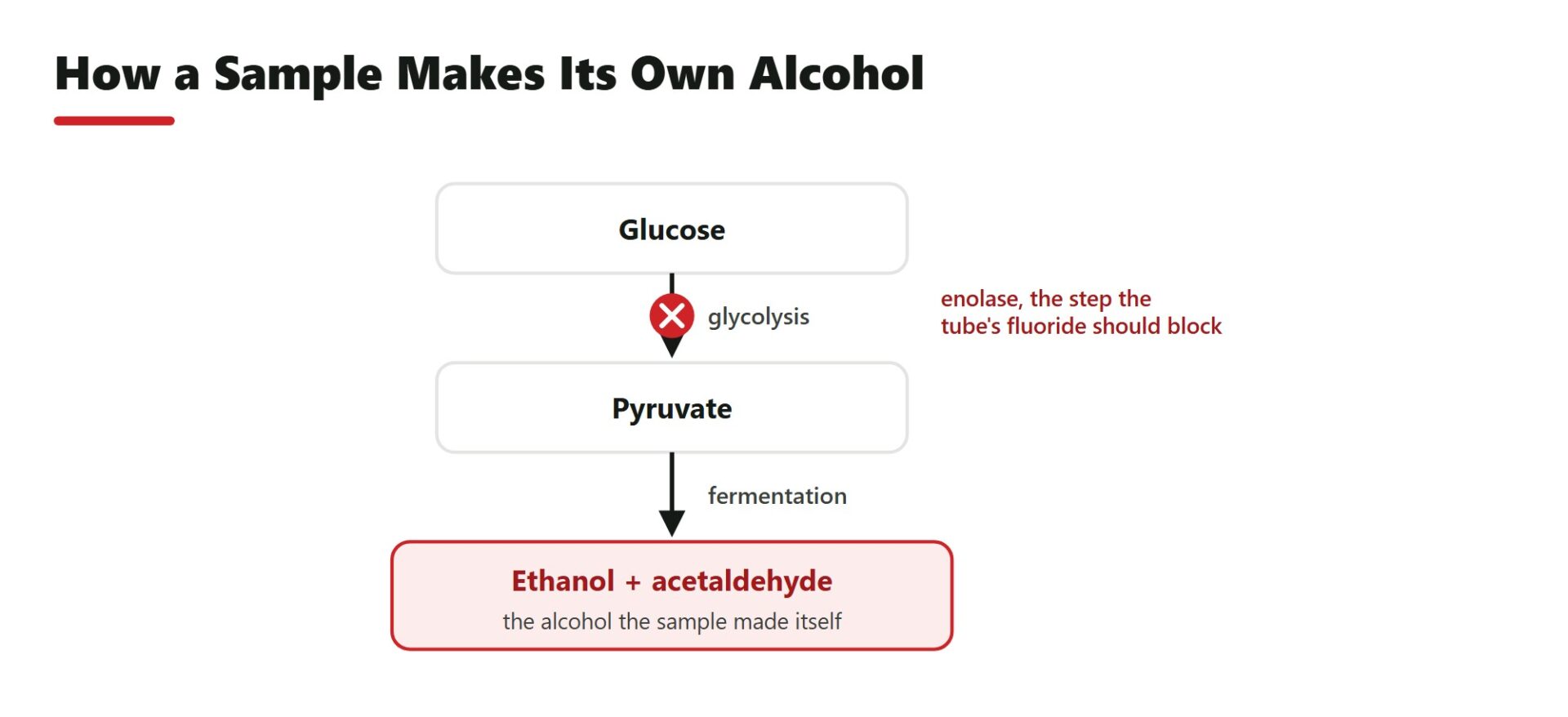
Fermentation is the process by which microorganisms convert sugar into alcohol. Blood contains glucose, and certain yeasts and bacteria, with Candida albicans among the best known, will ferment that glucose into ethanol if they are present in the sample. Forensic toxicologists call alcohol created this way neoformation, meaning alcohol that formed after collection rather than alcohol the person drank. The body itself does not work this way in a healthy living person, but a vial of blood sitting outside the body, contaminated and unprotected, is a different environment, and there fermentation can take hold.
The mechanism, and what is supposed to stop it
It helps to be concrete about how a tube of blood makes alcohol on its own. Blood carries glucose, and yeasts such as Candida, if they get into a sample, do to that glucose exactly what yeast does to sugar in a brewery, they ferment it into ethanol. The result is a blood-alcohol reading that was never in the living person. This is the reason the legal tube is not an ordinary one. The gray-top tube holds sodium fluoride, roughly 100 mg per 10 mL, as a preservative whose job is to suppress the microbial growth that drives fermentation. When that preservative is present in the right amount and the sample is kept cold, the risk is small. When the preservative is short, the tube is wrong, or the sample sat warm, the risk climbs, and a number that looks solid may be a number the sample manufactured.
What Stops It: Preservative and Cold
Two safeguards are supposed to prevent fermentation. The first is the preservative in the tube, sodium fluoride, which suppresses the microbial and enzyme activity that drives the process. That preservative only works if it is present in adequate amount and mixed into the blood, which ties this issue directly to the tube inversions page. The second safeguard is temperature. Refrigeration slows microbial growth, and a sample kept cold is far less likely to ferment than one left warm. When either safeguard is missing, the protection is incomplete.
When the Risk Is Highest
Several conditions raise the chance of fermentation, and they often appear together. A tube with no preservative or too little of it, a sample that was not refrigerated promptly, a long delay between the draw and the analysis, and contamination introduced during a sloppy draw all push in the same direction. Time and warmth let microbes multiply. The concern grows further with blood drawn at a hospital for treatment, because medical samples are collected and stored for clinical purposes, not under the forensic preservation rules, and they are not always in the right tube. The basic collection standards on the how blood is drawn page are what keep this risk in check, and the storage and time page covers the delay side in depth.
It Can Cut Both Ways
Fermentation is most often raised because it can add alcohol that was never in the driver, but the same instability can also work in the other direction, with alcohol lost from a poorly kept sample over time. Either way, the lesson is the same. A sample that was not properly preserved and stored is not a stable, trustworthy record of the blood-alcohol level at the time of driving. The State carries the burden of showing the result is reliable, and an unpreserved or mishandled sample makes that burden hard to meet.
How We Investigate
We trace the sample from the arm to the instrument. We look at whether the tube contained an adequate preservative and whether it was mixed, when and how the sample was refrigerated, how long it sat before testing, and whether anything in the lab notes flags a problem. Where the blood was drawn at a hospital, we pull the medical records to learn what tube was used and how the sample was handled before anyone thought about a prosecution. In Florida DUI cases that rest on hospital blood, these questions surface regularly, because the gap between medical collection and forensic standards is exactly where fermentation can slip in. When the records show the safeguards were not in place, we put the reliability of the number squarely in issue.
I always ask what was in the tube and how the sample was kept, because a blood-alcohol result assumes the sample stayed exactly as it was drawn, and biology does not always cooperate. I check the preservative, the storage temperature, and the time the sample sat, since a warm, poorly preserved sample can gain alcohol it never had or lose alcohol it did. When the record cannot rule that out, the number is not the stable fact the State treats it as, and I make that instability part of your defense.
I started out as an Assistant Public Defender in Florida’s Thirteenth Judicial Circuit, in Tampa, and today I am one of six ACS-CHAL Forensic Lawyer-Scientists in Florida and a Faculty member of the National College for DUI Defense. I work both the science and the procedure in your case the way the State’s own analysts and officers are trained to, and I show a jury the exact point where the evidence does not hold up. Learn more about my background.
Questions About Fermentation and Blood Alcohol
Can blood really produce alcohol after it is drawn?
Yes. Microbes such as certain yeasts and bacteria can ferment the glucose in a blood sample into ethanol if they are present and the conditions are right. Forensic toxicologists call alcohol that forms this way neoformation, meaning it appeared after collection rather than from drinking.
What is supposed to prevent fermentation?
Two things. The preservative in the tube, sodium fluoride, suppresses the microbial activity, and refrigeration slows microbial growth. Both have to be in place. If the preservative is inadequate or the sample was left warm, the protection is incomplete.
When is fermentation most likely?
When the tube lacked enough preservative, the sample was not refrigerated promptly, a long time passed before testing, or contamination entered during the draw. The risk is higher with hospital blood, which is collected and stored for treatment rather than under the forensic rules.
Could fermentation have raised my number?
It is possible where the safeguards were missing. Fermentation can add alcohol that was never in the driver, and the same instability can also cause alcohol to be lost. Either way, a poorly preserved sample is not a reliable record of the blood-alcohol level at the time of driving.
Does this apply to hospital-drawn blood?
Often it applies with extra force. Medical samples are gathered and stored for clinical care, not for court, and may not be in a preserved forensic tube. We pull the medical records to learn what tube was used and how the sample was kept.
How do you prove fermentation is a concern?
We document the preservative, the refrigeration, the time between the draw and the analysis, and any lab notes that flag a problem, and we are prepared to present the science to the court. When the safeguards were not in place, that supports a challenge to the reliability of the result.
Related: tube inversions, how blood is drawn, storage and time, hemolysis, and how we challenge a blood test.
This page is general information, not legal advice, and it does not create an attorney-client relationship. Blood testing in Florida is governed by Fla. Stat. 316.1932 and 316.1933 and the Florida Administrative Code chapter 11D-8. Procedures and rules change, and every case turns on its own facts. Past results do not guarantee a similar outcome.