A reliable test is built to find the truth, whatever it turns out to be. The drug evaluation is built differently. It opens by learning the arrest theory from the officer who made the stop, runs through a series of observations, and closes with an opinion that a chemical test is then said to confirm. From the first step to the last, the process is pointed at a conclusion, and that order is a problem the defense can show plainly.
The evaluation opens by learning the arrest theory and closes by confirming it. That sequence is a recipe for confirmation bias, not a guard against it.
The Order of the Steps
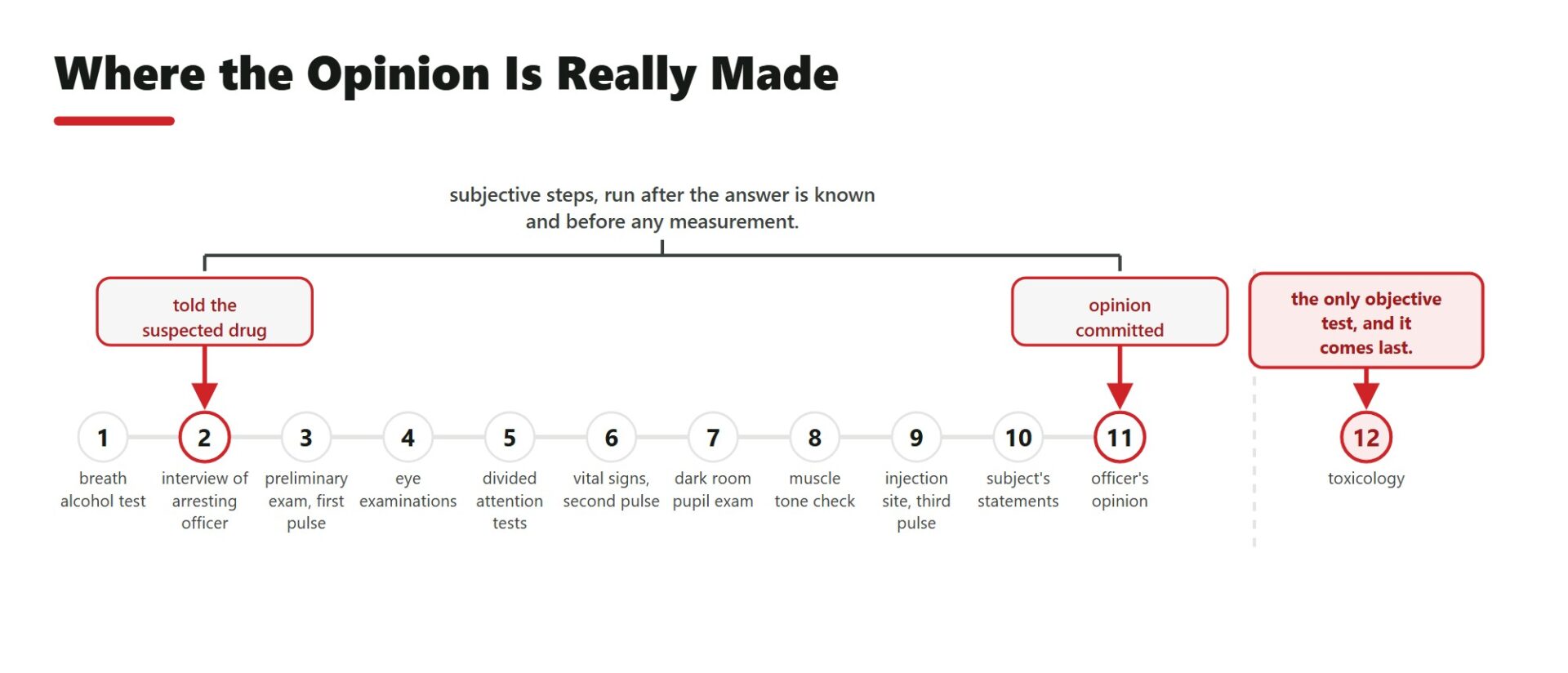
Step two of the evaluation is an interview with the arresting officer. Before the examination is truly underway, the evaluator learns why the driver was stopped and what drug is suspected. Knowing the expected answer at the outset shapes how every later sign is read, because ambiguous findings get interpreted in the direction of the conclusion already in mind. This is confirmation bias, a normal human tendency rather than bad faith, and the structure of the evaluation invites it instead of guarding against it.
Opinion First, Test Second
The sequence ends with the officer’s opinion at step eleven and the toxicology at step twelve. The opinion is formed before the laboratory result is known, and the result is then presented as confirmation. Real science runs the other way, forming a hypothesis and then testing it against evidence that could prove it wrong. When an opinion is reached first and the test is used to support it, the confirmation is far weaker than it sounds, and a jury shown the order can understand why.
Why a toxicology “match” does not fix the problem
The State’s answer to all of this is simple: the lab confirmed the officer was right. Look closer and that confirmation is thinner than it sounds. The toxicology only tells you whether a drug in the predicted category was somewhere in the body. It does not tell you the person was impaired, and it does not tell you the drug had anything to do with the driving. So a “match” lines up the officer’s guess with the presence of a substance, which is a much smaller claim than the one the officer made on the stand. Worse, the officer picked the category before the sample was ever tested, so the whole exercise is a person deciding on an answer and then being told whether the answer showed up, which is exactly the kind of bias that makes a result unreliable rather than proof.
How to Show the Bias to a Jury
Confirmation bias is easy to assert and harder to prove, so the work is in the documents and the timeline. I line up the arrest report against the face sheet and the narrative to show what the evaluator knew, and when. I look at whether the recorded signs were read in the direction of the expected answer, whether contrary signs were noted or quietly dropped, and whether the opinion was written before or after the sample was sent. A jury does not need a psychology lecture to understand that a test which starts with the answer and ends by confirming it is not a neutral one. Shown the order plainly, they can weigh the opinion accordingly.
What a Neutral Test Would Look Like
It helps a jury to picture the test that was not given. A neutral evaluation would keep the examiner from learning the arrest theory in advance, would record every sign before any conclusion was reached, and would lock in the opinion before the toxicology was known so the result could prove the opinion wrong. The drug evaluation does close to the opposite at each point. The examiner is briefed by the arresting officer, the signs are gathered with the suspected answer already in mind, and the opinion is announced before the test returns and then said to be confirmed by it. Holding the real procedure next to the neutral one makes the difference concrete, and it lets the jury see that the structure rewards agreement with the arrest rather than testing it.
Once you see the order of the steps, you cannot unsee it. The officer decides, then the test is asked to nod along, and the jury is told that nod is proof. I walk them back through the sequence and show them how the opinion came first and how a presence-only lab result was dressed up as confirmation of impairment. I know this protocol from the inside, so I can show exactly where the officer’s expectation did the work the evidence was supposed to do.
I started out as an Assistant Public Defender in Florida’s Thirteenth Judicial Circuit, in Tampa, and today I am one of six ACS-CHAL Forensic Lawyer-Scientists in Florida and a Faculty member of the National College for DUI Defense. I work both the science and the procedure in your case the way the State’s own analysts and officers are trained to, and I show a jury the exact point where the evidence does not hold up. Learn more about my background.
What honest science does, and what this does instead
In a fair test, the person judging the evidence does not know the answer they are hoping to find, because that knowledge bends what they see. A lab runs blind controls for this reason. The drug evaluation runs the other way. The officer builds toward a category the entire time, writes down the opinion, and only then sends off a sample whose job is to agree. Every ambiguous sign along the way, a slightly fast pulse, a bit of eyelid tremor, a small stumble, gets read in the direction the officer is already leaning. That is a path toward the opinion rather than a check on it.
Questions About DRE Bias
What does trained to confirm mean?
It means the evaluation is structured to reach and then support a conclusion. It begins by learning the arrest theory from the officer who made the stop and ends with an opinion, so the process is aimed at a result from the start.
Why is interviewing the arresting officer a problem?
Because step two tells the evaluator what answer is expected before the examination really begins. Once a person knows the conclusion they are looking for, it is human nature to read ambiguous signs in that direction. That is confirmation bias.
Does the toxicology keep the opinion honest?
Not really, because the opinion is formed first, at step eleven, and the test comes at step twelve. The result is then described as confirming the opinion, which reverses the order science would use.
Is the officer doing this on purpose?
Usually not. Confirmation bias is a normal human tendency, not a sign of bad faith. The point is that the structure of the evaluation invites it, which is a reason to weigh the opinion with care rather than to trust it on its face.
How do you prove bias in a specific case?
By comparing the records. The arrest report, the face sheet, the narrative, and the timing of the opinion against the toxicology show what the evaluator knew and when, and whether contrary signs were recorded or set aside.
The lab confirmed the DRE’s opinion, so does that settle it?
Not really. The officer picked a drug category before the sample was tested, and the toxicology only shows whether a drug in that category was present, not whether you were impaired or whether it affected your driving. A presence-only match does not cure the fact that the opinion was formed first, which is textbook confirmation bias.
Related pages: drug recognition expert overview, what a DRE is, attacking DRE reliability, and screening versus confirmation.
This page is general information, not legal advice, and it does not create an attorney-client relationship. Drug DUI in Florida is governed by Fla. Stat. 316.193, section 877.111, and chapter 893, and expert testimony is governed by Fla. Stat. 90.702. Procedures and rules change, and every case turns on its own facts. Past results do not guarantee a similar outcome.