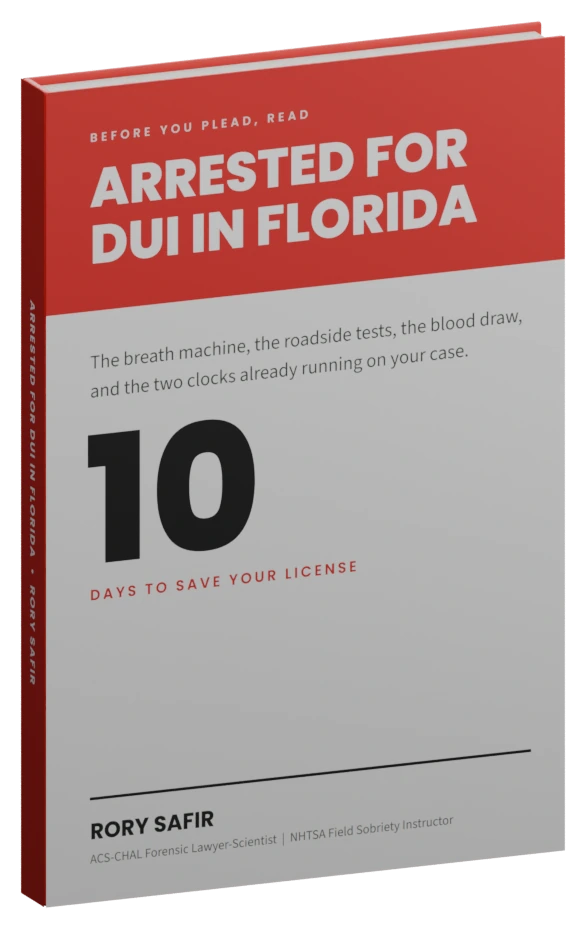
The administrative suspension is the part of a DUI that catches people off guard. It is a separate suspension of your driver license that the DHSMV imposes at the moment of arrest, long before your court case is decided, and it runs on a strict ten-day clock. Understanding it is the first step to protecting your ability to drive.
It starts at arrest, not at conviction
Under section 322.2615, Florida Statutes, the arresting officer takes your physical license and issues a notice of suspension whenever your breath or blood reading is 0.08 or higher, or you refuse a lawful breath, blood, or urine test. That notice usually acts as a ten-day driving permit. This is completely separate from the criminal case. Even if your DUI charge is later dropped or reduced, the administrative suspension can stand unless you challenge it, which is why the first ten days matter so much.
| Situation | Suspension | Hard time |
|---|---|---|
| First offense, breath or blood 0.08+ | 6 month suspension | 30 days hard time |
| First offense, refusal | 12 month suspension | 90 days hard time |
| Second offense, breath or blood | 6 to 12 months depending on the prior | 30 days hard time |
| Second refusal, any prior refusal | 18 month suspension | 18 months, all hard time, no hardship |
| Third or subsequent, two prior convictions | No restricted license on a breath case | All hard time |
The administrative suspension is set by section 322.2615, Florida Statutes, and begins at arrest. It is separate from the court revocation imposed after a conviction under section 322.28. Hard time is the period with no driving at all before a hardship license is possible. Procedures and figures last verified June 2026.
Why the two tracks matter
Because the administrative suspension and the criminal case are independent, they have to be fought separately. The good news is that challenging the suspension through a formal review hearing does double duty: it can remove the suspension, and it forces the officers to testify under oath early, which helps the criminal defense. The 10-day decision page explains the choice you have to make right away.
What the hearing officer reviews
The administrative side is narrow, and that is the opening. At a formal review hearing the officer is not deciding guilt, only a short list of things by a preponderance of the evidence. On a breath or blood case, whether there was probable cause to believe you were driving or in actual physical control while under the influence, and whether the reading was 0.08 or higher. On a refusal, whether there was probable cause, whether you refused a lawfully requested test, and whether you were warned that refusing would suspend your license. If the Department falls short on any one of those, the suspension is set aside.
The under-21 and commercial versions
Two variations work a little differently. A driver under 21 is suspended under section 322.2616 at a far lower level, a breath or blood reading of 0.02 or higher, which reflects Florida’s zero-tolerance rule for minors. A commercial driver faces a separate disqualification under section 322.64, and there is no hardship driving on a commercial license, a point covered on the CDL disqualification page. The ten-day clock and the right to a hearing apply across all of them.
The one outcome that can undo it later
Because the two tracks are independent, winning the criminal case does not automatically clear the suspension, with one exception worth knowing. On a breath or blood case, if you are later found not guilty at trial, the Department will invalidate the administrative suspension, but only if you demanded the formal review hearing in the first place. Let the ten days lapse and that safety net is gone, which is one more reason the early decision carries so much weight.
I started out as an Assistant Public Defender in Florida’s Thirteenth Judicial Circuit, in Tampa, and today I am one of six ACS-CHAL Forensic Lawyer-Scientists in Florida. I demand the formal review hearing in DUI cases and appear at the Tampa and Clearwater Bureau of Administrative Reviews offices, because that hearing protects your license and locks in the officers early. Learn more about my background.
Administrative suspension questions
What is an administrative suspension in Florida?
It is the driver license suspension the DHSMV imposes at the moment of a DUI arrest, before any court case. It happens automatically if your breath or blood reading was 0.08 or higher, or if you refused a lawful test. The arresting officer takes your license and gives you a notice of suspension, which often doubles as a ten-day driving permit.
How long is the administrative suspension?
For a first offense it is six months for a breath or blood reading of 0.08 or higher, and twelve months for a refusal. A second refusal carries eighteen months. The length rises with prior suspensions and refusals, and prior convictions can remove hardship eligibility entirely.
Is the administrative suspension the same as losing my license at sentencing?
No. The administrative suspension through the DHSMV and the court-ordered revocation after a DUI conviction are two separate things on two separate tracks. The administrative suspension starts at arrest and has a ten-day deadline to challenge. The court revocation only happens if you are convicted. They can overlap or stack.
Can I stop the administrative suspension?
You can challenge it by demanding a formal review hearing within ten days of arrest. If the hearing officer finds the paperwork or the proof is insufficient, the suspension is invalidated and removed from your record. On a first DUI with no prior, you can instead waive the hearing for an immediate hardship license. Doing nothing lets the suspension take effect.
What happens if I do nothing?
If you take no action within ten days, the administrative suspension takes effect on the eleventh day, and you lose the chance to challenge it. You would then have to serve the hard-time period with no driving before applying for a hardship license, and the suspension stays on your record.
Related: the 10-day decision, the formal review hearing, hard time and the 30 or 90 day rule, and the hardship license.
Not sure how many days you have left? The Florida DUI License Deadline Checker asks three questions and gives you the exact date your permit expires, the suspension length you are facing, and whether you still qualify to keep driving.
Someone just got arrested in Pinellas? This page collects what the Sheriff actually controls: the inmate search, posting bond, DUI immobilization and its fees, misdemeanor probation, and how to request body camera video before it ages out.
These rules are being rewritten. FLHSMV has opened rulemaking on Chapter 15A-6, the chapter that governs this entire process. What is in scope and what it means for a pending case. Nothing has changed yet.
Not sure how strong the case against you actually is? The case evaluator walks through the questions I would ask you, the stop, the roadside, the twenty minute observation, the machine, and tells you what your answers suggest. Three minutes, no email.
This page is general information about Florida law, not legal advice, and it does not create an attorney-client relationship. The Florida administrative suspension and review process is governed by sections 322.2615, 322.2616, and 322.64, Florida Statutes, and Chapter 15A-6 of the Florida Administrative Code, and license revocation, hardship, and reinstatement are governed by sections 322.271 and 322.28. Deadlines are short and the rules change, so confirm current requirements with the DHSMV or an attorney. Every case turns on its own facts, and past results do not guarantee a similar outcome.