When the dog that bit you belonged to a tenant, the first claim is still against the owner under Florida’s strict-liability statute. But the owner may have little or no insurance, which raises the next question: can the landlord or property owner be reached too? Sometimes, yes, but on a different legal theory.
The owner and the landlord are not the same claim
Fla. Stat. 767.04 imposes strict liability on the dog’s owner. A landlord is not the owner, so strict liability does not reach them automatically. A landlord can still be liable, but in ordinary negligence, and that claim has its own requirements rather than the near-automatic liability that applies to the owner.
Sometimes the dog’s owner is not the only one on the hook, and a landlord or property owner who knew about a dangerous animal can be liable too. I represent the person who was bitten, not the insurers looking to point fingers at each other. I am a trial lawyer who came up as a public defender, where I tried numerous cases and cross-examined witnesses constantly, so I chase down what each owner knew and which policies answer for it. I handle your case personally, read the records, and pin down every available source of coverage. I am willing to try the case in front of a jury, which is often what moves an insurer to pay fair value. Learn more about my background.
Two different claims against two different parties
It helps to keep two very different claims separate, because they run against different people under different rules. The strict-liability claim under section 767.04 runs against the dog’s owner, and it is automatic once the basic elements are met, no proof of carelessness required. A claim against a landlord is a different animal. A landlord is usually not the “owner” of a tenant’s dog, so strict liability does not reach them, and instead the claim sounds in negligence. That means it has to be built on two things: that the landlord knew, or had reason to know, that a tenant’s dog was dangerous, and that the landlord had the power to do something about it, such as enforcing a lease term or requiring the dog’s removal, and failed to act. When both are present, a landlord who allowed a known danger to remain on the property can be held responsible alongside the owner. Understanding which claim runs against whom is the first step, because the proof and the parties are not the same.
Knowledge plus the power to act
A landlord becomes a realistic defendant when two things line up. First, knowledge: prior complaints, a prior bite, animal-control involvement, or the dog’s own behavior put the landlord on notice that the animal was dangerous. Second, control: the lease or the law gave the landlord the ability to require the dog’s removal or otherwise act, and the landlord did nothing. A landlord who truly had no knowledge, or no ability to act, usually is not on the hook. Pulling the management records, the prior complaints, and the lease is how that question gets answered.
Keepers, sitters, and businesses
The same idea reaches others who had a dog in their care. A dog walker, sitter, groomer, or kennel is not the owner and so is not strictly liable, but each can be liable in negligence for failing to control a dog they were responsible for. Where the bite happened in a common area an apartment complex controls, the complex’s own duty over that space, including its security and maintenance, can come into play alongside the owner’s liability. That overlap with premises liability often opens a second source of recovery.
Who counts as the “owner” is broader than you think
The word “owner” in these cases is wider than the person whose name is on the adoption papers, and that can matter a great deal to a recovery. Section 767.11 defines an owner as a person or organization that possessed, harbored, kept, or had custody or control of the dog, which sweeps in more than the obvious. A dog sitter or walker who had the dog that day, a friend keeping it for the weekend, a boarding or daycare business that had custody, each can fall within strict liability because each had control of the animal when it bit. That breadth is useful, because the registered owner may be uninsured or hard to collect from, while a business that was keeping the dog may carry commercial coverage, and a homeowner who was watching it may have a policy that responds. So part of the work in these cases is figuring out exactly who had custody and control of the dog at the moment of the bite, using payment records, texts, app bookings, and witness accounts, because the answer can add a responsible party and a source of coverage that a quick look would miss.
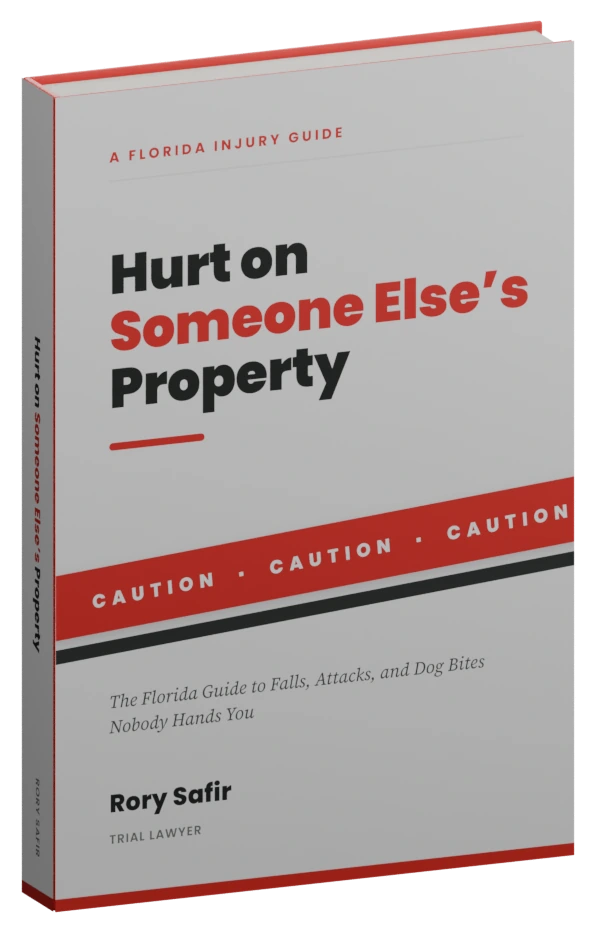
The book
Hurt on Someone Else’s Property
The evidence race, the owner’s records, negligent security, and a full chapter on Florida dog bites, the strictest rule in the state, in one plain-English book on the days and weeks after you are hurt. Free to Tampa Bay residents hurt on someone else’s property, with the digital edition to read the moment you ask.
The deadline
For a bite on or after March 24, 2023, the deadline to sue is generally two years under Fla. Stat. 95.11. Do not wait on it. The dog, the owner’s insurance policy, the animal-control report, and the vaccination and quarantine records are all easier to lock down in the first weeks than the first year.
The person who got bitten often assumes there is only one party to pursue, and there are frequently more once you look. I sort out the strict-liability claim against whoever had custody and control of the dog, which can reach a sitter, a keeper, or a boarding business, and I build the separate negligence claim against a landlord who knew about a dangerous dog and had the power to act. I represent injured people, not owners or landlords, and I find every party the law makes answerable and every policy that can respond.
Common Questions
Can I sue the landlord if a tenant's dog bit me?
Sometimes. Florida's strict-liability statute, 767.04, applies to the dog's owner, not the landlord. But a landlord can be liable in ordinary negligence if they knew, or should have known, that a tenant's dog was dangerous and had the ability to remove or control it, yet did nothing. That turns on what the landlord knew and what they could have done.
Is a dog walker or kennel responsible if the dog bites someone?
They are not the owner, so strict liability under 767.04 does not attach to them. A keeper such as a dog walker, groomer, sitter, or kennel can still be liable in common-law negligence if they failed to use reasonable care to control a dog in their charge. It depends on their degree of control over the animal.
What makes a landlord liable for a dog they do not own?
Knowledge plus control. If prior complaints, a prior bite, or the dog's behavior put the landlord on notice that the animal was dangerous, and the lease or the law gave the landlord the power to require removal and they failed to act, that inaction can be negligence. A landlord with no knowledge and no control usually is not liable.
The bite happened in an apartment complex's common area. Does that change things?
It can help. A property owner's duty over common areas it controls is stronger than over the inside of a private unit, so a bite in a shared hallway, courtyard, or parking area can raise additional questions about the complex's own security and maintenance, alongside the dog owner's strict liability.
How long do I have to bring a claim against a landlord?
Generally two years from the bite under Fla. Stat. 95.11. A negligence claim against a landlord depends on proof of what they knew and when, so the prior complaints, lease records, and management files matter, and they are easiest to obtain early.
Related: Dog bites overview, Premises liability, Dangerous dogs, Insurance and compensation, and About Rory Safir.
This page is general information about Florida dog bite law, not legal advice, and it does not create an attorney-client relationship. The governing authorities include Fla. Stat. 767.04 (the owner’s strict liability), the common-law duty of care that can make a landlord or keeper liable in negligence, and 95.11 (the limitations period). Every case is different, and past results do not guarantee a similar outcome. The hiring of a lawyer is an important decision that should not be based solely on advertisements.