If a dog bit you in Florida, the law is on your side from the start. Florida is a strict-liability state, which means the owner answers for the bite even if the dog had never shown a moment of aggression before. That is a much stronger position than most injury claims begin from, and it is one insurers work hard to chip away.
Where these cases are won or lost is not the basic liability. It is the defenses the insurer raises and the question of which policy pays. That is what I handle.

Florida holds the owner strictly liable
Under Fla. Stat. 767.04, the owner of a dog that bites a person who is in a public place, or lawfully on private property, is liable for the resulting harm, regardless of the dog’s former viciousness or whether the owner knew of it. In plain terms, Florida has no one-bite rule: the very first bite counts, and the owner cannot escape by saying the dog had never done it before. That is the heart of why a dog bite claim is stronger than an ordinary negligence case, where you would have to prove the owner was careless.
I represent people who were bitten, not insurance companies. Most dog bite money comes from a homeowner’s or renter’s policy, and the insurer’s playbook is to blame you for the bite or argue the policy does not cover the dog. I am a trial lawyer who came up in the courtroom as a public defender, tried numerous cases and cross-examined witnesses constantly, and I am not the lawyer who folds at the first lowball. I handle your case personally, read the records, pin down the owner and every available policy, and stay willing to put the case in front of a jury, which is often what moves an insurer to pay fair value. I am also a member of the National Association of Premises Liability Attorneys. Learn more about my background.
No “one free bite” here
It is worth naming the advantage Florida gives a bite victim, because it is bigger than many people realize. A lot of states follow a “one free bite” rule, where an owner escapes responsibility for the first bite because they did not yet know the dog was dangerous. Florida rejects that entirely. Under section 767.04, Florida Statutes, the owner is liable regardless of the dog’s former viciousness or the owner’s knowledge of it, so the very first bite counts, and “he has never done that before” is not a defense. That is why these cases are, at their core, simpler than a typical injury claim. You do not have to prove the owner was careless, or that the dog had a history, or that the owner should have restrained it. You show ownership, a bite, and that you had a right to be where you were, and liability is established. The dog’s gentle past, the owner’s surprise, the absence of any prior incident, none of it lets the owner off the hook.
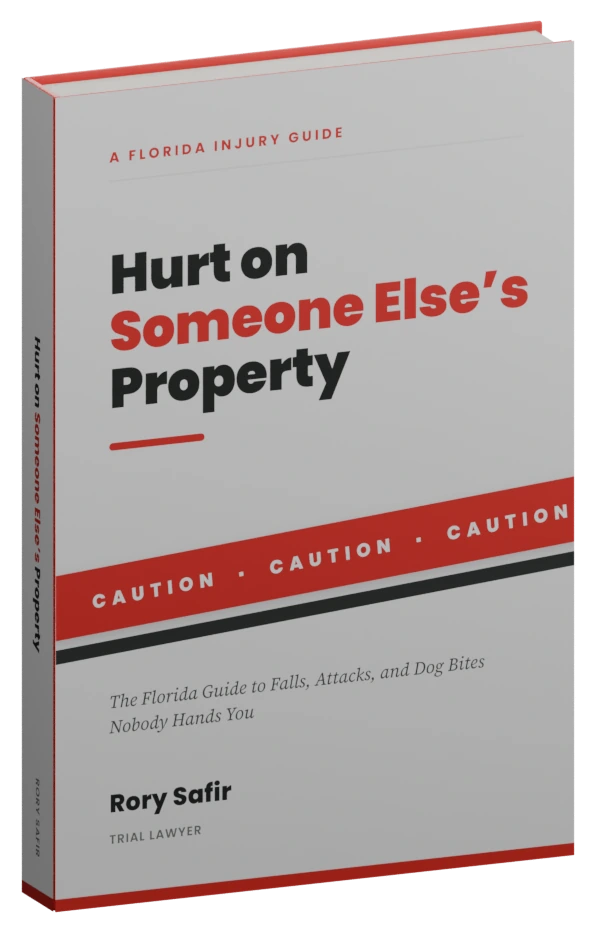
The book
Hurt on Someone Else’s Property
The evidence race, the owner’s records, negligent security, and a full chapter on Florida dog bites, the strictest rule in the state, in one plain-English book on the days and weeks after you are hurt. Free to Tampa Bay residents hurt on someone else’s property, with the digital edition to read the moment you ask.
What you really have to show
The basic claim comes down to three things: that you were bitten, that the dog belonged to the person you are pursuing, and that you were in a public place or lawfully on private property when it happened. Lawful presence is broad, covering invited guests, customers, and workers such as delivery drivers and mail carriers who are there under a duty. What you do not have to prove is just as important: you do not have to show the owner knew the dog was dangerous.
Florida has no one-bite rule, so the very first bite counts and the owner cannot escape by saying the dog had never done it before. Because liability is usually clear, the case is won on comparative fault and on insurance coverage.
Where the real fight is
Because liability is so often clear, the insurer fights on two other fronts. The first is the set of defenses built into the statute and the comparative-fault rules: that you provoked the dog, that a “Bad Dog” sign was posted, that you were trespassing, or that your own conduct shares the blame. The second is coverage: whether the owner’s homeowner’s or renter’s policy covers this dog at all, since many insurers exclude certain breeds or dogs with a bite history. I take both head on, on the defenses insurers raise and on how the claim gets paid.
| Source | How it applies |
|---|---|
| The dog owner | Strictly liable under Fla. Stat. 767.04, usually through a homeowner’s or renter’s liability policy. |
| A landlord or property owner | Liable in negligence when they knew a tenant’s dog was dangerous, could have acted, and did not. |
| A keeper or business | A kennel, groomer, or dog walker can be liable in negligence for failing to control a dog in their care. |
| The owner’s own negligence | When a prior bite or a dangerous-dog classification shows the owner knew the risk, it adds an uncapped negligence claim. |
More than one source can apply, which matters most when the first policy is too small or excludes the dog.
More than a bite: dangerous dogs and other attacks
Some cases reach beyond a single bite. Florida’s dangerous-dog law (Fla. Stat. 767.11 and 767.12) lets animal control classify a dog that has seriously bitten or attacked, and a dog already classified, or with a record of prior bites, is strong proof the owner knew the danger. A separate statute, Fla. Stat. 767.01, makes an owner liable for other harm a dog causes, such as a large dog knocking someone to the ground. More on dangerous dogs and prior attacks.
Dog bite cases I handle
Across Florida’s 6th, 13th, and 12th circuits, I handle the full range of these cases: the defenses insurers raise, landlord and property-owner liability when the biter was a tenant’s dog, children and dog bites, where the injuries and the law both cut differently, homeowner’s insurance and compensation, and dangerous dogs and prior attacks.
The deadline
For a bite on or after March 24, 2023, the deadline to sue is generally two years under Fla. Stat. 95.11. Do not wait on it. The dog, the owner’s insurance policy, the animal-control report, and the vaccination and quarantine records are all easier to lock down in the first weeks than the first year.
Florida’s strict-liability rule is one of the strongest tools an injury victim has, and I make full use of it. I establish the simple things the statute requires, ownership, the bite, and your lawful presence, and then I spend my energy on where these cases are really fought, the injuries, the defenses the insurer raises, and every source of coverage. I represent injured people and families, not dog owners or their insurers, and I do not let a company treat a first bite as a free one, because Florida law says it is not.
Common Questions
Is the dog owner automatically liable if their dog bites me in Florida?
Close to it. Under Fla. Stat. 767.04, Florida is a strict-liability state, so the owner is liable for a bite to a person who was in a public place or lawfully on private property, regardless of whether the dog had ever bitten anyone before. Florida has no one-bite rule. You do not have to prove the owner knew the dog was dangerous.
What do I have to prove in a Florida dog bite case?
Three basic things: that you were bitten, that it was the defendant's dog, and that you were in a public place or lawfully on private property when it happened. You do not have to prove the owner was careless or knew the dog might bite, which is what makes a dog bite claim stronger than an ordinary negligence case.
Where does the money come from in a dog bite case?
Usually the dog owner's homeowner's or renter's liability insurance, and sometimes a landlord's or business's policy. Identifying every available policy early matters, because some insurers exclude certain breeds or dogs with a bite history, and if there is no coverage the claim may have to reach the owner's personal assets.
The owner says I provoked the dog. Does that end my claim?
Not by itself. Provocation goes to comparative fault: your share of responsibility reduces recovery, and only a finding that you were more than half at fault bars it entirely. Insurers stretch normal behavior into 'provocation,' and pinning down what really happened is a large part of the case.
How long do I have to file a dog bite claim in Florida?
Generally two years from the bite under Fla. Stat. 95.11. The framing of the claim can affect the deadline, and a child's time to sue may be extended, but you should never rely on extra time. Evidence disappears quickly, so the sooner the work starts, the stronger the claim.
Related: How a Florida injury claim works, Dog bite defenses, Landlord and property liability, Children and dog bites, Insurance and compensation, Dangerous dogs, and About Rory Safir.
This page is general information about Florida dog bite law, not legal advice, and it does not create an attorney-client relationship. The governing authorities include Fla. Stat. 767.04 (strict liability for dog bites), 767.01 (an owner’s liability for other harm a dog causes), 767.11 and 767.12 (the dangerous-dog definition and classification), 768.81 (comparative negligence), and 95.11 (the limitations period). Every case is different, and past results do not guarantee a similar outcome. The hiring of a lawyer is an important decision that should not be based solely on advertisements.