
Some falls happen on a spill that appeared a minute earlier. Others happen on a leak that staff have been mopping around for weeks, and that history can make all the difference in a Largo slip and fall claim. I represent people hurt on someone else’s property in Largo, and I start by finding out whether the hazard that caught you was new or familiar.
What a Florida slip-and-fall claim requires
The leak that keeps coming back
Under Florida’s section 768.0755, a person who slips on a transitory foreign substance in a business has to prove the business had actual or constructive knowledge of the dangerous condition and should have fixed it. Constructive knowledge can be shown two ways. One is that the condition existed for such a length of time that the business, using ordinary care, should have known about it. The other is that the condition occurred with regularity and was therefore foreseeable.
That second route matters when a hazard repeats. A refrigerator case that sweats onto the same tiles, an ice machine that drips, a doorway where rain pools every time it storms: if it keeps happening, the business can’t say it had no reason to expect it. Work orders, repair invoices, earlier incident reports and employee testimony can show that pattern. A cooler or ice machine that’s been patched before leaves a trail in the repair invoices. Our page on proving a dangerous floor goes deeper into how that proof comes together.
The first route is about time. Surveillance footage can show how long a spill sat before you reached it and who walked past it. Sweep logs show when anyone last checked the aisle. The business keeps all of it, so I send a written request early asking it to keep the footage and the logs. The Florida premises liability overview covers the rest of Florida’s premises rules.
At the scene, look at the substance itself. Footprints, cart tracks, dirt or a dried ring around a spill can suggest it had been there a while, and a bucket or a pile of towels by a recurring leak suggests the staff knew about it. Photograph all of it before anyone cleans up.
Injuries and treatment
A fall can fracture a hip, a wrist or an ankle, injure the back or neck, tear a shoulder, or cause a head injury when you hit the floor or a fixture. For an older adult, a broken hip can mean surgery, a rehab stay and a long recovery that changes how they live. The medical records are what connect those injuries to the fall, so get care promptly and keep every follow-up appointment. A gap in treatment is something an insurer will use to argue the fall wasn’t the cause. Tell each doctor how you fell and what hurts, even if it seems small, so the chart reflects it.
Start a folder the day of the fall. Put in every bill, every pharmacy receipt and every note from work about time missed, and add a short entry each week about your pain and what you’ve had to give up. That record is the backbone of the damages claim.
If your fall involved a crime or a dispute and Largo officers came, the Largo Police Department handles records and reports, and it also lets people file some reports online.
Where a Largo case goes
Largo is in Pinellas County, in the Sixth Judicial Circuit, so a fall suit is filed in the Pinellas County civil court. The Pinellas County Courthouse is at 315 Court St. in Clearwater. You generally have two years from the fall to file a negligence suit, under section 95.11(5)(a). Plenty of claims settle with the insurer before a suit is filed, and I prepare every one as though a jury will decide it. Disputes over $50,000 go to the Sixth Circuit’s circuit civil division. Once a suit is filed, the business has to produce records in discovery, and its employees answer questions under oath in depositions. Two years is generally the outside limit, while the useful evidence has a much shorter life.
Blame, and what you can do now
The business will likely argue you should have seen the water. Florida’s comparative fault statute, section 768.81, reduces your damages by your share of fault, and a person found more than 50 percent at fault for their own harm can’t recover. I answer that with the video, the photographs and what the employees knew.
Report the fall to the manager and ask for a written incident report before you leave. Photograph the floor, the source of the leak and the lack of any warning sign. Collect names from witnesses and employees, keep your shoes and clothes, and see a doctor. Don’t give the insurer a recorded statement or sign anything until you know the full extent of your injuries. Keep the fall off social media, and send the adjuster to me if they call. I work on contingency, which means no fee unless you recover. The people I represent are the injured ones, not the businesses or their insurers, and your case stays with me personally. See my background here.
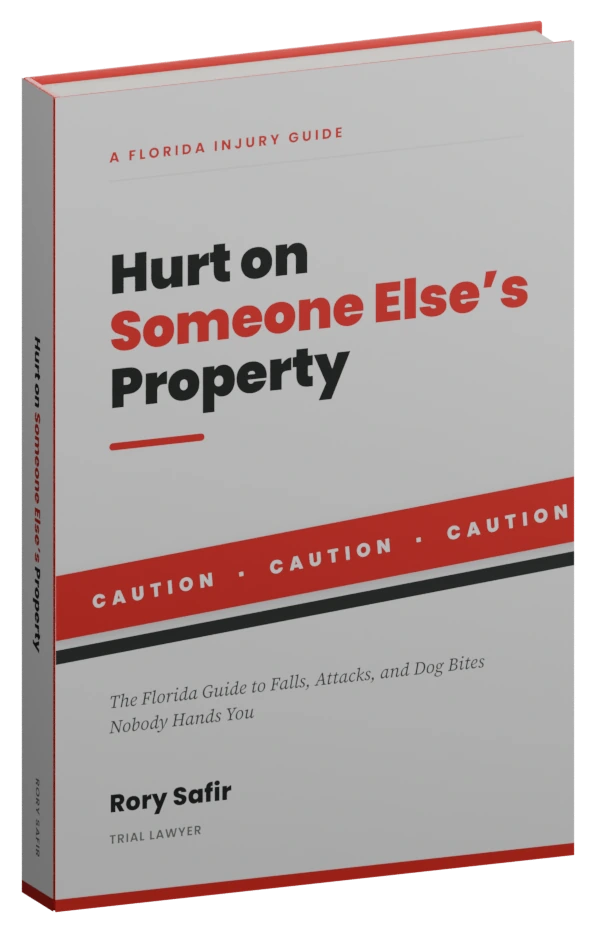
The book
Hurt on Someone Else’s Property
The evidence race, the notice fight, the owner’s records, and why many of these cases end up filed as lawsuits, in one plain-English book on the days and weeks after a fall. Free to Tampa Bay residents, with the digital edition to read the moment you ask.
Common Questions
Do I have a case if I fell in a Largo business?
Possibly. Under Florida law you generally have to prove the business had actual or constructive knowledge of the hazard and failed to fix it, which turns on evidence like surveillance footage, inspection logs, and prior incidents. A review of the specific facts is the way to know.
What do I have to prove in a Florida slip-and-fall?
For a fall on a spill or similar substance in a business, Florida Statute 768.0755 requires you to prove the business knew or should have known about the hazard and should have remedied it. Constructive knowledge is shown by how long the condition existed or that it happened with regularity.
How long do I have to file after a Largo fall?
For most fall injury claims the deadline is now two years from the date of the fall, shortened from four by a 2023 change in the law. Because the evidence in these cases disappears quickly, an early review is especially important.
Where would my Largo slip-and-fall case be heard?
Pinellas County is in Florida’s Sixth Judicial Circuit, so a lawsuit would generally be filed in the Pinellas County civil court. Most claims resolve through insurance before a lawsuit is needed, but preparing the case as if it will be tried is what protects its value.
What will a Largo slip-and-fall case cost me?
These cases are handled on contingency, so you pay no attorney’s fees unless there is a recovery, and case costs are advanced rather than paid up front. The first strategy session is free.