
The clock on a Clearwater slip and fall starts running in the store, not in my office. Somewhere in that building a camera recorded the spill and the minutes before you hit the floor, and an employee may have walked past it. I help people hurt in Clearwater falls get that evidence in hand and use it to show what the business knew.
What a Florida slip-and-fall claim requires
Two ways to show a business should have known
Florida’s rule for falls on spills and other foreign substances is section 768.0755. It makes the injured person prove that the business had actual or constructive knowledge of the dangerous condition and should have taken action to fix it. Actual knowledge means someone there knew, because they saw it, caused it or were told about it.
Constructive knowledge can be proved with circumstantial evidence, and the statute names two kinds. The first is time: the condition existed long enough that a business using ordinary care should have known. The second is repetition: the condition came up with regularity, so it was foreseeable. A puddle that sat for forty minutes in front of a camera fits the first, and a roof leak that drips onto the same entrance mat whenever it rains fits the second.
Asking for the video before it’s gone
The proof of time and repetition lives with the business. It keeps the surveillance footage, the sweep and inspection logs, the maintenance tickets, the incident report and any record of earlier falls. Camera systems can record over old footage, so in the first days I send a written request asking the business to keep it. Tell me as soon as you can which cameras might have caught the fall, whether at the entrance, the aisle, the register or the parking lot. A request that names the area and the time window is easier for a business to act on than a general one. That letter asks; it doesn’t force anyone, and a lawsuit gives stronger tools if they’re needed. Our page on preserving evidence after a fall goes through what to ask for. For the broader picture, see the Florida premises liability overview.
Filed at 315 Court Street
Clearwater is the county seat, so a Clearwater fall suit can be heard close to home. The Pinellas County Courthouse at 315 Court St. hears circuit and county matters for the Sixth Judicial Circuit, and the Sixth Circuit’s circuit civil division handles disputes over $50,000. Plenty of these claims settle with an insurer and never get there. I still prepare each one as if it’s going to trial, because a file built for a jury is the one an insurer has to take seriously. If yours doesn’t settle, the suit moves through written discovery and depositions, where employees answer under oath about what they saw and when.
The filing deadline for a negligence suit is generally two years, under section 95.11(5)(a). Two years can sound like plenty, but the camera footage won’t last that long.
What the fall did to you
Fall injuries range from a sprained wrist to a fractured hip, a broken ankle, a torn rotator cuff or a herniated disc. Striking your head on tile or a fixture can cause a concussion or a more serious brain injury that doesn’t show itself right away. For an older adult, one fracture can lead to a long decline. Get seen promptly and keep every follow-up, because those records connect the injury to the fall and gaps in care give an insurer something to argue about.
Keep track of what the fall costs you: medical bills, prescriptions, mileage to appointments, missed shifts and the chores you’ve had to pay someone else to do. Write a few lines each week about your pain and what you can’t do. Those notes show what the injury took from your daily life as well as your bank account.
If the injuries need trauma care, Pinellas County’s Level II trauma center is Orlando Health Bayfront Hospital, at 701 6th St. S. in St. Petersburg.
Your share of the blame, and your next steps
The business’s insurer will look for a way to put some of the fault on you: your shoes, your phone, the sign it says was there. Under section 768.81, Florida’s comparative fault statute, any share of fault assigned to you lowers your recovery by that share, and more than 50 percent bars recovery altogether. I meet that with the video, the photos and the testimony of people who saw the floor.
Report the fall before you leave and ask for a copy of the incident report. Take pictures of the floor, the lighting and any warning sign, or the lack of one. Get the names of witnesses and employees, keep your shoes and clothing, and don’t give a recorded statement or accept a fast settlement before you know the full extent of your injuries. Stay off social media about the fall, since an insurer can read anything public, and if its adjuster calls, you can refer them to me. I represent injured people, never businesses or their insurers, and I handle each case personally. Learn more about my background.
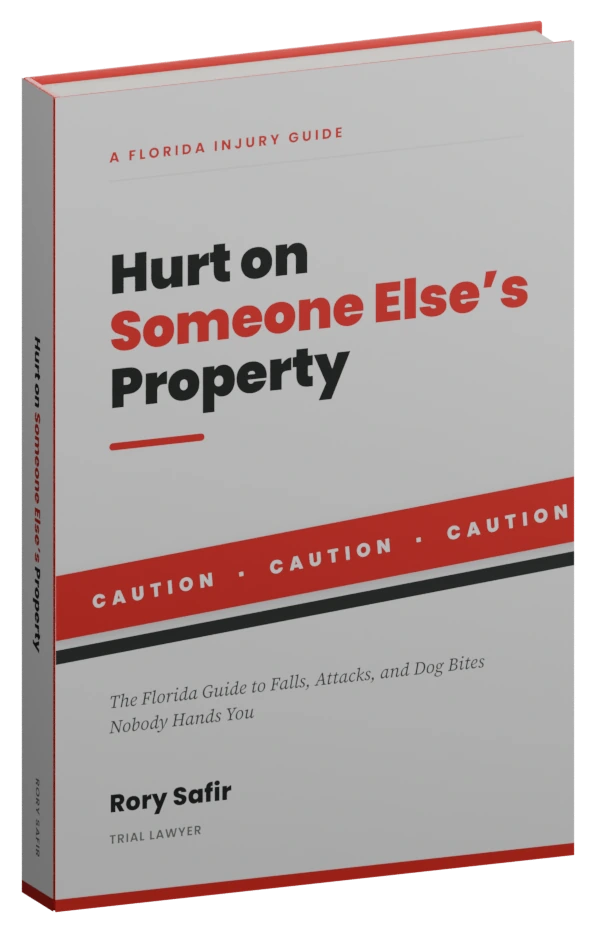
The book
Hurt on Someone Else’s Property
The evidence race, the notice fight, the owner’s records, and why many of these cases end up filed as lawsuits, in one plain-English book on the days and weeks after a fall. Free to Tampa Bay residents, with the digital edition to read the moment you ask.
Common Questions
Do I have a case if I fell in a Clearwater business?
Possibly. Under Florida law you generally have to prove the business had actual or constructive knowledge of the hazard and failed to fix it, which turns on evidence like surveillance footage, inspection logs, and prior incidents. A review of the specific facts is the way to know.
What do I have to prove in a Florida slip-and-fall?
For a fall on a spill or similar substance in a business, Florida Statute 768.0755 requires you to prove the business knew or should have known about the hazard and should have remedied it. Constructive knowledge is shown by how long the condition existed or that it happened with regularity.
How long do I have to file after a Clearwater fall?
For most fall injury claims the deadline is now two years from the date of the fall, shortened from four by a 2023 change in the law. Because the evidence in these cases disappears quickly, an early review is especially important.
Where would my Clearwater slip-and-fall case be heard?
Pinellas County is in Florida’s Sixth Judicial Circuit, so a lawsuit would generally be filed in the Pinellas County civil court. Most claims resolve through insurance before a lawsuit is needed, but preparing the case as if it will be tried is what protects its value.
What will a Clearwater slip-and-fall case cost me?
These cases are handled on contingency, so you pay no attorney’s fees unless there is a recovery, and case costs are advanced rather than paid up front. The first strategy session is free.