Packed onto the southern tip of the Pinellas peninsula, St. Petersburg depends on a steady stream of box trucks, delivery trucks, and other commercial vehicles to keep a large population supplied. When one of them collides with a passenger car, the gap in size and weight means the people in the car take almost all of the impact, and the harm is frequently catastrophic. The legal case looks different too. Federal regulations apply, the defendants are usually companies, and the decisive evidence sits inside the eighteen-wheeler, where it can be erased within weeks. Below I explain how these cases unfold in St. Petersburg. A St. Petersburg truck accident lawyer goes after that record quickly, since the trucking company begins guarding it within hours of the crash.
Why a truck case is different from a car crash
A semi or tractor-trailer loaded to as much as eighty thousand pounds meets a car of about four thousand, and the case that follows differs from an ordinary fender bender legally as well as physically. Commercial carriers answer to the Federal Motor Carrier Safety Regulations, a detailed federal rulebook covering how many hours a driver may stay behind the wheel, how trucks are kept up, how loads are tied down, and who is allowed to drive at all. If a carrier breaks one of those rules and a crash follows, the violation can itself prove negligence, which puts an injured person on much firmer ground than a debate over who was careless. Responsibility also spreads past the driver. The trucking company typically answers for its driver and may be directly liable for careless hiring or upkeep, while a broker, a shipper, a maintenance contractor, or the manufacturer of the truck may share fault as well. Each added party matters because federal law requires carriers to hold at least seven hundred fifty thousand dollars in coverage, often a million or more, and a catastrophic injury needs every dollar of it. For more, see our Florida truck accident overview, the guide to who is liable, and the higher insurance limits.
The evidence, and why it can disappear fast
Much of what decides a truck case has no counterpart in a car crash, and it can vanish within weeks unless someone moves to save it. The electronic logging device tracks the driver’s hours and can expose a fatigue violation. The event data recorder, or black box, stores speed, braking, and throttle readings from the moments before the collision. The driver qualification file, the inspection and maintenance history, the cargo loading records, and drug and alcohol test results each fill in another piece. Federal retention rules require carriers to keep some of these records for mere months, and absent a formal demand to preserve them, a carrier may legally overwrite the logs and repair the rig before anyone inspects it. So a spoliation letter, sent right away, ranks among the most important early moves in a truck case, and bringing in a lawyer quickly matters a great deal. Read more in our guides to the black box and truck evidence and the federal safety regulations.
Truck cases are decided by records and regulations: the electronic logs, the black box data, the maintenance and qualification files, and the federal safety rules that convert a violation into proof of negligence. They also depend on locking that evidence down fast and cross-examining the carrier’s witnesses about it. That records-heavy, technical work is the core of my practice. My clients are injured people, and I don’t represent trucking companies or their insurers. I began my career as a public defender, trying cases and cross-examining witnesses week after week, so I’m prepared to put a St. Petersburg truck case in front of a jury when fair value demands it. I handle every case myself, and I know this city’s roads, courts, and community. Learn more about my background.
The roads where St. Petersburg truck crashes happen
In St. Petersburg, truck crashes gather along the commercial arteries. US-19 and 34th Street, north-south corridors lined with retail and steady delivery and freight traffic, see many of them, and Interstate 275 carries heavy commercial volume through the city and over the bay. Gandy Boulevard, 4th Street, and the industrial routes around the warehouses put loaded trucks among everyday drivers. Understanding where these collisions cluster, and how a heavy truck handles on those roads, shapes how I investigate and reconstruct a St. Petersburg crash.
Who watches commercial trucks around St. Petersburg
Pinellas County falls under Florida Highway Patrol Troop C, whose Pinellas Park station at 6855 62nd Ave. N. covers the county. Commercial trucks also draw attention from the FHP’s commercial vehicle enforcement Tampa District Office, which covers Hillsborough and Pinellas.
The state highways trucks use through the city sit within FDOT District Seven, headquartered at 11201 N. Malcolm McKinley Dr. in Tampa and covering Citrus, Hernando, Hillsborough, Pasco, and Pinellas counties. When a truck crash happens here, the reports and records these agencies keep are on my list of evidence to request.
Where your St. Petersburg case is heard, and getting care
A truck crash suit from St. Petersburg is generally filed in Pinellas County, within Florida’s Sixth Judicial Circuit, which serves Pinellas and Pasco and sends disputes over $50,000 to Circuit Civil. The St. Petersburg Judicial Building at 545 1st Ave. N. hears circuit and county matters, civil cases among them. Insurance resolves most claims before a lawsuit, though the ones that settle for full value were built for trial from the beginning, which counts for even more against a carrier’s defense team. Getting medical care quickly matters as much. Orlando Health Bayfront Hospital, a Level II trauma center at 701 6th St. S. downtown with Bayflite air transport, treats many of the city’s serious injuries, and prompt treatment protects your health while documenting the link between your injuries and the crash. Florida gives you fourteen days to seek treatment and keep your PIP coverage, which still applies at the start even though a serious truck injury soon outgrows it.
What a truck accident case can recover
Truck crashes produce some of the gravest injuries in personal injury law, many of them permanent, so these claims can pursue every category of loss: medical care already received and care still to come, lost income and lost earning capacity, and compensation for pain, disability, and the upheaval the crash brought to daily life. When a crash ends a life, the family left behind can pursue a wrongful death claim. Florida law also permits punitive damages in the uncommon case of truly egregious carrier conduct, such as knowingly sending an unsafe driver or truck onto the road. Value depends on how severe the harm is and how strong the proof is, and no figure should be promised on an opening call. Building the case against every party that bears responsibility is how a claim reaches the coverage a serious injury demands.
Comparative fault and what to do after a truck crash
Carriers employ well-funded defense teams that start investigating within hours, and a common opening move is to pin the crash on the injured driver. Florida’s comparative fault rule rewards that tactic, because each share of blame shifted onto you reduces what they pay, and above fifty percent your claim is barred. The answer is hard evidence, including the black box data, the driving logs, and the reconstruction. Several steps protect your health and your claim. Get medical attention promptly. If you can, take photos of the truck, its license plate and USDOT number, the damage, and the scene, and collect the names of witnesses. Report the crash and ask for a copy of the report. Think twice before giving a recorded statement to the carrier’s adjuster or taking a fast settlement before the full extent of your injuries is known, and bring a lawyer in early so the evidence is preserved before it disappears.
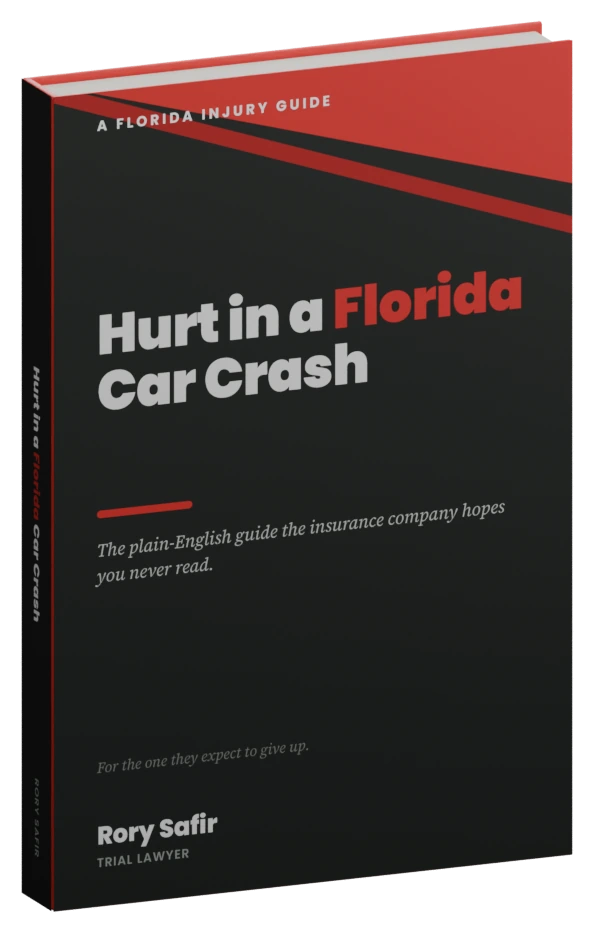
The book
Hurt in a Florida Car Crash
The insurance company’s playbook, the 14-day PIP rule, the serious injury threshold, and Florida’s two-year deadline, in one plain-English book on the hours, days, and weeks after a crash. Free to Tampa Bay crash victims, with the digital edition to read the moment you ask.
Common Questions
Do I have a case after a St. Petersburg truck accident?
If a commercial truck driver’s or trucking company’s negligence caused the crash and you were injured, likely yes. Truck cases often involve federal safety violations and multiple responsible parties, and because the injuries are usually serious, you can typically pursue the full range of damages.
Who can be held responsible in a truck accident?
Often more than the driver. The trucking company, the broker or shipper, the maintenance contractor, and the truck or parts manufacturer can each share liability, which matters because it reaches more of the insurance a serious injury requires.
Why does evidence have to be preserved so quickly?
The truck’s electronic logs and black box data, and the maintenance and drug-test records, can be lawfully overwritten or the truck repaired within weeks. A spoliation letter sent right away demands the carrier preserve it, which is why acting quickly matters.
How long do I have to file after a St. Petersburg truck crash?
For most crash injury claims the deadline is two years from the crash, shortened from four by a 2023 change in the law. Because truck evidence disappears fast, an early review matters even more here than in a car case.
What will a St. Petersburg truck accident case cost me?
These cases are handled on contingency, so you pay no attorney’s fees unless there is a recovery, and case costs are advanced rather than paid up front. The first strategy session is free.