
St. Petersburg is the second-largest city in Tampa Bay, and with roughly a quarter of a million residents and a steady stream of visitors, its roads carry a heavy load. Pinellas County sees well over fifteen thousand traffic crashes in a typical year, and St. Petersburg accounts for a large share of the serious injuries and deaths among them. When one of those crashes is caused by another driver’s carelessness, Florida law gives the injured person a way to recover for the harm, and understanding how these claims work is the first step toward protecting yourself.
How a Florida crash claim works
The roads where St. Petersburg crashes happen
If you have driven here for any length of time, the dangerous stretches will be familiar. US-19, which runs through the city as 34th Street, is the deadliest single corridor in the county, a fast, congested road lined with intersections and driveways where serious and fatal crashes recur year after year. 4th Street North carries some of the highest per-trip crash risk in the city. 38th Avenue North, and the ramps where it meets I-275, produce a steady stream of collisions. Central Avenue, which runs from the bay to the beaches through a busy downtown of bars, restaurants, and hotels, is especially dangerous for people on foot. And I-275 itself, at its interchanges and on the Skyway approach, sees high-speed wrecks that tend to cause the most severe injuries. Knowing where these crashes cluster is part of understanding how one happened, and it often matters to how a case is investigated.
How a Florida car accident claim works
Florida is a no-fault state, which surprises people and shapes every crash claim. After a collision, your own Personal Injury Protection coverage pays first, covering a portion of your medical bills and lost wages regardless of who caused the crash. That is only the beginning of the story in a serious case. When an injury is serious and permanent enough to cross Florida’s injury threshold, you can step outside the no-fault system and pursue the driver who caused the crash and their insurer for the full extent of your harm, including the pain, the disability, and the losses that no-fault does not touch. Whether an injury crosses that threshold is a legal and medical question, and it is one of the things that determines what a case is worth. You can read more about the mechanics on our Florida car accident overview.
The book
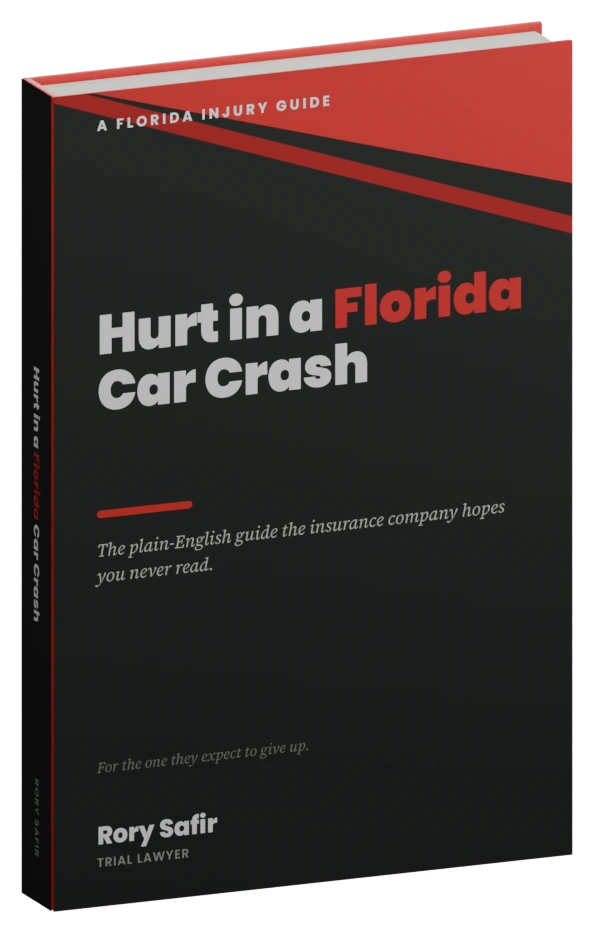
Hurt in a Florida Car Crash
The insurance company’s playbook, the 14-day PIP rule, the serious injury threshold, and Florida’s two-year deadline, in one plain-English book on the hours, days, and weeks after a crash. Free to Tampa Bay crash victims, with the digital edition to read the moment you ask.
Comparative fault, and the insurer’s playbook
Florida uses comparative fault, which means the insurance company will almost always try to pin some of the blame on you. Every percentage of fault it can shift onto the injured person lowers what it has to pay, and past a certain point it can bar the claim entirely. This is not a side issue. It is often the heart of the fight, and it is why the evidence, the crash reconstruction, the vehicle data, the scene, the medical records, matters so much. Insurers are practiced at making a fair claim look doubtful, and answering that with proof is a central part of the work. The other reality worth knowing early is that the first offer is rarely a fair one, and an unrepresented person is the one an adjuster is least worried about.
Where your case is heard, and getting the right care
St. Petersburg sits in Pinellas County, part of Florida’s Sixth Judicial Circuit, so a crash lawsuit is generally filed in the Pinellas County civil court. Most claims resolve through insurance long before a lawsuit is necessary, but the cases that settle for full value are the ones prepared from the start as if they will be tried. Just as important in the early days is your medical care. The most serious crash injuries in the area are often treated at Bayfront Health St. Petersburg, the local trauma center, and getting prompt, consistent care both protects your health and creates the record that connects your injuries to the crash. Gaps and delays in treatment are among the first things an insurer uses to minimize a claim.
Getting the crash report, and what it can and can’t do
Depending on where the crash happened, the report comes from the St. Petersburg Police Department, the Florida Highway Patrol, or the Pinellas County Sheriff’s Office. When anyone is hurt or complains of pain, Florida law requires the investigating officer to complete a long-form crash report and submit it within 10 days after the investigation is finished. For the first 60 days after it’s filed, the report is confidential, but you, your lawyer, and your insurer can get it right away by showing identification and signing a sworn statement that it won’t be used to solicit crash victims.
One rule catches people off guard. What you tell the officer so the report can be completed generally can’t be used as evidence in a civil trial. The report is where the investigation starts, and the evidence that decides fault is usually gathered after it: the scene, the vehicles and their recorded data, the witnesses, and the medical records.
When the other driver has little or no insurance
Florida doesn’t require drivers to carry coverage for the injuries they cause, so the driver who hit you may have little or none. That’s what uninsured and underinsured motorist coverage on your own policy is for. It pays when the at-fault driver has no coverage or not enough, and it can also reach a hit-and-run driver who’s never identified. Under Florida law it comes with every auto liability policy unless it was rejected in writing on a state-approved form, so check your policy before assuming it isn’t there. The page on uninsured and underinsured motorist claims covers stacking, the rejection form, and what changes when your own insurer becomes the other side.
What to do after a St. Petersburg crash
A few steps in the days after a collision protect both your health and any claim. Get medical care promptly and follow through with it. If you can, document the scene, the vehicles, the other driver’s information, and the names of any witnesses. Report the crash. Keep everything, the medical records, the bills, the repair estimates, and anything the other driver or an insurer sends you. And be careful about giving a recorded statement or accepting a quick settlement before you understand the full extent of your injuries, because early offers are designed to close a claim cheaply before its true cost is known. If you are unsure, a conversation before you sign anything can protect a great deal.
A car accident case is won on the documents and the proof, the crash reconstruction, the vehicle and scene evidence, the medical records, and the cross-examination of the insurer’s experts and hired doctors, and that is the kind of detail-driven work I have built my career on. I represent injured people, not insurance companies, and I came up in the courtroom as a public defender, trying cases and cross-examining witnesses constantly, so I am prepared to take a case to a jury when that is what fair value requires, which is often what moves an insurer to pay it. I handle your case personally, from the first conversation through resolution, and I know the roads, the courts, and the community here in St. Petersburg. Learn more about my background.
Common Questions
Do I have a case if I was in a car accident in St. Petersburg?
If another driver’s carelessness caused the crash and you were injured, likely yes. Florida is a no-fault state, so your own PIP coverage pays first, and if your injury is serious enough to cross Florida’s threshold, you can pursue the at-fault driver for the full harm, including pain and suffering.
How long do I have to file after a St. Petersburg crash?
For most crash injury claims the deadline is now two years from the date of the crash, shortened from four by a 2023 change in the law. Because the clock is shorter than many people expect and evidence fades quickly, it is worth having your case reviewed soon after the collision.
What if the crash was partly my fault?
Florida uses modified comparative fault, often called the 51% rule. Being partly at fault reduces your recovery by your share, and if you’re found more than 50 percent at fault for your own harm, you can’t recover anything. Insurers push hard to shift blame onto you, which is why answering that argument with the evidence is a central part of the case.
What are the most dangerous roads for crashes in St. Petersburg?
US-19, which runs as 34th Street through the city, is the deadliest corridor in the county, and 4th Street North, 38th Avenue North, Central Avenue downtown, and the I-275 interchanges all see a heavy share of serious crashes. Many of the worst happen at high-traffic intersections along these roads.
Where would my St. Petersburg car accident case be heard?
St. Petersburg is in Pinellas County, part of Florida’s Sixth Judicial Circuit, so a lawsuit would generally be filed in the Pinellas County civil court. Most claims resolve through insurance before a lawsuit, but preparing every case as if it will be tried is what protects its value.
How do I get the crash report for a St. Petersburg accident?
Ask the agency that responded, usually the St. Petersburg Police Department, the Florida Highway Patrol, or the Pinellas County Sheriff’s Office. The report is confidential for 60 days after it’s filed, but the people in the crash, their lawyers, and their insurers can get it right away with identification and a sworn statement.
What if the driver who hit me had no insurance?
Florida doesn’t require drivers to carry bodily injury coverage, so it can happen. Uninsured and underinsured motorist coverage on your own policy is built for it, and it’s included unless it was rejected in writing, so check your policy before assuming you have nothing to claim against.