In Brief
If you fell in a store, the store started building its case before you got up, and the surveillance video that decides these claims may be overwriting itself right now. This post pulls three things from the firm’s free guide, starting with the preservation demand that cannot wait.
The property owner didn’t wait to find out whose fault it was. The defense started building its case in the minutes after you fell, with documentation systems designed to help the store and limit what you ever see. That’s why I wrote a Safir Guide called After a Slip and Fall in Florida. Here are three things from it.
Three things from the guide
The video is being erased right now
Surveillance footage is the single most important piece of evidence in a store fall, and many systems overwrite in a matter of days to a few weeks. A preservation demand can’t wait for a convenient moment. And it should ask for the full window before and after the fall, not just the moment you went down, because the footage before you arrived can show how long the hazard sat there and whether an employee walked right past it. The guide explains why that timing question is the whole case.
Florida makes you prove what the store knew
Many people assume that if you fell on someone’s property, the property pays. Florida law says otherwise, on purpose. Under Fla. Stat. 768.0755, a statute the Legislature passed in 2010, you have to prove the business had actual or constructive knowledge of the hazard. It’s the hardest burden in premises law, and it’s why the adjuster’s line that “the store had no way to know” isn’t a throwaway comment. The guide walks through how that burden gets carried anyway: the condition of the spill itself, sweep logs, inspection gaps, and prior incidents.
A slip is not a trip, and the difference is worth real money
A slip on a spill runs through that tough notice statute. A trip over a permanent defect, like a cracked walkway, an unmarked step, or a failing handrail, skips it, because an owner is charged with knowing the permanent condition of its own property. That’s a meaningfully better road, which is why I never accept the store’s label for what happened. The guide shows how to tell the two apart, and what changes when the fall happened at your apartment complex instead of a store.
Get the full guide free
The guide also covers the store’s settlement playbook, the four elements of a Florida negligence case, and the two-year filing deadline that surprises people who remember the old four-year rule. It’s free. One email unlocks it and the whole Safir Guides library at thesafirlawyer.com/free-guides. For the full web coverage, visit the slip and fall section.
And if your fall just happened, skip the reading and get in touch. The evidence clock is already running. Every case is different, but the first hours are yours to protect.
You’re better Safir than sorry.
The book
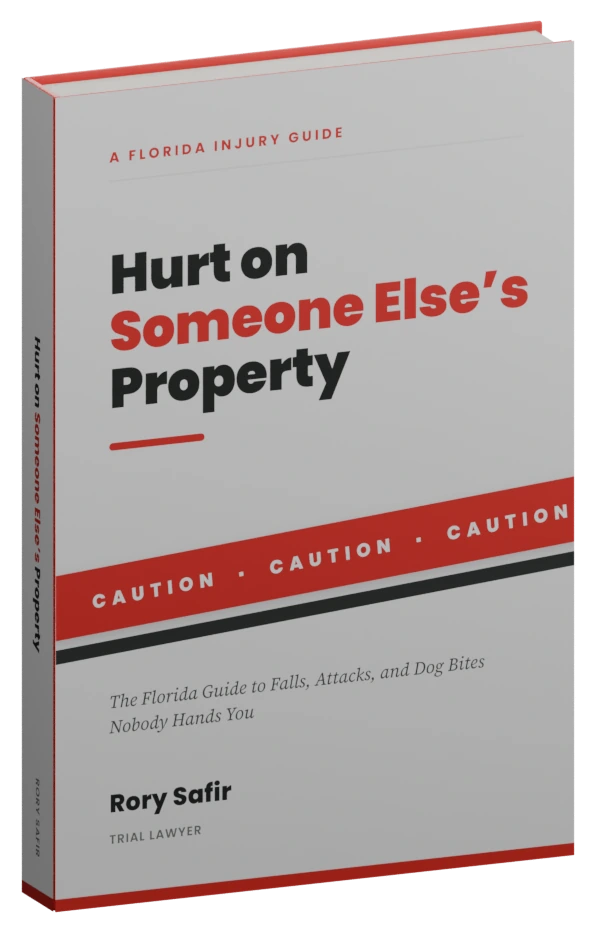
Hurt on Someone Else’s Property
The evidence race, the notice fight, negligent security, and dog bites, in one plain-English book on the days and weeks after you are hurt on someone else’s property. Free to Tampa Bay residents, with the digital edition to read the moment you ask.

About the author
Rory Safir is a St. Petersburg attorney who handles injury claims and criminal defense across the Tampa Bay area. He is one of a handful of ACS-CHAL Forensic Lawyer-Scientists in Florida and a former Assistant Public Defender in Tampa, and he brings that same evidence-driven approach to fighting for injured clients.
WRITTEN AND REVIEWED BY
Rory Safir, ACS-CHAL Forensic Lawyer-Scientist
He is the author of The Florida DUI Trial Manual, an NHTSA-qualified instructor in the standardized field sobriety exercises, faculty of the National College for DUI Defense, and a former Assistant Public Defender in the Thirteenth Judicial Circuit.
This post is general information about Florida law as of this writing. It is not legal advice about any specific case.