Back to the Safir Brothers Lawcast
Gary turns the tables and puts Rory in the hot seat. Rory is a Florida DUI defense lawyer and a forensic lawyer-scientist, and this episode is about the science the state uses to win a DUI case: breath, blood, and the roadside exercises. The method behind each test is sound. The question is what happened with that test, on that person, on that day.
They cover how Rory came to forensic science, the lawyers and scientists he learned from, the Florida DUI Trial Manual, how a blood tube that was never mixed can produce alcohol that was never in the person, and why hospital blood is not forensic blood. Gary brings the injury side: MRI magnet strength and slice thickness, what an ER scan does not show, and a client whose normal brain MRI missed a real injury.
Episode 2 · October 9, 2026
In this episode
- 00:09Welcome: Gary turns the tables
- 01:01A number printed on a machine, and why Rory started asking why
- 02:46Becoming a lawyer-scientist, and a father who took math for fun
- 03:55Learning from the best: Deandra Grant, Dr. Lee Polite, and Harold McNair
- 07:07The Florida DUI Trial Manual
- 10:19How accurate are breath and blood tests? The tube, the preservative, and fermentation
- 11:54Hospital blood is not forensic blood
- 14:09The injury side: MRI strength, slice thickness, and what a CT does not show
- 17:31Gold standards that still miss things: MRIs, arthroscopy, and an ear problem behind the eye test
- 20:20The Rule Out Method and who carries the burden
- 21:03One piece of advice for someone facing a DUI
- 24:32Sign-off
Full transcript
Made from the episode audio and lightly cleaned for reading: filler words, abandoned word fragments and repeated words are dropped, and nothing was added or reworded. Each timestamp opens that moment on YouTube.
00:00[music]…
00:09Gary Safir: Welcome to the Safir Brothers Lawcast. I’m Gary Safir, I’m a personal injury trial lawyer in the Detroit area. And I’m here with my brother, Rory Safir, my co-host. And I’m turning the tables on him this episode, because he spent a lot of time grilling me last episode about personal injury, so I wanna turn the tables on him. ’cause Rory’s a Florida DUI defense lawyer and one of only a handful of forensic lawyer-scientists in the state. And we’re getting into the science the state uses to win a DUI. Breath, blood, and field… Field sobriety. So Rory, your practice has a pretty unique focus on forensic science, which I don’t really see very much, and I didn’t even know it was like a whole thing until you got this certification. How did you become such an im-… How did this become such an important part of your approach to DUI defense?
01:01Rory Safir: Well, so that’s exactly like you said, you didn’t know it was, you know, it’s the same as most folks is, you know, you get a piece of paper that prints off and says a number on it, and that’s it. So if it’s above.08, you know, case closed. And that’s kind of how it felt like when I when I started, you know, not I don’t mean to make any comments on the public defender, I learned everything I know there. But just that’s kind of how DUI seemed, and so I, you know, went along with that for a bit and as I got older and got more experienced, I kind of thought, well why? Why is that number like what makes that number, you know, the state’s toxicologist gets on the stand and says what they’re gonna say from their script, why does that why is that beyond a reasonable doubt? Why does that make my client impaired? I think DUI is one of the only it might be the only, yeah, it’s really the only crime where a number on a machine printed after the fact makes someone, you know, supposedly guilty. So I dug into it. I, you know, when I when I started my practice, I always kind of enjoyed DUI and you know, I made it my mission to become the DUI guy and part of that involved joining I joined the DUI Defense Lawyers Association, which is a national organization, amazing. I also joined the National College for DUI Defense. Another amazing organization. I’m on two task forces with them. Won’t get into that I don’t need to get into that, but they’re both are they both feature the science. They’re both very intelligent organizations. And it led me to Axion Labs in Chicago, which is where I dug into some of the… It’s where I became a lawyer-scientist, which involved..
02:46Gary Safir: Dad would be so proud.
02:48Rory Safir: Yeah. You know our and for the for the listeners out there, our dad was a well let me say this first, he took math for fun in college because it was easy…
02:59Gary Safir: It was a blow-off class for him.
03:00Rory Safir: Yeah, math was a blow-off class. So, but he’s a he was a professor of plant pathology. This is our late father, but yeah, he’s a science guy, and you know, I’ve always been a math and science guy too, but I just didn’t really like it. It was I also got a bit of that from my from our dad, but I you know I went and became a lawyer, and this was an also an opportunity to kind of draw into that as well. So it’s kind of a fun thing about DUI defense is that you not only have the normal traditional aspects of being a lawyer, but you also have this science part. Well, if you choose to make this I mean most I think, you know, I don’t think it’s a stretch to say that most DUI defense lawyers have no idea about any of this stuff. ’cause there’s, you know, there’s six lawyer-scientists in Florida, for example. But yeah, I mean, it’s I would say..
03:47Gary Safir: And you had to pass like a like a certain like a course. Like you actually do these breathalyzer, you have to like do a breathalyzer, do a blood test, like you know how to train on this stuff.
03:55Rory Safir: Yeah, so that’s part of what we did. So again, Axion Labs, I cannot shout them out enough. Learn from Dr. Lee Polite, and a number of other professors. My idol is Deandra Grant, who’s like if not the top DUI defense lawyer in the country, top, you know, top handful of people, she’s in Texas, and runs a firm there, but I kind of just like looked at her resume and yeah, she’s even a forensic toxicologist, but I looked at her resume, saw the lawyer-scientist thing dug into it, and then she’s actually one of the professors there. She’s also, I think one of the only defense attorneys that, and I promise this is a podcast about my brother and I, but I’ll shout her out a little bit. It’s she also works at she’s faculty for what’s called Borkenstein, which is like the state’s top-secret, you know, how do we prosecute DUIs program, and she is that good that they have her as part of the, you know, you know, working on the curriculum and so forth. I think she I well, I don’t know for a fact, but she might be the only defense lawyer. But yeah, so I learned from all these you literally learned from the best. Yeah, you learn from the best of the best, you know, she’s telling me you know along with the and Lee Polite, Dr. Lee Polite, he learned from the late Harold McNair, who is like the he I mean there’s a whole bunch of cool stories you could have a whole podcast on him, multiple podcasts, but he’s like the pioneer of forensic chromatography, which is blood testing, he example of him from a story at second hand from Dr. Lee Polite, but he I think it was I want to say it was Poland, but he was teaching in Poland and somewhere in or maybe it was oh, it was the Netherlands, I think, the Netherlands. But he was this is in the 1950s or 60s or 70s, something like that, in the Cold War and so forth, but he got offered a position to teach, and it was in Dutch, and so…
06:00Gary Safir: [crosstalk] Oh you had to speak Dutch…
06:00Rory Safir: I think I think that’s the language. It was a one of the difficult, you know, not a roman language. One of the more difficult languages. And he they’re just like you can have this job this you know, to teach, but you have to do the whole thing in Dutch. So he just learned Dutch like that. And then that was, you know, as you can imagine for someone who’s been so im-… No big deal. Just these people like dad, or just you know, you know, I don’t mean to minimize you know, not like you and I are chopped liver, but just yeah.
06:27Gary Safir: I couldn’t learn Dutch just to teach a class, I don’t know if I could do that. Especially in, what, a few months, however long they gave him, yeah…
06:30Rory Safir: Insane to me. He’s got so many other cool stories. I mean, you could have a whole podcast about him. He was just really brilliant guy, and my professor, the guy who runs Axion Labs, was like his star pupil. And also brilliant, one of the books that I always recommend other lawyers who have no idea about chromatography, like where do you get your start? Well, as luck will have it, McNair wrote a book called Basic Gas Chromatography. If you don’t have that and you’re a DUI defense lawyer, get it…
07:07Gary Safir: Well I wanna talk about another book that people should have in their library now, because that’s not the only book people should have. You actually wrote a book too on this, didn’t you?
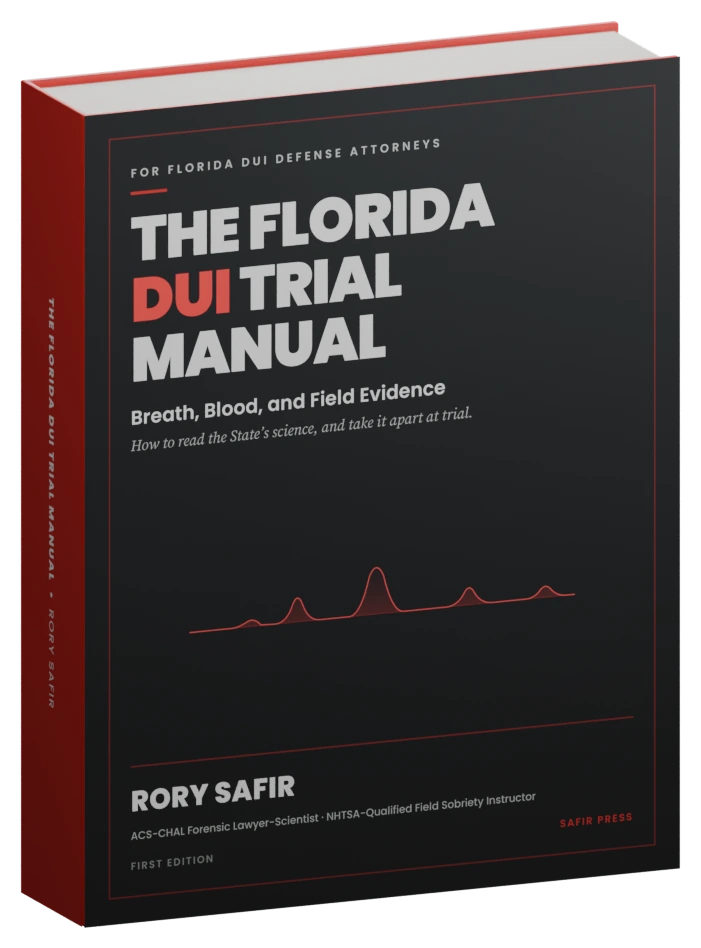
07:16Rory Safir: I did, yes, so I am still in the process of getting it well, it’s published but I’m getting it available by hard cover. It’s already available by Amazon, Kindle…
07:29Gary Safir: What’s the name of the book?
07:30Rory Safir: It is The Florida DUI Trial Manual. It is 750 pages, 8 and a half by 11.
07:37Gary Safir: Really sell it to the audience, 700 pages, folks.
07:40Rory Safir: And it yeah, it’s so I what I will say is it is not just a trial manual although that’s the title. It is largely my method, which is… Well, it’s not my method, but just the ideas of how I operate…
07:53Gary Safir: Don’t be bashful.
07:54Rory Safir: Well, no, I didn’t you know, I learned this from other you know excellent lawyers.
07:57Gary Safir: We all stand on the shoulders of giants, Rory.
08:00Rory Safir: Right, I guess so my point is that it’s all based on science. It’s how to how do you how do you build a case and how do you win on the science. So how do I how do I you know, how do I crush a toxicologist? How do I you know, what are all the things that you need to know? How do you how do you beat a breath test? How do you run you know, like something we call the disconnect defense, which is where…
08:23Gary Safir: And people can get this on your website, right?
08:25Rory Safir: They can, or if you know me just reach out, and I might share it with you, but yeah, it’s what I you know I do a lot of work with other lawyers who maybe aren’t as keen on the science or you know, they aren’t as up to you know ’cause again it’s a niche practice. There’s a whole just like personal injury, there’s a whole world of criminal defense, you got white collar, DV, drug cases, DUIs of course, you know violent cases, weapons cases, juvenile cases, you know go on and on and on. But I for me, DUI is my thing and so I wanted to kind of provide that method for you know, either a young me, the book that I wish I had, you know, four or five years ago, or you know, when I was a young public defender. I wanted to write something for that person, who kind of thought, yeah, the number, like I said at the beginning, the number on the machine, you know, just take it, you know, why should you take that as gospel? Well, this book tells you why you shouldn’t, or why you don’t need to. And yeah, I mean it…
09:32Gary Safir: I think that’s what I admire the most about you as your older brother, is ever since you were a kid, you always had this way of finding a system that wasn’t working and either you know building your own system or mastering it, like you would find the rules of any game which made you horrible to play against in Risk or things like that, you would find the rules of the game and then just master them, like to a level that is insane to fight against. And it’s just so fun as your older brother to see you like going in on such a really interesting area. And you keep bringing up, you know, these breath tests, I mean, how accurate are breath and blood tests, and you know, what affects these results?
10:19Rory Safir: That’s a loaded question. What I what I can say is that the method itself, just in a vacuum, is sound. It’s like the you know, the science is there, of course there are, you know, you can you can try a Daubert motion and poke at the science, but that it’s more about that test with that defendant on that day. What errors were that, you know, what did that toxicologist do wrong? What did that you know, whether if it’s from the, you know, if it’s from a blood draw, whether they you know what do they do pre-analytically, which is like before they put it through the gas before they do chromatography, what you know what did they did they invert the tube correctly? And what I mean by that is there’s in a blood I know I’m gonna try to keep this answer not too long, but we’ll I guess I’m already talking about blood. But you’ve got a preservative and you’ve got an anticoagulant in a forensic tube. So it’s a gray top tube. Did they use the right color tube? Did they use the gray top tube? Did they do the inversion? So when you’re taking blood, did they mix that in? ’Cause if they didn’t, there is there’s something called well, there’s a process called fermentation, which is where the you can actually produce alcohol, well, not you, but the royal you, but alcohol can be produced in the tube that was not there in that person’s blood by like organisms like Candida albicans, for example.
11:50Gary Safir: So there’s a lot of ways that people would screw these tests up, even if the science is sound.
11:54Rory Safir: Yeah, and the other side of it too is like there’s two different kinds of blood too. There’s medical blood, and there’s the forensic blood that I was just talking about, but medical blood, I mean if you read medical records, and this is one of my favorite cross-examination questions, it literally says on there, not for forensic purposes, this is for clinical treatment only. We are like and the reason why is because they are not taking that blood to prosecute someone, they are taking that blood ’cause they want to make that person better, who, you know, probably the reason they’re having their blood taken is because they were in some kind of crash or you know, related to the DUI, but you know, alleged DUI. But the there they’re doing they’re not taking forensic blood. And so that the nuance there, and again, not to go into a whole science talk, but they’re taking serum blood, not whole blood. And so just I don’t need to explain too much what the difference is on that, other than to say that…
12:46Gary Safir: That’s in your book, right?
12:47Rory Safir: Yeah, sure. There you go, I appreciate the plug. But yeah, serum blood is results, you know the peer-reviewed studies are gonna differ on the number, but I’ll say just for to be conservative, 16 to 25% higher than forensic blood. So you get some medical blood, and you don’t know that, and yours is 0.1 medical blood, and it’s 25% higher, that’s a.075, that’s below the legal limit. So you know it’s just another thing, you just got a piece of paper on a, or sorry, a number on a piece of paper.
13:16Gary Safir: So it sounds like there’s a lot of pitfalls for other DUI lawyers on this very area. It seems like more lawyers should know about this stuff.
13:24Rory Safir: I agree. And I think you know, I think if you’re gonna and I’ll turn this around on you, it’s like you see this a lot in personal injury where you’ve got the and I know this world myself as someone who owns a small law firm, and you call it door law. You take whatever comes in the door. But personal injury too is a very niche practice. You gotta learn the medicine. There’s all this science to it. You can’t just pick up not anybody can just pick up a car crash case and do it right. So, I mean, I, you know, we were talking about DUI defense here, but I did want to ask you, what can you tell us about the importance of the science or the medicine in car crash cases, or personal injury at large?
14:09Gary Safir: I mean, medicine is everything. I mean, it’s, you know, you have to know like you can look at an MRI, and you know, I’ve gotten okay at reading them, I mean, still not great at it, I’m getting there, but you know, just ’cause an MRI says something, you know if you see like an MRI that says your client has no herniations, no problems in their neck, it may not be accurate. For example, MRIs are magnets, right? And they have different levels of strength. And so you have different Teslas for them. So there’s different strengths of magnets. And then you can have…
14:42Rory Safir: So how do they work?
14:43Gary Safir: So, the higher the Tesla, the more powerful the magnet, right? And the more powerful the magnet, the like the better the read. And you can have different slices. So like when youre looking at an MRI, and you look at an MRI image, and you’re zooming in and out of it, you’re seeing little slices, little pictures of this person’s spine, for example. And if they’re using too thick of a slice, you may miss the entire injury. So you have to know what kind of MRI you’re looking at. And this is just MRIs. There’s all kinds of other stuff. You also have to know that a CT scan is an X-ray and it’s not really gonna show soft tissue injuries. So if you go to the ER and it says that you have a normal CT, that does not mean you don’t have an injury. It means you don’t have like a blood like a hemorrhage or, you know, your neck is snapped in half. It’s not gonna show whether you have a disc herniation or not. It’s not gonna show whether you have nerve issues. And then even MRIs sometimes won’t show the whole picture. Like if you’re gonna miss one, you could miss it in the slices. It may not show a ligament injury, ’cause there’s different ligaments in your neck, it may not show that. So, you know, knowing the medicine and knowing your area of medicine that you deal with on a regular basis. If you’re doing car crash cases, you got to learn joints, you got to learn your shoulder injuries, your neck injuries, your knee injuries, you got to learn sometimes inner ear injuries. If you’re not if you’re not familiar with why somebody’s having these problems, you gotta learn the medicine. And if you don’t know it for a case, spend the damn time to learn it. You know, there’s plenty of tools out there, like, figure it out. You know, you have to start with listening to what your client’s telling you because they may not have the medical diagnosis, they may not be at the right doctor. I mean I have to get them to a specialist that can look at this stuff. I had a client who had a brain injury and she was having suicidal ideation and she was gaining weight, and she was a hermit all of a sudden, a complete personality shift. But her MRI of her brain came back normal. Like it was a normal, there was no, they couldn’t find this what they were looking for in this brain injury, but we had her checked out by a neuroendocrinologist. And that neuroendocrinologist found that she had an injury to the hypothalamus and pituitary gland, a pituitary injury, where they got separated. And that can cause this post-traumatic hypothyroidism, or post-traumatic hypogonadism, and it can cause horrible issues like this. And they got her on human growth hormone and all of a sudden, you know, it changed her life. So, you know, you have to know the medicine, you gotta know, you got to listen to your client first, and then, and then go from there. And, you know, listen to what they’re telling you because they’re probably not making it up. But I want to turn this back to you because this is about you. If someone is facing a DUI charge, and you know, they’re sitting there and they’re scared and they’re trying to figure out what lawyer to get or what to do with themselves, and they there’s a probably a tremendous amount of guilt and all this other stuff, you know, what should they be thinking about, the role that science actually plays in their defense?
17:31Rory Safir: So, I’m going to answer that question, but I wanna you raised a number of things that I think actually tie back quite well to DUI defense or you know, any other kinds of litigation, but just the science aspect, and that’s that where you have this, you know, they sometimes call the MRI the gold standard, you know, so to speak. Well, so is gas chromatography. But there are issues that can happen there. I can just think from my own experience, like an arthroscopic surgery, where I’ve had clients where they’ve had knee injuries and the MRI is clean. And you’ve got your defense attorney who’s gaslighting you and saying your clients, you know, they’re not hurt, ’cause there’s nothing on the MRI, right? It’s the gold standard. But then you have a doctor, you know, you get a good orthopedic surgeon who, I mean, why don’t you’re you’re this is, why don’t you explain what an arthroscopic surgery is.
18:27Gary Safir: So they’re outpatient procedures. You know, they go in with like a little tool, and they use a like a special device and it goes in there and they can make little tiny, they can make kind of non- like minimally invasive surgeries with it. It’s not like they’re like replacing a knee or something, you know, that’d be that’d be a totally more invasive surgery, but arthroscopies are, you know, they’re going into the, you know, they’re going into the joint to fix it there, clean it out, or do whatever it is they’re gonna do.
18:52Rory Safir: And you can see things on there that might not show up on an MRI, right?
18:55Gary Safir: I mean absolutely, they can be diagnostic, absolutely.
18:57Rory Safir: And that’s the gold standard. So I mean it’s just it’s, you know, it’s there’s nothing wrong with the science of MRIs, it’s just it’s not there are things that you need to know if you’re practicing, if you’re doing personal injury. I think a couple other things that you said just tying back to just as you would in a car crash case where you want to talk to your client. You mentioned something about inner ear issues. So in a DUI case, that’s a means a different thing. One common field sobriety exercise is something called horizontal gaze nystagmus or HGN. It’s the one where they’ve got the little pen and they’re, you know, everybody, you know, they have the light or they go back and forth, they do their different passes. One thing that can cause nystagmus that is not due to alcohol or some kind of controlled substance is tinnitus. So it’s an ear issue. So if your client had an ear issue and there’s nystagmus, you know, maybe it’s not alcohol, maybe it was that. And again, at the end of the day, it’s not my it’s not my burden, like it isn’t in I guess yeah, we can you can say that the difference and I’ll actually turn around to you in a second, but I’m just it’s their job to rule out that the and when I say rule out, this is another thing I can turn back around on you, that is not my terminology although I use it gladly, that comes from a person named David Ball, who is commonly, you know, like…
20:19Gary Safir: Yeah he’s a legend in the world [crosstalk].
20:20Rory Safir: He’s a legend in the well he’s a legend now in criminal defense too. From there’s a book called The Rule Out Method. Which you again, same as Harold McNair’s book, you need to have The Rule Out Method if you practice criminal defense. And it’s exactly like the method is, or as the title is, it’s the prosecutor needs to I mean, and this is gonna vary based on your jury instruction for reasonable doubt across the country, but for the most part, you know, ’cause we can’t have a possible doubt, you know, I won’t get into that, a criminal defense lawyer listening will understand, in Florida. But the prosecutor’s job is to rule it out. It’s not my job. But in a in a personal injury case, you know, going off of David Ball, you’ve got a you’ve got to prove damages, you know. It’s a you’ve got a totally different burden.
21:03Gary Safir: In sum here, you know, to kind of wrap up the episode a little bit here for everybody. You know, if you had one piece of advice for somebody who’s looking at a, you know, a car crash or not a car crash, a DUI case and they’re defending it, and they’re defending it, what’s the what’s the one piece of advice you can give them and kind of kind of close out the episode here?
21:26Rory Safir: No, I’m actually you didn’t mean to say car crash, or you didn’t mean to say it in that context, but I think it actually is perfect in what you said and the reason why is and this goes back to one of my previous points about, you know, you can’t just have any door lawyer that can just do any personal injury case, it’s the same for a DUI case. You know, you want, you know, not to toot my own horn, but you want me, you want the person who did 160 hours at the in the science course in Chicago learned from the best. You want that person just like in a car crash case, you want the guy who works at the country’s largest injury firm and just does car crash cases and specializes in well I don’t want to say specialize, but just and I don’t mean that you know to offend the Florida bar or Michigan bar, I mean it just that you have it’s not that you specialize in smaller cases, it’s just you’re amazing at them. But you want, you want that person that is gonna know about this, you know whether it’s the how you were maximizing the damages in with all those you know you’re not doing it ’cause you’re maximizing it…
22:28Gary Safir: Well I mean, and your and your line of work, people’s liberty is at stake, right? I mean it’s their liberty that’s at stake.
22:33Rory Safir: Yeah, no, it’s exactly that. Yeah, it is it is it’s different. It actually makes me enjoy personal injury a lot more. Not only because I think the deck is maybe a little bit less stacked against you and but you’re still able to do a lot of good for someone. You’re still representing a person, you’re still representing a human being. You’re not representing you know, I say this before and I say it all the time, you’re not representing the Death Star, you’re not representing the Sith Empire, you’re not representing an entity, you’re not representing big insurance or an insurance company, you’re not representing the government, like who likes the government? You’re not you’re representing a human being and their family. But you want someone who recognizes that, whether it’s a car crash case or a DUI case, or any kind of case. I mean, if you’re looking for a divorce, you want to you want to get…
23:30Gary Safir: The point is get the specialist, right? Like get the person who’s done the time.
23:33Rory Safir: You want that’s exactly it. So you should they should have experience in you know, like if you I’ll use this example, it’s a marketing example but it applies equally here, if you want Chinese food, say, or Italian food, it doesn’t matter, but just a specific kind of food, are you gonna go to the food court where they’ve got Mexican food, Chinese food, Italian food, maybe they’ve got two Chinese restaurants next to each other, I find that they always seem to do that, they’ve got the same thing next to each other, I mean, well I don’t know why, but that’s off not the point, but, or, say you’d so say let’s just go with this example, you want Chinese food, you’re gonna go to the Chinese restaurant that serves only Chinese food. You’re not, I mean unless you’re, you know…
24:13Gary Safir: Unless you got kids with french fries, they wanna eat french fries at the Chinese restaurant, then you give them that.
24:18Rory Safir: Yeah, it’s not a perfect analogy, but yeah, you’re going to the you’re going to the person that just does that one thing. And so for me, it’s DUI, for you, it’s car crashes, but yeah, that’s how I would answer that question.
24:32Gary Safir: So, get the specialist, get the people who know what they’re doing in their specific area that put the time in. I think it’s probably the best advice it’s the best advice any lawyer can give anybody is get the specialist. And I think with that’s all for today’s episode of the Safir Brothers Lawcast. If you wanna learn more about us, learn more about Rory, learn more about his books, learn more about me, make sure to visit our website safirbroslawcast.com. Thank you so much for listening. Don’t forget to like, leave a review, and subscribe. We’re a brand new podcast, so any support is super helpful. We’ll see you next time.
25:05[outro music]…
25:06Gary Safir: Thanks for watching. Be sure to hit that like and subscribe button, and leave us a review in the comments.
Keep going
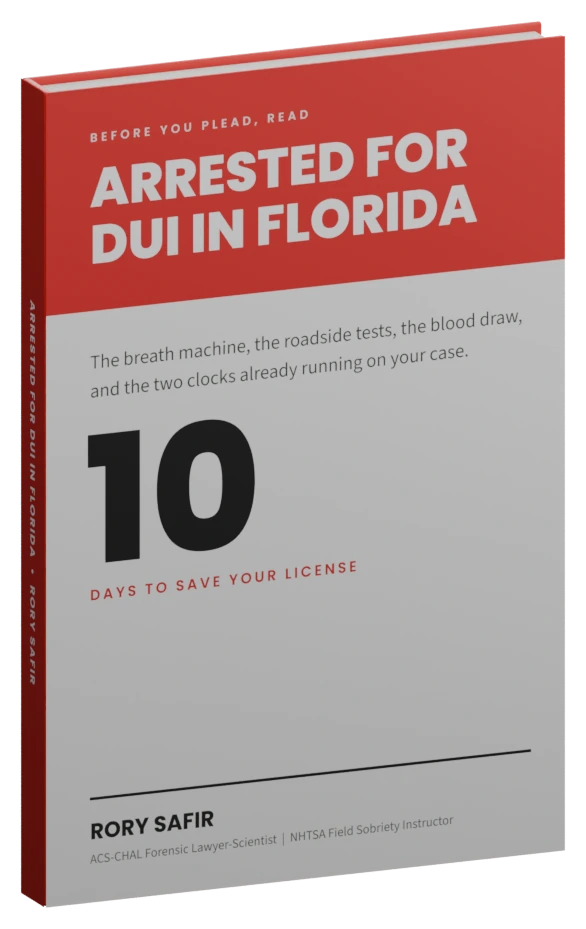
Short clips cut from this episode are on the Safir Brothers Lawcast page, with the hosts, the channels the show goes out on, and every episode. The science in this conversation has written companions on this site: fermentation and the missing preservative, serum versus whole blood, the breath test, and the HGN eye test. The book Rory talks about is The Florida DUI Trial Manual. If you were hurt in Michigan or Ohio, Gary takes those cases himself at getsafir.com. Rory’s other show, Reasonably Safir, walks the week’s Florida appellate decisions in plain English.
Nothing in this episode is legal advice, and listening to it does not make either of us your lawyer. Rory Safir is licensed in Florida, and only Florida. Gary Safir practices in Michigan.