Assisted living is not a nursing home, and that changes your case
Assisted living and skilled nursing look similar from the outside, but the law treats them as two different things. An assisted living facility is licensed for a lower level of care and is governed by Chapter 429, with its own separate residents’ bill of rights in section 429.28, while a skilled nursing home runs under Chapter 400. That difference is not a technicality. It defines what the facility promised, what it was allowed to take on, and where it crossed the line, which is why our first step is often sorting out which kind of facility you were really dealing with.
The dangers that show up most in assisted living
The harm in these facilities tends to cluster in a few places: a resident who wanders or elopes from a building that was supposed to keep track of them, a resident kept on long after their needs have outgrown what the facility is licensed to handle, and the medication and supervision failures that follow when a facility markets more safety than it staffs for. The common thread is a facility that accepted a person it was not truly equipped to keep safe, and did not adjust.
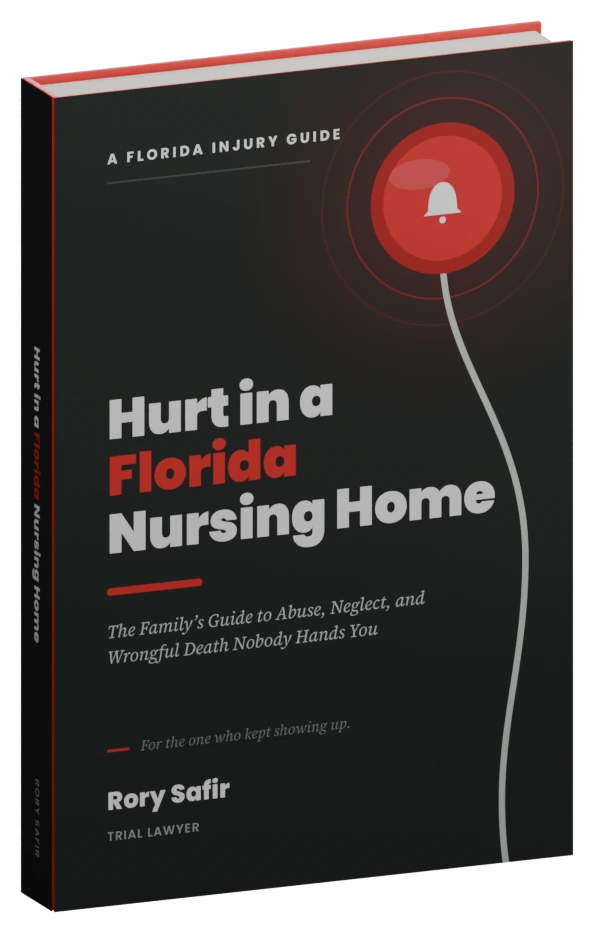
The book
Hurt in a Florida Nursing Home
The warning signs, the records race, the staffing spreadsheet at the root of almost everything, the arbitration trap, and the two-year clock that is shorter than it sounds, in one plain-English book written for the family that suspects something is wrong. Free to Florida families, with the digital edition to read the moment you ask.
Why the facility is not off the hook
Assisted living facilities like to argue they are really just housing, not caregivers, so nothing that happens medically is their fault. That defense rarely holds. They choose which residents to accept, they advertise safety and supervision to families, and they take on real duties under Chapter 429 and their own care agreements. When a facility keeps a resident whose needs have clearly outrun what it can safely provide, that is a decision it made, and it is answerable for where that decision led.
I spent time on the other side, so I know how these facilities defend themselves
Before I represented residents and their families, I worked on the defense side of these cases, for the facilities and the companies behind them. I know how the defense is built, which records come out fast and which ones they hope no one asks for, how a care agreement gets used as a shield, and where the aging in place story collapses once you line up the marketing, the service plan, and what the staff actually documented. That is the view I now use for the families on the other side of it.
How we prove an assisted living case
We build these cases out of the resident’s file, the care agreement and any service plan, the staffing and training records, the medication records, and the marketing that promised more than the facility delivered. Florida gives assisted living residents enforceable rights under section 429.28, and a facility’s failure to meet them can support a claim for damages. As with any injury claim, Florida generally gives you two years to act, and the presuit and records work takes time, so the sooner a case is reviewed the more of the record we can lock down before it is explained away.
The parts of an assisted living case we handle
Common Questions
What is the difference between assisted living and a nursing home, and why does it matter?
Assisted living is licensed for a lower level of care and runs under a different Florida law, Chapter 429, than a skilled nursing home. The distinction matters because it defines what the facility was allowed to take on and what it promised your loved one, and that promise is the heart of the case.
The facility says it is not responsible because it is not a medical provider. Is that right?
No, not by itself. An assisted living facility still owes duties under Chapter 429 and under the care agreement it signed, and it remains answerable when it keeps a resident whose needs have outgrown what it can safely provide.
My loved one wandered off and was hurt. Is that a case?
Often, yes. A facility that accepts a resident known to wander is supposed to plan for exactly that. When an elopement happens anyway, it usually points to a supervision or staffing failure the facility is responsible for.
What does it cost to hire you?
These cases are handled on a contingency fee, so there is no fee up front and no fee unless we recover for you, and the first strategy session is free.
How long do I have to file?
Florida generally gives you two years to bring this kind of claim, and the clock can start before you fully understand what happened, so the safest step is to have the case reviewed promptly rather than waiting.
This page is general information about Florida assisted living facility law, not legal advice, and it does not create an attorney-client relationship. The governing authorities include Fla. Stat. 429.28 (assisted living residents’ rights) and Chapter 429 generally, along with Fla. Stat. 768.21 (wrongful death damages) and 95.11(5)(a) (two-year limitations). Every case is different, and past results do not guarantee a similar outcome. The hiring of a lawyer is an important decision that should not be based solely on advertisements.